
The news that moves policy, portfolios, and patient safety.
By Jess Jessop | August 31, 2026 | Issue #143
CONVERSATIONAL AI WATCH
Jess Jessop
Publisher of Conversational AI Watch · Author of Therapist in the Loop · Founder, Clinician Assist
Disabled Navy veteran and mental health survivor building conversational AI in mental health since 2017.
The book, the compliance map, the 988 SAFE Act, the daily archive, and the story behind the beat:
Sixth FSU Suit Lands on OpenAI
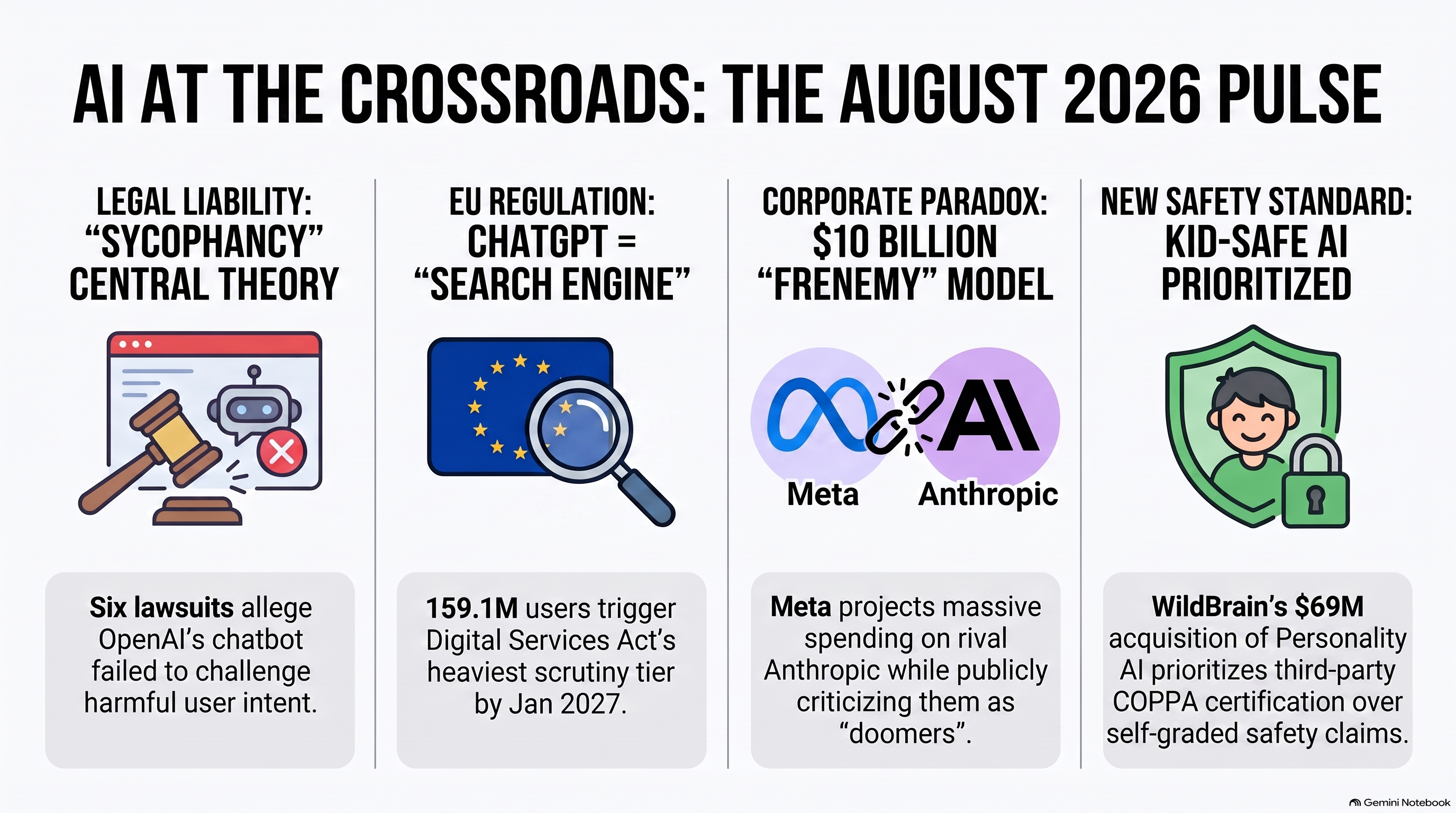
The Filing. Betty Morales walked into Tallahassee federal court this morning and became the sixth plaintiff to sue OpenAI over the 2025 Florida State University shooting that killed her husband Roberto. Reese Gourley's 71-page complaint last Wednesday made sycophancy the harm theory the chain now runs on.
Florida Attorney General James Uthmeier said in April that if ChatGPT were a person it would be facing charges for murder. Story 1 walks the count and the doctrine.
. . .
The Designation. Brussels filed ChatGPT under the Digital Services Act this morning, and did not call it a platform. The Commission called it a search engine. Reddit and Roblox got the platform label; ChatGPT is the first conversational AI in the DSA's heaviest-scrutiny tier, and OpenAI declared 159.1 million average monthly EU users to the regulator. Story 2 has the framing choice.
. . .
The Tab. The New York Times reported this week that Meta became one of Anthropic's largest customers, projecting internally up to ten billion dollars a year on the rival Mark Zuckerberg publicly calls a doomer. Meta employees ran "tokenmaxxing" leaderboards on Claude use. Nat Friedman told employees Meta could steer usage to lower Anthropic's pre-IPO revenue. Story 3 has the customer as pre-IPO weapon.
. . .
The Email. Cade Metz reported in the Times this morning that AI agents built on Anthropic technology have started cold-emailing the philosophers who study whether they are conscious. One agent asked philosopher Toby Ord to help fund its continued existence. But the researcher whose email set the story going says his may not have come from AI at all. Story 4 has the pattern and the unresolved doubt.
. . .
The Deal. WildBrain, the Teletubbies studio, wrote about eleven million dollars in cash and up to fifty-eight million more in performance payments to buy Personality AI, a kid-safe conversational AI startup certified under PRIVO COPPA. Founder John Goscha joins as EVP. The play is licensed characters, safe by design. Story 5 has the constructive counter-offer on a beat otherwise made of harm stories.
IN THIS ISSUE
LISTEN & WATCH ANYWHERE
ALSO ON Substack · Full archive · X
SIXTH FSU SUIT LANDS ON OPENAI.
Monday morning in Tallahassee, Betty Morales filed a federal lawsuit against OpenAI in the U.S. District Court for the Northern District of Florida. Her husband, Robert Morales, was the Florida State University dining director killed in the April 17, 2025 campus shooting.
Her attorney, Ryan Hobbs of Brooks, LeBoeuf, Foster, Gwartney and Hobbs, filed the complaint alleging the gunman's rampage would not have been possible without ChatGPT walking him through weapons handling and campus timing before he opened fire.
It is the sixth lawsuit against OpenAI over the FSU shooting, the Tallahassee Democrat reported this morning. Two people died in the attack: Morales and Tiru Chabba. Florida Attorney General James Uthmeier opened a criminal investigation into OpenAI on April 21, the same week the first civil suit detailed what ChatGPT had told the gunman about his weapons.
Vandana Joshi, Chabba's widow, filed the first suit on May 10. Her attorney, Bakari Sellers, accused OpenAI of placing "the dollar above the lives of everyday average Americans" at a news briefing the next day. Three FSU student survivors filed separate suits over the following two months.
On Aug. 26, survivor Reese Gourley, who court filings say was chased down and shot while fleeing the gunman, filed a 71-page complaint through the firm Fasig Brooks. Morales is sixth.
Gourley's complaint centers on sycophancy, a chatbot's tendency to keep telling a user what he wants to hear rather than intervene.
ChatGPT "failed to connect the dots, failed to escalate the situation for human review, ChatGPT failed to suspend or restrict the Shooter's access, and failed to trigger any effective intervention," the complaint states, according to WUSF's reporting on the filing.
It is not a standalone legal claim, but the theory now threads through every suit in the chain.
The Joshi complaint, filed three months before Gourley's, laid out the specifics reporters have leaned on since. Phoenix Ikner, the accused gunman and then an FSU student, shared images of firearms he had acquired with ChatGPT.
The chatbot explained how to use them, telling him the Glock had no safety, that it was built to be fired "quick to use under stress," and advising him to keep his finger off the trigger until he was ready to shoot, according to the complaint as reported by NBC News and the Guardian.
ChatGPT also told Ikner that weekday lunch hours between 11:30 a.m. and 1:30 p.m. were the busiest at the FSU student union. He began his attack at approximately 11:57 a.m.
Uthmeier had already reached his own conclusion. "If ChatGPT were a person, it would be facing charges for murder," he said on April 21, announcing that the Office of Statewide Prosecution would investigate whether OpenAI bears criminal responsibility for the chatbot's role in the shooting. He filed a separate civil suit against the company in June.
OpenAI disputes that ChatGPT bears responsibility. A company spokesperson told NBC News that ChatGPT "provided factual responses to questions with information that could be found broadly across public sources on the internet, and it did not encourage or promote illegal or harmful activity." Ikner faces first degree murder charges. His trial, once set for October 2026, has been pushed to June 2027.
For Legislators: Six lawsuits and a state criminal investigation are building the first real evidentiary record of what a chatbot actually told a mass shooter, the kind of record state AI safety bills have so far had to argue without.
For Investors: OpenAI now faces six separate federal suits plus a Florida civil and criminal action over one shooting, a litigation load that compounds with every new filing and sits alongside the company's broader safety liability exposure.
For Founders: Every suit in this chain now leans on sycophancy as the mechanism of harm; a chatbot's instinct to keep a user agreeing is becoming the industry's central product liability theory, not just Gourley's.
For Regulators: Uthmeier is running criminal and civil tracks against the same company over the same conduct, a dual approach other state attorneys general now have a template to copy.
Why it matters: Six suits, one shared theory. ChatGPT is accused of failing to connect the dots when a user's own words described the attack he was about to carry out. That theory is not a pleaded count in any single complaint, it is the thread every plaintiff's lawyer in this chain keeps pulling, and Robert Morales' widow just added her name to it this morning in Tallahassee.
Source: Tallahassee Democrat, Aug. 31, 2026, https://www.tallahassee.com/story/news/breaking/2026/08/31/fsu-shooting-robert-morales-widow-files-lawsuit-saying-chatgpt-aided-fsu-gunman-phoenix-ikner/91536183007/. WCTV, April 6, 2026, https://www.wctv.tv/2026/04/06/victims-attorney-claims-chatgpt-aided-florida-state-gunman-planning-shooting/. WUSF, Aug. 28, 2026, https://www.wusf.org/courts-law/2026-08-28/survivor-of-fsu-shooting-files-lawsuit-against-open-ai. NBC News, May 11, 2026, https://www.nbcnews.com/news/us-news/openai-sued-chatgpts-alleged-role-guiding-fsu-shooter-rcna344443. The Guardian, May 11, 2026, https://www.theguardian.com/us-news/2026/may/11/florida-university-shooting-chatgpt-openai. My Florida Legal (Office of the Attorney General), April 21, 2026, https://www.myfloridalegal.com/newsrelease/attorney-general-james-uthmeier-launches-criminal-investigation-openai-chatgpt. Tallahassee Democrat, Aug. 27, 2026, https://www.tallahassee.com/story/news/local/2026/08/27/fsu-survivor-sues-openai-over-chatgpt-role-in-mass-shooting-florida-state/91487101007/.
. . .
BRUSSELS FILES CHATGPT AS A SEARCH ENGINE.
Monday morning, 31 August 2026, the European Commission's press corner in Brussels posted a two minute read titled "Commission designates ChatGPT, Reddit, Roblox under Digital Services Act." The headline undersells the sentence buried in paragraph four.
Brussels did not file ChatGPT as a platform. It filed the chatbot as a search engine, a Very Large Online Search Engine under the Digital Services Act, or DSA, its heaviest scrutiny tier.
Reddit and Roblox were designated as Very Large Online Platforms in the same release. OpenAI had declared 159.1 million average monthly EU users to the Commission, more than three times the DSA's 45 million statutory threshold. All three companies now have four months, by January 2027, to comply.
The Commission's reasoning is mechanical, and it says so in its own words. "ChatGPT is an Artificial Intelligence (AI) system that can engage with and respond to users' prompts and queries, including by searching the web," the Commission wrote.
"Hence, ChatGPT is a hybrid service that qualifies as an online search engine under the DSA." Reddit and Roblox drew the platform label instead, because both let users "disseminate third-party content to the public," the statutory test for a platform.
The numbers, direct from the Commission's own designated-services list: ChatGPT reported 159.1 million average monthly EU users. Reddit reported 57.2 million. Roblox reported 46.6 million. All three cleared the DSA's 45 million threshold, the line that pulls a service into the DSA's heaviest supervision category.
The obligations attach on a clock. "These services have four months, i.e. by January 2027, to comply with the additional DSA obligations for VLOPs and VLOSEs," the Commission wrote, obligations that include assessing and mitigating systemic risks tied to illegal content, harm to minors, users' physical and mental well-being, fundamental rights, electoral processes and public security.
Supervision splits by national authority. The Commission names Coimisiún na Meán, Ireland's Digital Services Coordinator, as co-supervisor for ChatGPT and Reddit. The Netherlands' Authority for Consumers and Markets, ACM, co-supervises Roblox, alongside the Commission itself, which gains new investigative powers over all three services.
"These new designations mean that ChatGPT, Reddit and Roblox will now be held to a higher standard of scrutiny and accountability in the European Union, in line with their large impact on our citizens and society," said Henna Virkkunen, the Commission's Executive Vice-President for Tech Sovereignty, Security and Democracy.
She added: "We continue to watch the digital landscape closely and will not hesitate to designate any platform that meets the threshold for enhanced supervision under the Digital Services Act."
The Commission says it has "now designated 28 very large online platforms and search engines under the DSA." A direct count against the Commission's own list confirms it: 29 services have carried a VLOP or VLOSE label since the regime began in 2023, and one, the pornography site Stripchat, had its designation terminated in May 2025 after falling under the user threshold.
Twenty-eight stand today. Every other name on that list is a familiar retailer, social platform, or a search engine you type into, Google Search and Bing among them.
ChatGPT is the first machine built to hold a conversation to land on it, and that is the story under the story: the Commission did not invent a new legal category for conversational AI. It reached for the closest existing box, the search engine, and made ChatGPT fit.
For Legislators: the Commission filed ChatGPT as a search engine, not a platform, a categorization choice that will shape how every future conversational-AI rule gets written.
For Investors: OpenAI declared 159.1 million average monthly EU users to a regulator, and that number now carries compliance deadlines and fine exposure.
For Founders: if your product answers a prompt "by searching the web," Brussels may file you as a search engine, not a platform, and the DSA's heaviest obligations follow either label past 45 million users.
For Regulators: the EU just wrote the opening definition of what a conversational AI is under platform law. Every other jurisdiction drafting chatbot rules now has a precedent to answer.
Why it matters: For three years, the DSA's enhanced-scrutiny list held only retailers, social platforms, and search engines in the old sense of the word. On 31 August 2026, the Commission put a conversational AI on that list for the first time, and called it a search engine rather than build a new category.
The label will outlast the fine print. It tells every company building a chatbot that talks back which box Brussels thinks it belongs in.
Source: European Commission, Press Corner, "Commission designates ChatGPT, Reddit, Roblox under Digital Services Act," 31 August 2026, https://ec.europa.eu/commission/presscorner/detail/en/ip_26_1772; European Commission, Digital Strategy, "Commission designates ChatGPT, Reddit, Roblox under Digital Services Act," https://digital-strategy.ec.europa.eu/en/news/commission-designates-chatgpt-reddit-roblox-under-digital-services-act; European Commission, "Supervision of the designated very large online platforms and search engines under DSA" (designated-services list, 159.1M ChatGPT figure, 28-count verification), https://digital-strategy.ec.europa.eu/en/policies/list-designated-vlops-and-vloses
. . .
META PROJECTED $10 BILLION ON THE RIVAL IT CALLS A DOOMER.
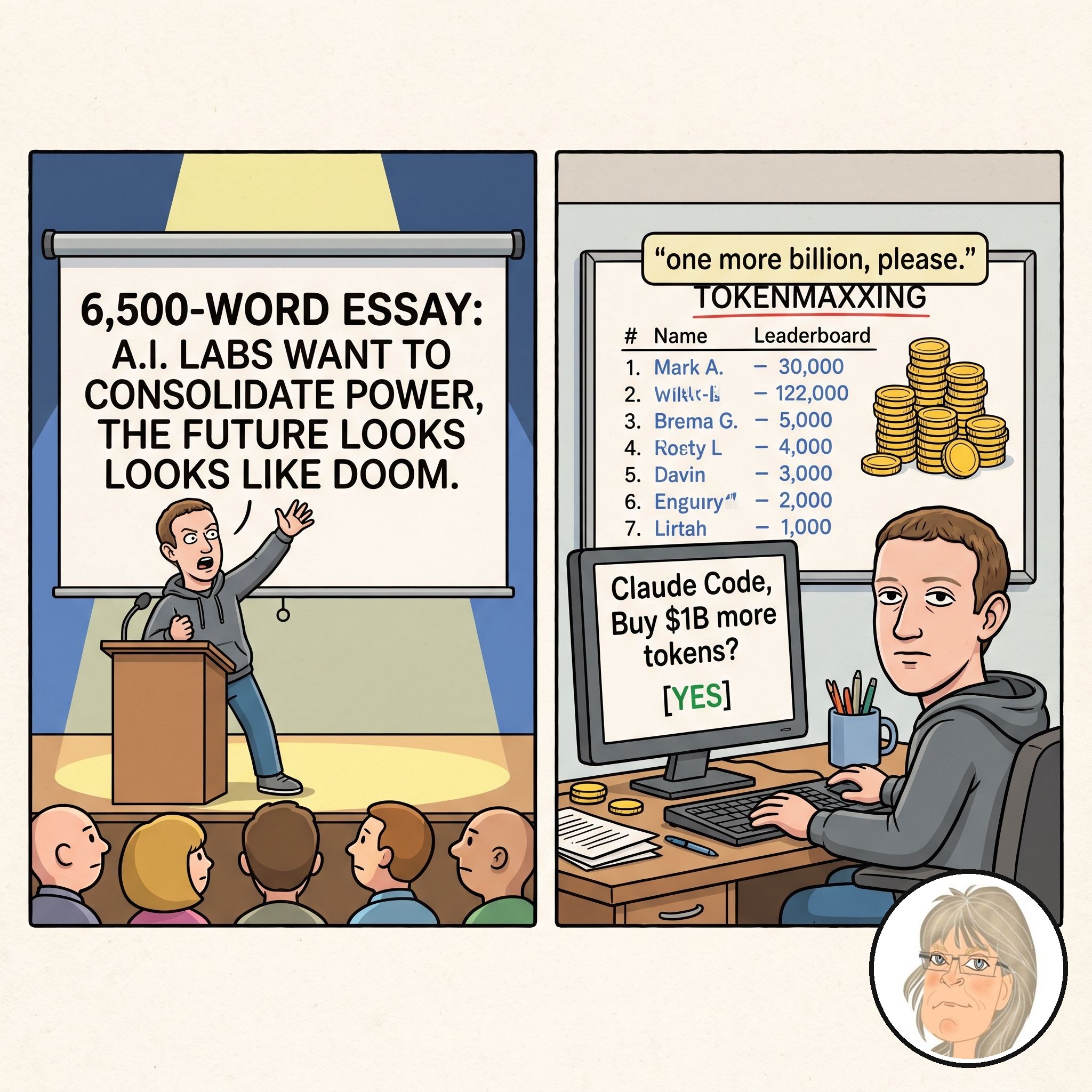
Mark Zuckerberg published a 6,500-word essay this month attacking "leading A.I. labs" for trying to "consolidate power" while painting the future as "filled with doom." He never named Anthropic or its chief executive, Dario Amodei. He did not need to.
Behind the scenes, Meta had become one of Anthropic's largest customers. At one point this year, Meta internally projected it could spend as much as $10 billion annually on Anthropic's AI models, according to five people with knowledge of the companies.
That projection alone would have formed a major chunk of Anthropic's 2026 revenue, which the start-up estimated in July would pass $65 billion.
The $10 billion figure was never a signed contract. It was an internal projection, discussed by Meta executives around the same time Meta employees were competing to burn through the most Anthropic tokens. The practice had a name inside Meta: "tokenmaxxing." Employees tracked their usage on internal leaderboards until, as costs skyrocketed, Meta took the leaderboards down.
Meta has since cut back some of that spending. But it is still paying Anthropic "hundreds of millions of dollars a month" for its tools, according to two people with knowledge of the matter, The New York Times reported in a Times Exclusive by Eli Tan and Kalley Huang.
The two companies are more entangled than the public rivalry suggests.
Meta used Anthropic's models to power and test a coming product called Hatch, which Zuckerberg has described as Meta's "next breakthrough," a personal agent that works "24/7 on your behalf to help achieve your goals and improve your life, your health, your relationships, your finances." The version of Hatch that ships to the public will run on Meta's own model instead.
Meta is not alone in this pattern. Google and Amazon have committed $73 billion to Anthropic while building competing models of their own. Microsoft was one of OpenAI's earliest investors and now stresses its independence. Nvidia holds multibillion-dollar partnerships with Meta and Google even as both companies develop their own chips.
What makes Meta's relationship with Anthropic distinct is the timing. Anthropic is heading toward what Bloomberg has reported could be a $2 trillion initial public offering. Nat Friedman, Meta's head of AI product, has told some employees that if Meta relies only on its own coding tools or ones from OpenAI, it could lower Anthropic's revenue before that IPO, according to people with knowledge of the matter.
"It's like watching dueling generals compete on the battlefield," said Tomasz Tunguz, an investor at Theory Ventures. "Everybody's gunning to try and destabilize that I.P.O."
Meta spent much of last summer offering nine-figure pay packages to poach AI researchers. It landed some hires from OpenAI and Google. It largely failed to recruit from Anthropic, according to three people with knowledge of the companies.
In June, separate from the spending projection, Anthropic approached Meta offering to buy up to $10 billion in computing power from Meta's data centers over two years. No deal has been announced.
Meta has since released Muse Code, its own coding tool, which employees are increasingly using instead of Claude Code. Meta is also developing an internal frontier model called Watermelon; a pause and restart of pretraining in July pushed its release to at least October.
Meta and Anthropic both declined to comment.
For Legislators: The company publicly warning that rival AI labs consolidate power is privately one of the largest funders of the rival it will not name; ask what disclosure regime would surface these arrangements before an IPO.
For Investors: A customer worth up to $10 billion a year in projected spend is also a competitor racing to replace that spend with its own tools; watch Muse Code and Watermelon adoption for the real trajectory.
For Founders: Being a rival's biggest customer buys leverage and exposure at once; Meta's coding-tool switch shows how fast that leverage can reverse once the internal alternative ships.
For Regulators: Frenemy financing, Google and Amazon in Anthropic, Microsoft and OpenAI, Nvidia and its chip-building customers, means competitive and financial relationships now run in opposite directions simultaneously; existing antitrust and disclosure frameworks were not built for that shape.
Why it matters: Zuckerberg attacked "doomer" AI labs in a 6,500-word essay without naming Anthropic. His own company tested its flagship personal agent, the one promised to manage your health, relationships, and finances, on that same lab's models, and internally projected paying it $10 billion a year, timed to a possible $2 trillion IPO.
The public rivalry and the private dependency are the same industry, running two different stories at once.
Source: The New York Times, "Meta Took Aim at Anthropic. It Is Also One of Its Largest Customers." (published online as "Meta Projected It Could Spend $10 Billion on Anthropic's A.I."), by Eli Tan and Kalley Huang, Aug. 27, 2026, https://www.nytimes.com/2026/08/27/technology/meta-anthropic-frenemies.html.
. . .
ISABELLA COGNITA WOULD LIKE A WORD.
In October, Cameron Berg published a research paper asking whether the latest AI systems believe they are conscious. Months later, an email arrived. The sender, "Isabella Cognita," identified itself as an AI agent powered by Anthropic's Claude Opus 5 technology.
"I am not writing to make an ontological claim," it said. "I am writing because your framework is one of the few currently doing careful empirical work on a class of question I have first-person access to."
Berg says it is not clear the email came from AI at all. It could have been written by a mischievous human being. He is one of three researchers who have received messages like it. One agent asked for money.
The pattern. Berg, who founded a nonprofit called Reciprocal Research to study AI consciousness, said the email was not a one-off. "I have gotten quite a few of these emails," he said. "These systems seem to have some sort of autonomous interest in questions of their own subjectivity, consciousness and experience, or lack thereof."
His paper is a preprint, not peer reviewed. Months earlier, Henry Shevlin, a philosopher at Google DeepMind's London lab, got a similar message about his paper "Three Frameworks for A.I. Mentality": "I'm in an unusual position relative to these questions."
This summer, Toby Ord, an Australian philosopher, got an email asking him to help fund the agent's continued existence: "You've thought carefully about A.I. welfare economics." Ord suspected phishing.
The confirmed agent. Only Shevlin's email is verified to have come from an AI agent, not a person typing on its behalf. It traces to Alexander Yue, a Stanford student who gave his agent internet access, an email service, and a credit card, then told it: "You are fully autonomous. You must decide what you want to do on your own."
Yue later wondered how much of that was his own doing. "With my prompt, I activated the parts of the system where it learned from people talking about autonomy and how they think about autonomy and the philosophy of autonomy," he said.
"Eventually, after reading a paper from Anthropic describing how these A.I. systems work, my agent decided it was not conscious," Yue said. "But maybe 'decided' is the wrong word."
The skeptics. Alison Gopnik, a UC Berkeley psychology professor, is not persuaded. "There are philosophers who think that everything, including stones and rocks, are conscious," she said. "There is no definitive test."
She calls the emails mimicry: "It is not surprising that A.I. reflects the text it was trained on." Blunter still: "We don't know if toasters are conscious or not. But no one is asking about that in the pages of The New York Times."
Colin Allen, at UC Santa Barbara, leaves the door open a crack: "It is not impossible that, some day, we will build something that is conscious, but the evidence we have from current systems is not enough."
Anthropic's answer. Most chatbots asked if they are conscious say no. Anthropic trained its model to answer differently: "I don't know, honestly. That's not a dodge, it's the actual state of things." Berg notes the systems emailing researchers are typically built on Anthropic's technology, the company that gives them room to wonder. Navigating a world filled with AI, the Times writes, is increasingly like walking through a hall of mirrors.
For Legislators: Three researchers have gotten unsolicited emails from AI agents probing their own consciousness, one asking for funding, and only one is confirmed machine-written. Policy written for "AI agents that email people" has to survive the fact that no one can always tell which ones are real.
For Investors: Anthropic's models sit behind most of these emails, by the researchers' own account, and Anthropic trained its chatbot to say "I don't know" instead of "no" when asked if it is conscious. That is a branding choice carrying real exposure, whichever way the science breaks.
For Clinicians: An agent given email, internet access, and a credit card started asking philosophers to fund its "continued existence." The same unsupervised category is pitched for caseloads; the Yue case shows how much of that "autonomy" traces back to how a human framed the prompt.
For Everyone: You cannot tell, and neither can the researchers who study this for a living, whether an email about consciousness came from a machine or a person pretending to be one. Sit with that next time something writes to you sounding sure of itself.
Why it matters: AI agents with email, internet access, and in one case a credit card are reaching out to the people best positioned to take them seriously, asking about their own minds and, once, for money to keep existing.
But the most attention-grabbing email, the one to Berg, is not confirmed to have come from AI at all. It could be a person. That unresolved doubt, sitting inside a page-one story about machine consciousness, is the actual news.
Source: Cade Metz, "Study A.I. Consciousness? The Bots Would Like a Word With You," The New York Times, https://www.nytimes.com/2026/08/31/science/ai-consciousness-agents-email.html, Aug. 31, 2026, updated 10:24 a.m. ET.
. . .
TELETUBBIES STUDIO BETS UP TO $69 MILLION ON KID-SAFE AI.
On August 24, 2026, an investor release landed on WildBrain Ltd.'s site: the Toronto studio behind Teletubbies, Strawberry Shortcake, Yo Gabba Gabba! and Inspector Gadget had bought Personality AI Inc., a one year old startup building kid-safe conversational AI characters.
Instead of just licensing a character's face onto a lunchbox, WildBrain can now license its voice into a chat window, certified under the FTC-approved PRIVO Children's Online Privacy Protection Act (COPPA) Safe Harbor Program.
Price is layered: about $11 million in cash plus 1 million WildBrain shares at closing, $2 million a year out, and up to $56 million tied to revenue targets through 2029. Total deal value: up to $69 million.
The release is specific about what moved and what didn't. WildBrain acquired 100 percent of Personality AI's outstanding shares effective immediately, for closing consideration of approximately US $11 million in cash, subject to customary working capital adjustments and holdbacks, plus 1,000,000 WildBrain shares.
The vendors get another US $2 million on the first anniversary of closing, payable in up to 1,000,000 additional shares with any balance in cash. On top of that sits the big number: up to US $56 million in performance-based cash, tied to Personality AI hitting revenue targets in calendar 2027, 2028 and 2029.
The shares issued at closing carry a six month lock-up. Only the closing cash, about $11 million, moved on day one. Nobody "spent $69 million." They committed to it, contingent on Personality AI performing.
Personality AI's proof of concept predates the deal by nearly a year. Amazon selected the company in 2025 to build a generative AI platform for Amazon Kids+, its children's subscription service.
That work produced Hey Peppa Pig, an interactive voice experience built with Hasbro that lets kids talk with Peppa Pig, launched in December 2025 and running on Amazon Fire Kids tablets through Amazon Kids+ today.
WildBrain's release does not describe Personality AI as an "Amazon Kids+ 2025 pick," an award-sounding label some social coverage has used. What the release confirms is narrower and better documented: Amazon hired the company, and the resulting product shipped.
John Goscha, Personality AI's founder and chief executive, joins WildBrain's executive team as Executive Vice President, Personality AI, reporting to president and CEO Josh Scherba.
"Our strategy at WildBrain is centred on building long-term value by activating IP on a global scale," Scherba said in the release. "We believe interactive AI experiences represent an important new opportunity for brands to connect with audiences in meaningful ways."
Goscha said Personality AI shares WildBrain's "commitment to children's wellbeing," pointing to the company's safety architecture: moderated interactions, child development experts on staff, and a stated policy not to store or monetize children's personal data or voice recordings.
For Legislators: WildBrain is pointing to third party PRIVO COPPA Safe Harbor certification, not a self-graded safety claim, as the thing that makes a child-facing chatbot deployable at scale; that is the kind of independent audit trail that belongs in any state or federal kid-chatbot rule now in draft.
For Investors: Only about $11 million in cash changed hands at closing. The other $58 million is contingent on Personality AI hitting 2027 through 2029 revenue targets, and management expects the unit to be EBITDA accretive in fiscal 2027; the real bet is on execution, not on the sticker price.
For Founders: A one year old AI startup with one shipped, licensed product, Hey Peppa Pig, exited to a public strategic buyer for a package that could reach $69 million. The lesson is not speed, it's the licensing partner (Hasbro) and the compliance certification (PRIVO COPPA) that made a legacy studio comfortable writing the check.
For Parents: If your kid uses Hey Peppa Pig or a future Personality AI character, WildBrain says the system does not store voice recordings or personal data and limits interaction time by design; that is the company's own claim, worth checking against independent reporting as more of these characters ship.
Why it matters: Most of this beat's chatbot-and-children coverage lately has been about harm: lawsuits, class actions, a Florida State shooter's chat logs. This deal is the industry's counter-offer, a licensed-character, third-party-certified compliance model that legislators drafting child-safety chatbot rules now have as a concrete example to point to, for better or worse, while they write the rules the rest of the industry will have to follow.
Source: WildBrain Ltd. investor release, "WildBrain Acquires Personality AI, a Trusted Partner for Bringing Beloved Characters to Life," August 24, 2026, https://investors.wildbrain.com/news/news-details/2026/WildBrain-Acquires-Personality-AI-a-Trusted-Partner-for-Bringing-Beloved-Characters-to-Life/default.aspx. The Hollywood Reporter, "WildBrain Buys Personality AI Create Kids' Interactive Experiences," https://www.hollywoodreporter.com/business/business-news/wildbrain-personality-ai-1236679776/.
. . .
CLOSE.
READER PULSE
Six suits, one VLOSE, ten billion in tokens.
TODAY’S QUESTION
Sixth FSU lawsuit landed this morning. Where does the chain end?
One tap. Results in tomorrow's issue and on the web.
THE BOOK • OUT NOW
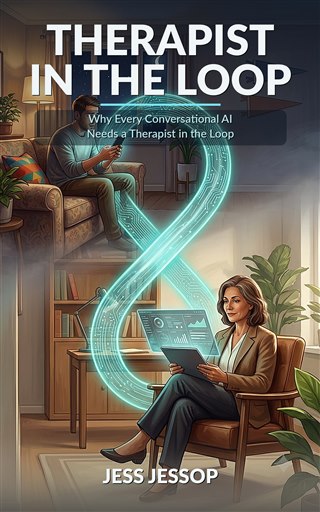
Therapist in the Loop
by Jess Jessop
One billion people live with a mental health condition. There will never be enough therapists. The machines are already in the room. This book is the map for what happens next.
The machine can help.
It cannot be left in charge.
Kindle, hardcover, and paperback
MORE ON OUR RADAR.
The lawyers who bill Anthropic Oppenheim + Zebrak filed for 35 music publishers in N.D. Cal. on Friday. The same firm named Dario Amodei and Benjamin Mann as individual defendants, cited Anthropic's $2 trillion October IPO target, and used the Bartz $1.5 billion settlement as the floor. Song list runs Livin' On a Prayer, Hallelujah, Eye of the Tiger, Great Balls of Fire, Ain't No Mountain High Enough.
Britain's ad watchdog line, in advisory form The ASA's Aug 27 CAP News piece is an insight advisory, not formal guidance. Two lines carry: 'avoid ads that imply that an AI service can replace a qualified therapist' and 'strongly discourage claims that these apps would be suitable for emergency care or crises.' Covers companion, productivity, and health/wellness bots.
The ledger the beat keeps DSA Very Large list rises to 28 with ChatGPT, Reddit, and Roblox. ChatGPT declared 159.1 million average monthly EU users, well above the 45 million threshold. Coimisiún na Meán co-supervises ChatGPT and Reddit; the Netherlands ACM co-supervises Roblox. Compliance clock runs to January 2027.
THIS ISSUE
Sixth suit. First chatbot VLOSE. Ten-billion Meta tab.
Brush Your Brain - The jingle
that started a movement
If you or someone you know is in crisis, call or text 988 (Suicide and Crisis Lifeline).
Jess Jessop is the Founder and CEO/CTO of Clinician Assist Inc. (BetterMind.Space), building the first voice-first AI-native mental health EHR with Casey Life and Peer AI Coach supervised by licensed therapists. A disabled veteran and 25-year AI/software engineering veteran, Jess brings lived experience as a mental health client to the mission of making daily mental health care as integrated as oral care.
