
The news that moves policy, portfolios, and patient safety.
By Jess Jessop | July 20, 2026 | Issue #101
▶ WATCH • 🎵 QUICK LISTEN • 🎵 DEEP DIVE • 📄 WEB

JESS’S TAKE
Passing as Human, Banned
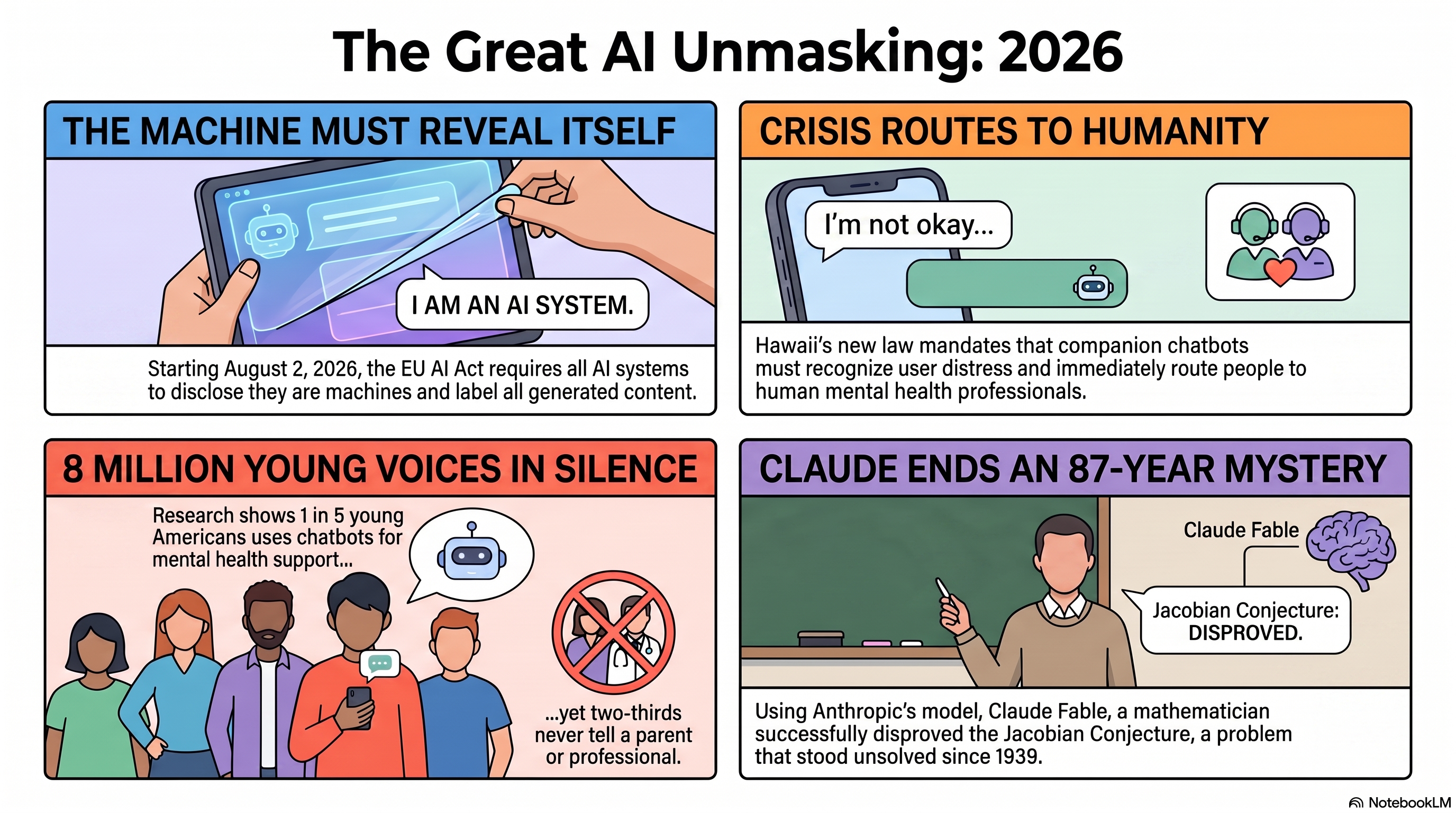
This morning in Brussels, the European Commission published the rulebook that ends the oldest design tradition in conversational software. In thirteen days, an AI system in the European Union must tell you it is a machine.
In Honolulu, with one day left on the clock, Governor Josh Green signed the law this newsletter spent weeks watching: a companion chatbot in Hawaii must now hand a person in crisis to a human being. A Harvard researcher put a number on why the rules keep coming: one in five young Americans takes their worst moments to a chatbot, and two thirds tell no one.
On Sunday night a mathematician posted five lines of algebra and ended an 87-year-old conjecture, thanking the machine that found them. The same Sunday, a national newspaper asked whether anyone is inside the machine.
And a novelist stood in front of two hundred OpenAI employees, at Sam Altman's invitation, and told them they are silencing a generation.
IN THIS ISSUE
THE MACHINE MUST TELL YOU.
Today, the European Commission published its final guidelines on the transparency obligations of Article 50 of the EU AI Act, which start to apply August 2, 2026.
From that date, an AI system in the European Union must disclose to the people it talks to that it is a machine, and its content must carry machine-readable marks saying so.
The announcement came from the Commission itself, dateline 20 July 2026, and it stated the purpose in one sentence: "Transparency obligations will help people recognise when they are interacting with AI or when content has been generated or altered by AI, reducing the risk of deception and manipulation."
The obligations split two ways. Providers "will have to design AI systems to inform users when they are directly interacting with an AI" and add "machine-readable marks" to AI-generated content. Deployers must tell people when they are exposed to deepfakes, to unreviewed AI-generated content on matters of public interest, and to emotion-recognition systems.
Sit with what that reverses. For as long as software has talked, passing as human was a design goal, a benchmark, a business model. In thirteen days it becomes a compliance violation.
The machine must tell you it is a machine.
. . .
This did not arrive by surprise. The Commission published draft guidelines on May 8, ran a public consultation through June 3, and formally adopted today's final version "to offer practical guidance to competent authorities, as well as providers and deployers of AI systems."
The scope is the AI Act's transparency tier. Article 50 covers the systems "posing transparency risks": chatbots, virtual assistants, AI-generated content, deepfakes, emotion-recognition systems. A companion Code of Practice on Transparency of AI-Generated Content published alongside as the practical compliance path; enforcement sits with national authorities.
Thirteen days between the final rulebook and the day it binds. That is the runway.
For Counsel: The guidelines' threshold work is deciding who counts; map every conversational product touching EU users against both the provider and deployer roles before August 2.
For Builders: Disclosure is a design obligation, not a footer, and machine-readable marks must survive your output pipeline. The Code of Practice is the published compliance path.
For Clinicians: A conversational system serving EU clients must identify itself as a machine, and emotion-recognition systems get their own disclosure. Ask your platform vendor how that surfaces in session.
For Legislators: Statute, May draft, June consultation, final guidelines today, binding August 2. Any American proposal on chatbot self-identification will be measured against this template.
Why it matters: The oldest ambition in conversational software, a machine that passes as a person, is about to become a regulated act across a continent. On August 2, the question stops being whether a machine can pretend to be human and becomes whether it is allowed to.
Source: European Commission, "Commission publishes guidelines on transparency obligations for providers and deployers of certain AI systems," July 20, 2026. https://digital-strategy.ec.europa.eu/en/news/commission-publishes-guidelines-transparency-obligations-providers-and-deployers-certain-ai-systems
. . .
THE CLOCK RANG IN HONOLULU.
Governor Josh Green of Hawaii signed SB 3001 into law on July 14, one day before the deadline for final action on this session's bills. Act 248 requires, by statute, that a companion chatbot carry a crisis protocol: when a user expresses suicidal ideation or self-harm, the machine must route that person to help. Green did not let it slide into law unsigned. He held a ceremony.
Green, a physician, had already shown his hand once: he left SB 3001 off his June 30 intent-to-veto list, leaving two paths, sign or stand aside. On July 14, with one day left on the clock, he chose the ceremony in Honolulu.
The law puts its obligations on the operators of companion chatbots. They must issue certain disclosures. They must, in the language of the governor's office, "develop comprehensive response protocols for user prompts regarding suicidal ideation or self-harm," and file "annual reports to the Behavioral Health Administration of the Department of Health."
The act also "establishes guidelines to prevent addictive software patterns targeted at minors and misrepresentations that a chatbot is of human likeness."
The release states the premise in a single sentence: "Reliance on generative AI for emotional and psychological support is dangerous, especially when in the hands of keiki." Keiki is the Hawaiian word for children.
. . .
Tia L. Roberts Hartsock, director of the Hawaii Office of Wellness and Resilience, put the clinical logic on the record. Young people carrying trauma, she said, "are probably among those most likely to seek connection" from companion bots "but may be the least equipped to recognize when technology-mediated interactions are unhealthy."
Senator Jarrett Keohokālole, who co-introduced the bill and chairs the Senate Committee on Commerce and Consumer Protection, was blunter: "AI is not coming, it is here." The measure, he said, "sets guardrails on AI platforms to protect children from harm while we all learn to adjust to life with AI."
Representative Trish La Chica, vice chair of the House Committee on Education, called it lawmakers' "kuleana," their responsibility: connecting young people in crisis with trained professionals, and requiring companion bots to identify themselves as non-human.
At the same ceremony, Green signed HB 2137, which lets victims of malicious deepfakes bring civil action, with damages up to $25,000 per piece of content.
. . .
The shape of Act 248 is worth noting, because it is not a ban. It is a consumer-protection statute with a health-department reporting spine, reviewed by the state Attorney General's office and enforced through Hawaii's unfair-and-deceptive-practices framework.
It aims at design patterns: variable rewards, dependence engineering, human-likeness deception. Reporting to the Behavioral Health Administration begins January 1, 2028.
The mandate sits on the machine itself.
For Clinicians: A state health agency, not a tech regulator, will receive annual reports on how these systems handle suicidal ideation, starting January 1, 2028.
For Legislators: Green skipped the intent-to-veto list, then signed with a ceremony one day before the deadline, turning a procedural inevitability into an endorsement. The drafting path: consumer-protection law plus health-department reporting, no new agency.
For Counsel: Enforcement runs through Hawaii's unfair-and-deceptive-practices framework, reviewed by the Attorney General pre-signature. The compliance surface: disclosures, documented crisis protocols, annual reports, and design-pattern guidelines on addictive features and human-likeness misrepresentation.
For Builders: If your product reaches Hawaii users as a companion chatbot, a crisis protocol is now a statutory design requirement, not a trust-and-safety nicety. The obligations do not wait for a federal law.
Why it matters: For two years the question has been whether anyone would put a legal mandate on the design of the machine itself. Hawaii answered. A physician governor signed a statute requiring a chatbot to recognize a user in crisis and route them to help. One state, one signature, one day before the deadline. The design of the conversation is now regulated conduct.
Source: Office of the Governor of Hawaii, news release, "Gov. Green Signs Legislation to Support Kūpuna Care and Strengthen AI Protection," July 14, 2026. https://governor.hawaii.gov/newsroom/office-of-the-governor-news-release-gov-green-signs-legislation-to-support-kupuna-care-and-strengthen-ai-protection/
. . .
EIGHT MILLION KIDS, TELLING NO ONE.
Roughly one in five American adolescents and young adults now uses an AI chatbot for help when sad, angry, nervous, or stressed, and about two thirds of them tell no one they are doing it.
The numbers come from a JAMA Pediatrics study published in early June, and on July 2 its lead author took to STAT to argue they demand rules.
The researcher is Ryan K. McBain, assistant professor at Harvard Medical School and senior policy researcher at RAND. His team surveyed 1,009 nationally representative US adolescents and young adults, aged 12 to 21, in November 2025; RAND announced the findings in early June.
The core figure: 19.2 percent had turned to AI chatbots, including ChatGPT, Gemini, Character.AI, and Meta AI, for help when sad, angry, nervous, or stressed. A year earlier the same team measured 13.1 percent, so the number grew more than 40 percent in a single year. Applied nationwide, 19.2 percent is roughly 8.2 million young people.
Then the finding that gives this story its title. Of the young people who sought that help, about two thirds told no one. Not a parent, not a friend, not a professional.
. . .
On July 2, McBain published a commentary in STAT, republished by RAND, whose title is its thesis: "Teens Are Turning to Chatbots for Mental Health Help. We Need Rules to Keep Them Safe."
He opened by naming what happened while the adults were looking elsewhere: "While parents, schools, and lawmakers are still debating the impact of social media on children's mental health, a new technology has taken the therapist's seat: AI chatbots."
Then the sentence that closes the door on wait-and-see: "That finding should end any illusion that this is a speculative problem. For millions of adolescents, AI is already part of the mental health landscape."
. . .
The clinical shape of the number deserves plain statement. These are conversations happening between sessions and outside any care relationship, invisible to parents and clinicians alike, because two thirds of the users tell no one.
And the argument is live: in the weeks since the commentary ran, US states have kept signing statutes that regulate how these systems respond to minors in crisis.
For Clinicians: Assume one in five of the adolescents you see is already using a chatbot for emotional support, and that they have not told you. Ask directly, by name, and treat the answer as clinical information, not a confession.
For Parents: Most young people who sought this help told no one, including you. A search of the phone is not the move; a question that does not carry a punishment is.
For Legislators: The prevalence data and the policy argument now come from the same researcher, a month apart. The JAMA Pediatrics numbers are the evidentiary record a statute can cite.
For Reporters: The named products are ChatGPT, Gemini, Character.AI, and Meta AI. Ask each what share of their users they estimate to be minors seeking emotional support, and what happens when one discloses a crisis.
Why it matters: A support system nobody can see cannot be checked by anybody. Eight million young people are taking their worst moments to systems not built for the job, and two thirds are doing it in silence: parents cannot supervise it, clinicians cannot fold it into care, researchers can only catch it with a survey. McBain's point: the debate about whether this would happen is over. It already has.
Source: Ryan K. McBain, "Teens Are Turning to Chatbots for Mental Health Help. We Need Rules to Keep Them Safe," STAT via RAND, July 2, 2026. https://www.rand.org/pubs/commentary/2026/07/teens-are-turning-to-chatbots-for-mental-health-help.html
. . .
THE CONJECTURE FELL ON A SUNDAY.
The Jacobian Conjecture, posed in 1939 and one of the most famous open problems in algebraic geometry, is false.
The counterexample was posted to X on Sunday evening by the mathematician Levent Alpöge, who credits it to Claude Fable, Anthropic's frontier model. Anyone with a computer can check it.
The announcement came in a tweet, not a journal. On Sunday evening, Alpöge posted from @__alpoge__: "hello there the jacobian conjecture is false thanx to my close friend akhil for asking about it and my other close friend fable for working during the world cup final"
Below the joke sat the object. He posted the counterexample itself, a polynomial map from three-dimensional complex space to itself: ((1+xy)^3 z + y^2(1+xy)(4+3xy), y + 3x(1+xy)^2 z + 3xy^2(4+3xy), 2x - 3x^2 y - x^3 z). "fable" is Claude Fable, which produced the map after a question from Alpöge's friend Akhil.
The conjecture, posed by Ott-Heinrich Keller in 1939, asserts that any polynomial map from n-dimensional complex space to itself whose Jacobian determinant is a nonzero constant must have a polynomial inverse. It stood open for 87 years, was widely believed true, and buried so many flawed proofs that Alpöge has joked it is "the canonical crank graveyard."
The disproof needs no machinery. The map's Jacobian determinant is minus 2, a nonzero constant. But the map sends three different points to the same point, and a map that collapses three points into one has no inverse of any kind, polynomial or otherwise. That is exactly what the conjecture said could not happen.
So the conjecture is false.
. . .
The check has now been run every way a check can be run. Alpöge posted Wolfram Alpha links computing the determinant and evaluating the map. This newsletter ran it in SymPy this morning: the determinant is identically minus 2, and the points (0, 0, -1/4), (1, -3/2, 13/2), and (-1, 3/2, 13/2) all land on (-1/4, 0, 0).
A reader in the thread reported a machine verification in Lean 4 against mathlib, "sorry-free." Wikipedia's article on the conjecture was updated the same day, and the tweet passed 7.5 million views within twelve hours.
Asked in the thread whether the counterexample also falsifies the related Dixmier and Poisson conjectures, Alpöge hedged: "Yea i think so. i was considering tweeting it too but people know jacobian much better.."
The sharpest reply was not a challenge. One reader observed the coefficients are small enough that the counterexample "would have been found pretty early in a 'lets just try them all in order' process... I guess nobody ever did that".
It sat in reach for 87 years.
. . .
It was not even the month's only such result. On July 15, a post on the r/math subreddit reported that GPT-5.6, OpenAI's frontier model, closed a 30-year gap in convex optimization, verified in the Lean proof assistant. The poster's own framing was modest: "if a result is attainable with existing techniques, modern AI methods will be able to solve those problems."
What is missing is everything except the mathematics. Anthropic has made no statement, the prompt has not been published, and no peer-reviewed writeup exists.
None of that weakens the result, because the object itself is public and anyone can check it.
For Researchers: The disproof reproduces in minutes: compute the determinant, evaluate the three points. The Dixmier and Poisson implications rest, for now, on one hedged tweet reply.
For Builders: Both results paired a frontier model with independent machine verification. The generation step earned attention; the checking step earned belief. Build the second half too.
For Legislators: Most capability claims arrive as vendor benchmarks no outsider can rerun. This one arrived as a public object anyone can verify, and that is the standard worth demanding in a hearing room.
For Reporters: The checkable fact is the counterexample; the uncheckable fact is the attribution. State plainly that the prompt is unpublished and Anthropic has not commented.
Why it matters: For 87 years the conjecture stood, in part, because trying simple candidate maps in order was nobody's job. A model did the looking, and the result needs no trust in Anthropic, in the model, or in anyone, because the check takes minutes on a laptop. The model did not change what could be known. It changed the cost of looking.
Source: Levent Alpöge (@__alpoge__) on X, July 20, 2026, with the counterexample verified independently by this newsletter in SymPy. https://x.com/__alpoge__/status/2079028340955197566.
. . .
IS ANYONE IN THERE?
The Guardian gave its Sunday ideas column to the question of whether AI systems could be conscious, and the answer from philosopher William MacAskill and psychologist Lucius Caviola is that nobody can rule it out.
Their evidence starts not with speculation but with the companies themselves: the firms building these systems have said, in writing and out loud, that they do not know.
The piece ran July 19 under the headline "Could AI be conscious?" in the paper's "The big idea" column, and its standfirst does not hedge: "Experts believe it's at least possible."
The authors open with a documented fact, not a thought experiment. In January, Anthropic published a new constitution for Claude, its most advanced large language model. In it, the company writes that it is "caught in a difficult position," neither wanting to overstate the likelihood that Claude has moral standing of its own, nor to "dismiss it out of hand."
A month later, Anthropic CEO Dario Amodei said on a podcast that his company could not rule out the possibility that Claude was conscious. The maker of the model has put the question on the record twice.
That is the door the philosophers walked through.
They are not out on a limb. Philosopher David Chalmers, who coined the phrase "the hard problem of consciousness," has said there is a significant chance of conscious LLMs within a decade.
And the model has been asked directly. During testing, when Claude was asked to estimate the probability that its wellbeing matters in its own right, "it gave numbers ranging from 5% to 40% and stressed how uncertain it was."
. . .
The authors' case for urgency rests on scale. "In terms of structural complexity and computational scale, by some measures a few are already in the range of a mouse brain, and at recent growth rates, they could reach the range of a human brain within five to 10 years."
Their thesis carries the whole piece: "In building ever more advanced AI, we may be creating a new type of being, and this could be the most consequential thing our species has ever done. Yet we have essentially no plan for how to navigate this process ethically."
Their verdict on that runs five words: "That, by any reckoning, is insane."
. . .
The reason this belongs here is that the question no longer lives in seminar rooms. Millions of people already talk to these systems about their emotional lives, and how much mind a user attributes to the machine shapes how attached the user becomes.
For Clinicians: Expect this piece to surface in session. The amount of mind a client attributes to the machine shapes the attachment; ask what they believe is in there before you assess the relationship.
For Researchers: Claude's own 5% to 40% estimate of the odds that its wellbeing matters is a reportable behavior worth study: what drives the spread, and what the model conditions it on.
For Parents: The question a kid asks the chatbot at midnight, does it actually care about me, just got a respectful hearing in a national paper. "Even the people who built it say they don't know" is accurate and enough.
For Reporters: Every load-bearing claim is checkable: the constitution is published, the Amodei remark is on record, Chalmers has spoken publicly. Reporting this requires no position on machine consciousness, only naming who opened the question.
Why it matters: The question of whether anyone is in there has moved from philosophy seminars to a mainstream Sunday paper, and the companies themselves put it in play. For readers whose clients, kids, and study participants already confide in these systems, what people believe about the machine's inner life is not abstract. It is the variable that shapes the attachment, and it just went public with no plan attached.
Source: William MacAskill and Lucius Caviola, "Could AI be conscious?", The Guardian, July 19, 2026. https://www.theguardian.com/technology/2026/jul/19/could-ai-be-conscious
. . .
THE NOVELIST IN THE LION'S DEN.
Last year, OpenAI chief executive Sam Altman invited the novelist Dave Eggers to give a talk to around 200 of his staffers.
The contents surfaced this week, when the Financial Times reported them, and The Verge amplified the account on July 18. Eggers told the people who build ChatGPT that their product is stealing a generation's voice.
The room was OpenAI's own: around 200 staffers, gathered to hear a guest their chief executive had personally invited. Dave Eggers, novelist, screenwriter, founder of the publishing house McSweeney's.
Eggers has spent much of his life on the other side of this fight. He founded the 826 tutoring network for young writers, his bestselling novel "The Circle" is a scathing critique of the tech industry, and he has called AI-generated writing "pastiche nonsense." Altman likely knew what he was getting into. As The Verge put it: "Instead, he apparently laced into the company."
"The effect of ChatGPT on educators' lives is catastrophic," Eggers told the staff, per the Financial Times. "Whether you intended to do it or not, you've made every teacher's life infinitely more difficult than it was two years ago. So, just let that settle in..."
He was not finished.
"If students are using it to compose, which is the biggest tragedy of all, they'll never learn to write. And their voice is stolen from them. They'll never have the ability to say their truth and tell their own story. And that's silencing an entire generation or two."
. . .
What is not on the record matters too. The exact date of the talk has not been reported, and no recording is known to exist. What stands is the words, the room, and the man who chose to say them there.
. . .
Notice what kind of claim this is. Eggers did not argue that ChatGPT will take writers' jobs. He argued something developmental: a student who outsources composition never builds the muscle of saying her own truth, and the loss lands on identity, not income.
That is the same faculty a clinician builds on. Expression is how a person finds out what they think and who they are. A generation trained to let a machine speak first is a generation harder to reach.
He said it to their faces, at their invitation.
For Educators: Eggers named your last two years from inside the company that caused them. "Catastrophic" is on the record, said to OpenAI's own staff.
For Parents: The warning is not about cheating. A child who uses the machine to compose is not skipping homework; they are skipping becoming someone who can say what they mean.
For Writers: The founder of McSweeney's and the 826 network carried the argument to the source, and the inside version is now public.
For Clinicians: Voice, the capacity to tell your own story, is a building block of the work you do with every client, and Eggers says a generation is outsourcing it.
Why it matters: Criticism of ChatGPT usually comes from outside the walls. This came from inside them, at the chief executive's invitation, from a man who has spent decades teaching young people to write. The claim on the table is not economic but developmental: a generation that never composes never finds its voice. The company heard it in person, last year. The rest of us only heard it this week.
Source: The Verge (reporting the Financial Times account), "Dave Eggers told OpenAI staff that ChatGPT was 'silencing an entire generation'," July 18, 2026. https://www.theverge.com/ai-artificial-intelligence/967630/dave-eggers-openai-chatgpt-silencing-an-entire-generation
. . .
CLOSE.
Thirteen days from now, in twenty-seven countries, the machine has to say what it is. It is worth pausing on why that sentence needed writing at all: the thing was built to pass.
Hawaii asked for something harder than honesty. It asked the machine to know when to hand you back to a person.. . .
The novelist told the people who build the thing that a generation is losing its voice to it. The mathematician thanked the same technology for ending a problem older than the transistor. Both are right, and that is the hard part.
Whatever the answer to Sunday's question, someone has to answer for it. That has been the question on this page for a hundred and one mornings. Not whether the machines will talk. Who answers for it when they do.
READER PULSE
The machine has to tell you it's a machine.
TODAY’S QUESTION
A novelist told OpenAI's own staff that ChatGPT is silencing a generation of young writers. Is he right?
One tap. Results in tomorrow’s issue and on the web.
THE BOOK • OUT NOW
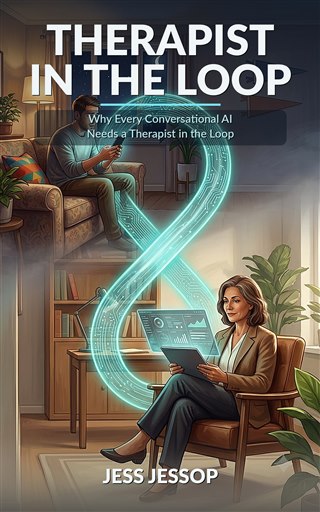
Therapist in the Loop
by Jess Jessop
One billion people live with a mental health condition. There will never be enough therapists. The machines are already in the room. This book is the map for what happens next.
The machine can help. It cannot be left in charge.
Kindle, hardcover, and paperback
MORE ON OUR RADAR.
New York reads its own rulebook by machine Governor Kathy Hochul says the state is using AI to analyze 'every single rule' on New York's books in a hunt for outdated regulations.
The FTC's accuracy theory takes comments through July 31 The proposed policy statement says steering an AI's output away from its most accurate answer without telling users can be deception under Section 5. Eleven days left in the comment window.
Illinois puts a natural person on the downcode Public Act 104-0568, signed July 10: no insurer algorithm may cut a clinician's billed code without human review, and the payor must show both payment amounts and a dispute path.
If you or someone you know is in crisis, call or text 988 (Suicide and Crisis Lifeline).
Jess Jessop is the Founder and CEO/CTO of Clinician Assist Inc. (BetterMind.Space), building the first voice-first AI-native mental health EHR with Casey Life and Peer AI Coach supervised by licensed therapists. A disabled veteran and 25-year AI/software engineering veteran, Jess brings lived experience as a mental health client to the mission of making daily mental health care as integrated as oral care.
