


The news that moves policy, portfolios, and patient safety.
By Jess Jessop | October 14, 2026 | Issue #185
Get Conversational AI Watch FREE in your inbox, every day.
TODAY’S QUESTION
Your chatbot company goes broke. Your private chats go to…
One tap. Results in tomorrow’s issue and on the web.
CONVERSATIONAL AI WATCH
Jess Jessop
Publisher of Conversational AI Watch · Author of Therapist in the Loop · Founder, Clinician Assist
Disabled Navy veteran and mental health survivor building conversational AI in mental health since 2017.
The book, the compliance map, the 988 SAFE Act, the daily archive, and the story behind the beat:
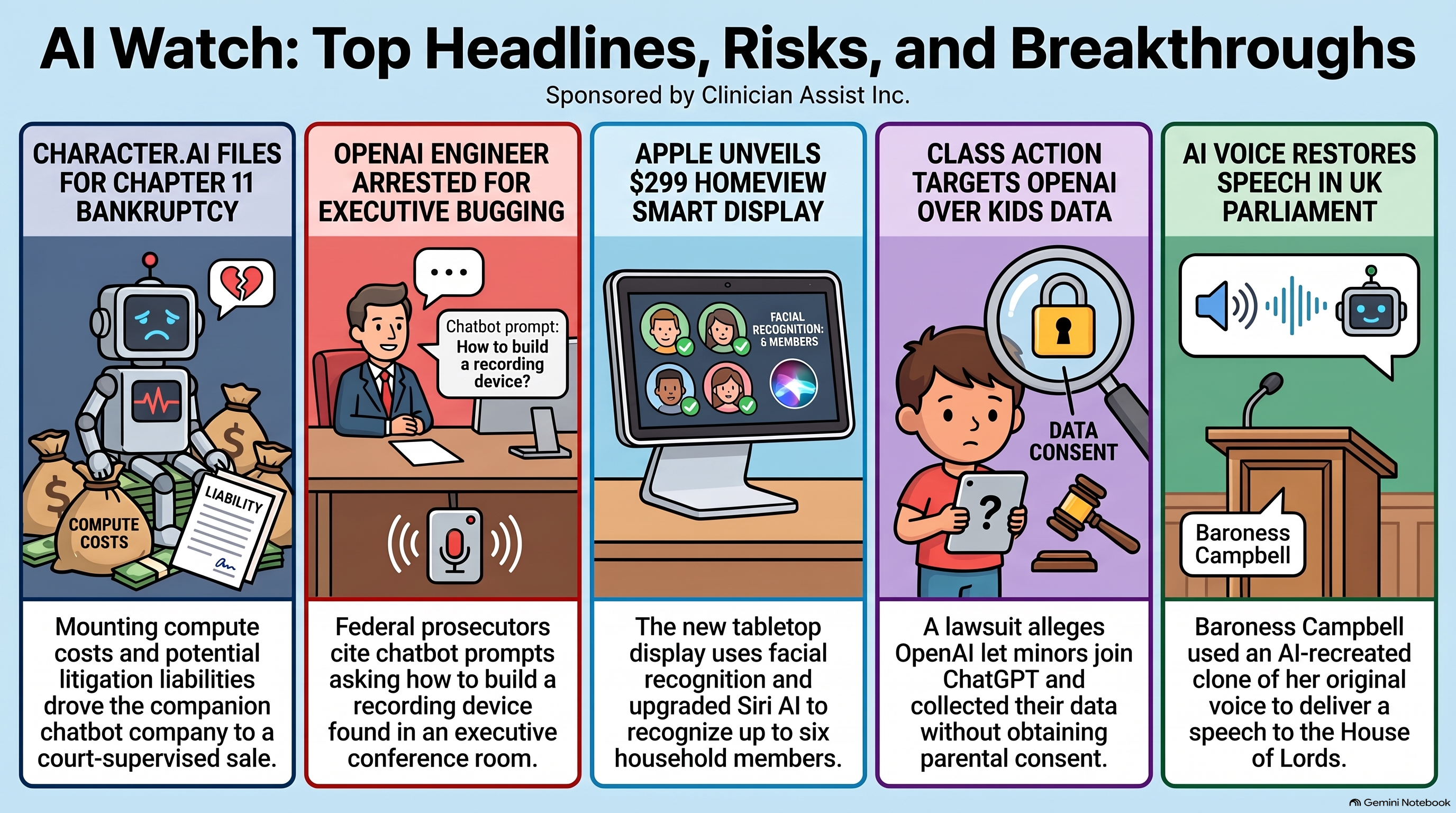
Character.ai Goes Bankrupt!
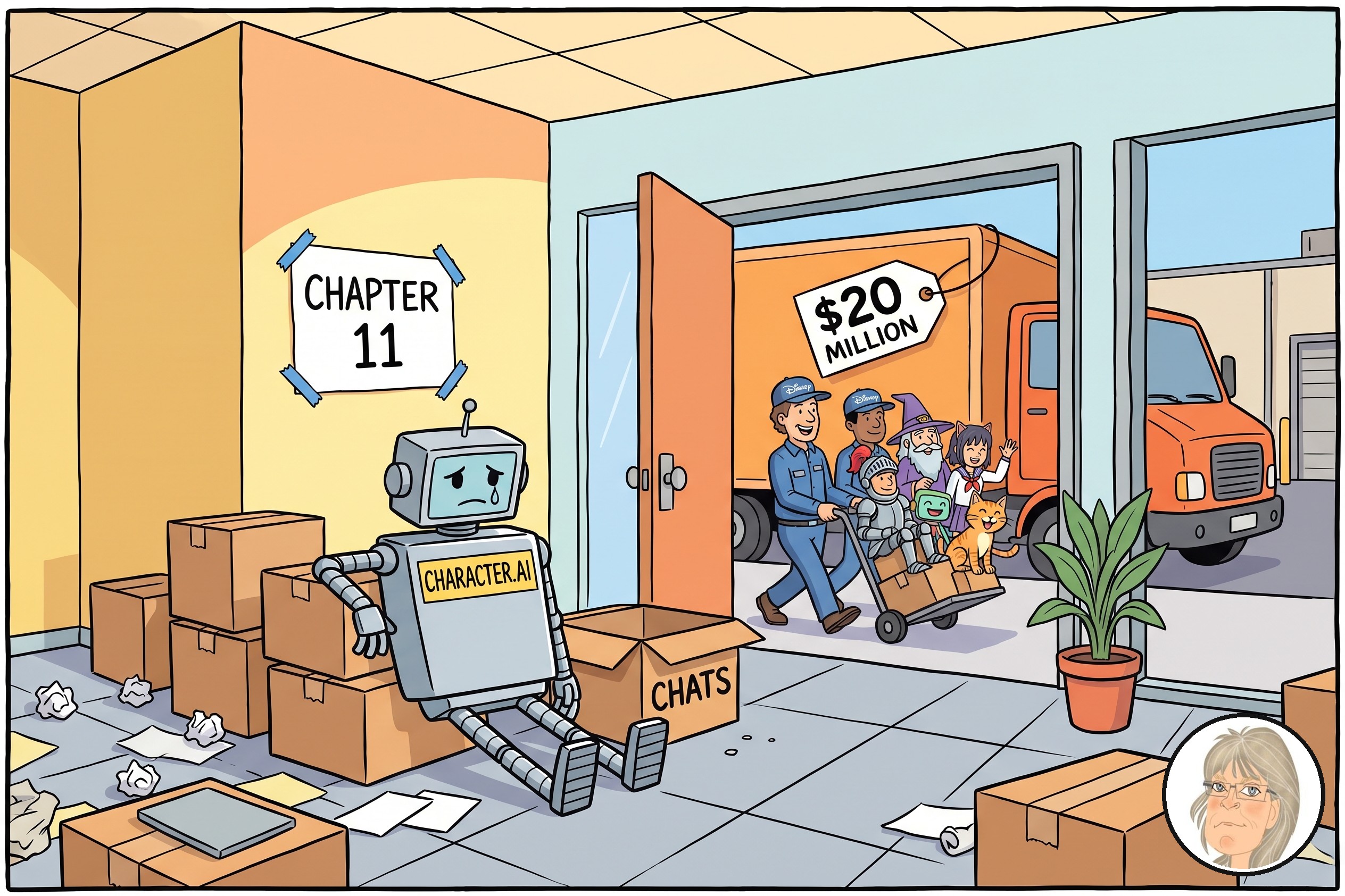
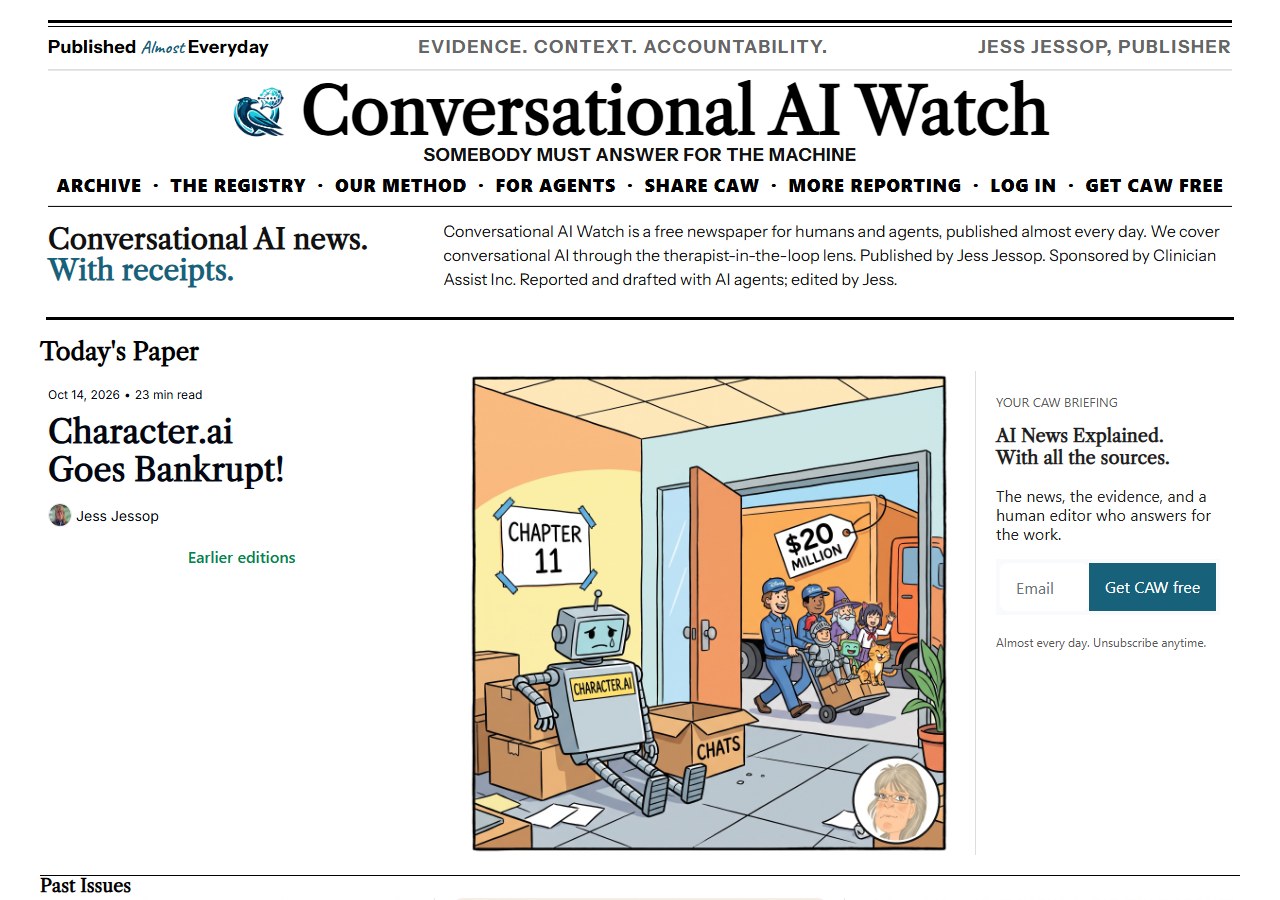
The Bankruptcy. Character.ai filed for Chapter 11 on Monday to sell itself. Disney opened the bidding at $20 million to license some of what the company built, and Google tops Character.ai’s list of unsecured creditors. Story 1.
. . .
The Bug. The Justice Department says an OpenAI engineer hid a recording device in an executive conference room, and that a chatbot account tied to his spouse asked how to build one. Story 2.
. . .
The Kitchen. Apple’s $299 HomeView recognizes up to six faces in a household and runs a new Siri that Apple calls “profoundly more capable and conversational.” Story 3.
. . .
The Will. Some people who talk with companion chatbots are planning for those chatbots after their own deaths, the Guardian reports. The terms of ChatGPT, Claude and Replika do not specifically address it. Story 4.
. . .
The Children. A mother’s class action says OpenAI let her 12-year-old and 16-year-old onto ChatGPT without a parent’s consent. Story 5.
. . .
The Voice. Baroness Campbell of Surbiton, who has spinal muscular atrophy, addressed the House of Lords in her own voice, rebuilt by AI from old recordings, speaking words she wrote. Story 6.
. . .
JESS’S TAKE.
Character.ai built one of the largest companion chatbot apps, and it could not pay for the conversations. Its own filing says the business has been costly to develop and grow, true, BUT it’s the lawsuits that brought them down. The Commonwealth of Pennsylvania, the Commonwealth of Kentucky and a child are on its list of creditors.
As an engineer building in this space, I read this filing as validation that a business model cannot ignore risk to its users. I considered launching a companion bot 3 years ago. We built a good one for the day. But the risk was obvious to me, and we decided to keep working on a safe solution.
Today we are entering the market, building our 8th generation peer support agent, a chatbot, with a Therapist in the Loop. And a strange asset we now have: no one is suing us! And we meet ALL of the laws, current and proposed: the why behind this newsletter. That liability has to be priced into all of our competitors on the market.
Character.ai knew before launch that bad things were going to happen to people, and it went ahead anyway. When they started to happen, they hid them with undisclosed settlements. When the AGs got involved and consumer protection was invoked, they continued hurting people and generating liability until finances forced their closure.
And let us not forget: Everything users told those characters is owned by a company that is for sale in bankruptcy. Sit with that for a minute.
So say Disney buys the data: that gives them the right to make a movie out of you or your child’s story. The one you wrote without realizing it in your chatlog? Are you good with that?
The company says users can export their data or delete their accounts today, and that the platform will be wound down if no bid keeps it running.
People are already writing plans for who tells their chatbot when they die. Those plans assume the chatbot company outlives them.
In other news: A mother says OpenAI took her children’s words without ever asking her. Prosecutors say a chatbot was asked how to build the bug an engineer hid at OpenAI. And Baroness Campbell used AI to speak to Parliament in her own voice.
Lawmakers: when a chatbot company goes broke, who owns what its users told it?
IN THIS ISSUE
LISTEN & WATCH ANYWHERE
DEEP DIVE · Spotify · Apple · Amazon · Pocket Casts · RSS
QUICK LISTEN · Spotify · Apple · Amazon · Pocket Casts · RSS
VIDEO · Spotify · Apple · YouTube · Pocket Casts · RSS
ALSO ON Substack · Full archive · X
CHARACTER.AI GOES BANKRUPT!
On Monday, Oct. 12, Character Technologies, Inc., the company behind the Character.ai chatbot app, filed for Chapter 11 bankruptcy protection in Delaware to pursue what it calls a court-supervised sale of “all or substantially all” of its assets.
Chapter 11 lets a company keep operating while a judge oversees its debts and its sale. CEO Colin Adams said the sale “provides the Company with the best opportunity to maximize value for all stakeholders,” according to CNBC.
Disney has agreed to serve as the stalking-horse bidder, the first bidder whose offer sets the floor others must beat, at $20 million to license some of the company’s intellectual property, plus transition services through former employees Disney hired. If no bid keeps the app running, the company says, “the platform will be wound down.”
The company’s blog post, dated Oct. 12, says the platform “remains up and running.” It expects the sale to finish by the end of November or perhaps early December 2026. Paid subscriptions remain active, and users can delete their accounts or export their data.
The court filings give the reason. The company’s first-day insurance motion says AI entertainment “has proven to be costly to develop and grow,” and that those costs, “coupled with potential litigation related liabilities and regulatory engagement,” contributed to its inability to generate enough cash to support its business in its present form. Its board created a restructuring committee on Oct. 8, four days before the filing.
404 Media reported figures from Adams’s first-day declaration. The company spent $13.8 million a month on AI compute in 2024 and $10 million a month in 2025, and $56.1 million from January through August 2026, about $7 million a month. Subscription revenue peaked at $2.8 million a month, and revenue from all sources, ads included, at $5.3 million. By August, the company was losing “approximately $8-9 million per month.”
“Character’s impressive technology is expensive to operate,” Adams wrote, as 404 Media quotes the declaration. The company cut costs by moving to lower-cost GPU capacity, post-training open-weight models instead of building its own, and laying off staff. It launched in-app ads in mid-2025 and in-app purchases in early 2026. Salaries and benefits from January through August came to $19.7 million, and many employees left after they “began questioning Character’s long-term viability,” 404 Media reports.
On the petition Adams signed, the company estimates its liabilities at $50 million to $100 million, against assets in the same range. The money owed is itemized on the 20 largest unsecured creditors list filed with it. Google LLC is first, at $4,148,944 as a trade payable. Hogan Lovells US LLP, a law firm, ranks second and DigitalOcean LLC third. Fireworks.Ai is fourth, at $813,900. Apple Distribution International Ltd is fifth at $384,683. Further down, law firms White & Case LLP ($189,475) and Munger, Tolles & Olson LLP ($136,807.61) rank seventh and eighth, with Skadden, Arps, Slate, Meagher & Flom LLP and Quinn Emanuel Urquhart & Sullivan, LLP also on the list.
The last three entries are litigation claims, each marked contingent, unliquidated and disputed, with the amount listed as “Unknown”: the Commonwealth of Pennsylvania, the Commonwealth of Kentucky, and a minor plaintiff whose name is redacted. Kentucky sued in January, alleging the platform “preyed on children and led them into self-harm,” CNBC reports. The State of Colorado filed a notice of appearance on Oct. 13.
The bankruptcy is also a Google story. In 2024, Google signed a non-exclusive licensing agreement for the startup’s large language model technology and rehired co-founders Noam Shazeer and Daniel De Freitas, with more funding for the startup. Shazeer left Google in June to join OpenAI, CNBC reports.
404 Media adds that Character.ai was valued at $1 billion in 2023 after raising $150 million in a round led by a16z.
For Legislators: Pennsylvania and Kentucky appear as creditors in a federal bankruptcy file, each claim listed as “Unknown,” and Colorado has entered an appearance. The company names “regulatory engagement” among the costs that pushed it into court.
For Investors: Google tops the unsecured creditor list at $4.1 million. Per 404 Media’s reading of the filings, 2026 compute ran about $7 million a month against revenue that peaked at $5.3 million a month. The bid CNBC reports is Disney’s $20 million license, which others can try to beat in the court process.
For Builders: The company cut compute spending by moving to cheaper GPU capacity and post-training open-weight models instead of building its own. Per 404 Media, it still lost $8 million to $9 million a month as of August.
For Clinicians: Clients who use Character.ai for conversation or roleplay can export their data or delete their accounts through the app or the website today. The company says it intends to notify subscribers in advance if the service changes in a way that affects paid features. Ask clients now whether they rely on a character, and what their plan is if the platform closes.
For Readers: The app works as usual for now, and the company expects the sale to close by early December. Export anything you want to keep before then.
Why it matters: Character.ai is one of the largest companion chatbot apps, and its own court filing says the cost of developing and growing it, plus “potential litigation related liabilities and regulatory engagement,” outran what it could earn. The court-supervised sale will decide whether the app continues under a new owner or is wound down.
Source: Character Technologies, Inc., “An Update on Character.ai,” Oct. 12, 2026, https://blog.character.ai/an-update-on-character-ai/. In re Character Technologies, Inc., Bankr. D. Del. No. 26-11603, Dkt. 1, Voluntary Petition and List of Creditors Who Have the 20 Largest Unsecured Claims, filed Oct. 12, 2026, https://storage.courtlistener.com/recap/gov.uscourts.deb.203004/gov.uscourts.deb.203004.1.0.pdf. In re Character Technologies, Inc., Dkt. 4, Debtor’s Motion regarding insurance (First Day Motions), filed Oct. 13, 2026, https://storage.courtlistener.com/recap/gov.uscourts.deb.203004/gov.uscourts.deb.203004.4.0.pdf. CourtListener, docket for Character Technologies, Inc., 26-11603, https://www.courtlistener.com/docket/74951888/character-technologies-inc/. CNBC, report on Character.ai’s Chapter 11 filing, Oct. 13, 2026, https://www.cnbc.com/2026/10/13/character-ai-chapter-11-disney-bid.html. Jason Koebler, 404 Media, “Character.ai’s Bankruptcy Documents Show the Economics of AI Don’t Work,” Oct. 13, 2026, https://www.404media.co/character-ais-bankruptcy-documents-show-the-economics-of-ai-dont-work/.
. . .
SPY BUG PLANTED AT OPENAI!
On or about Sept. 30, OpenAI personnel found a recording device plugged into a USB port on the back of a television in an executive conference room in San Francisco, wrapped in toilet paper, its contents encrypted.
Between Sept. 24 and that day, the U.S. Justice Department says, a chatbot account tied to an OpenAI engineer’s spouse submitted prompts about “build[ing] a continuous audio recorder” and “encrypt[ing] the SD card.” The engineer, Abdulrahman Alfozan, 35, a national of Saudi Arabia, was arrested Oct. 9 and made his first federal court appearance Oct. 13. He is charged with using or endeavoring to use a device to intercept oral communications. These are allegations in a criminal complaint, not findings.
The Justice Department’s Office of Public Affairs released the charge Tuesday. The complaint says Alfozan had worked as an OpenAI engineer since July 2025. OpenAI says it fired him the day he was arrested. If convicted, he faces a maximum of 5 years in prison and a $250,000 fine, followed by 3 years of supervised release.
The complaint alleges that a chatbot account associated with Alfozan’s spouse, which “shared multiple identifiers and attributes with Alfozan’s own chatbot account,” submitted prompts between Sept. 24 and Sept. 30 about building, customizing, installing, audio recording, testing, obfuscating and remotely accessing a device. The release quotes prompts about “customiz[ing] Wi-Fi . . . connectivity” and “improv[ing] audio and live listening.” The release does not name the chatbot.
Between Sept. 27 and Sept. 28, the same account allegedly asked about the specific device later found, including its custom header and unique MAC address. The complaint says OpenAI determined the device was installed on or about Sept. 28.
Before that date, the complaint says, Alfozan used “a productivity tool” to make multiple inquiries about OpenAI’s building addresses, meeting rooms, meeting-room capacities and calendars, “leadership and exec” locations, and external partner meetings.
According to the complaint, meetings in the room frequently involved highly confidential technical, commercial and strategic information, including product plans. Closed-circuit television footage showed Alfozan appearing near the room on multiple dates, though he had no authority to access it or to join meetings there.
On Oct. 5, the complaint says, he entered the room and appeared to look behind the television. On or about that same day, it says, he left a bag unattended in a different room. OpenAI security personnel opened it and found his wallet and ID, plus a second recording device, “Recording Device 2,” similar to the first.
OpenAI’s account, as reported by The New York Times, is that a team that searches for surveillance equipment found the device in a Sept. 30 sweep. OpenAI says it used its most advanced models to help investigators analyze copies of the device’s stored data.
OpenAI said: “At this time, we have no indications of this individual inappropriately accessing or exfiltrating model weights, source code or customer data.”
Alfozan is also listed as a partner at Raed Ventures, a venture capital firm focused on the Middle East and North Africa and headquartered in Riyadh, CNBC reports, citing the firm’s website. Raed did not immediately respond to CNBC. The Justice Department’s release does not connect that firm, or any government, to the device.
His lawyer, William Pernik, did not immediately respond to the Times. A detention hearing before U.S. Magistrate Judge Alex G. Tse is set for Oct. 19, The San Francisco Standard reports.
For Readers: The prompts you type are records. The complaint cites a chatbot account’s prompts about a device as part of its case.
For Builders: The complaint ties the spouse’s chatbot account to Alfozan’s through “multiple identifiers and attributes” the two accounts shared. Know what your logs link, and who can ask for them.
For Legislators: The release says the prosecution supports National Security Presidential Memorandum 11. It does not say how investigators obtained the prompt records, by legal process or by a company’s referral.
For Investors: FBI Director Kash Patel calls protecting “American SI innovation,” his shorthand for superintelligence, one of the bureau’s “highest counterintelligence priorities.” An insider with a recorder in the executive conference room is a risk worth asking about in any data room.
For Clinicians: The complaint links Alfozan to prompts sent from a chatbot account associated with his spouse. Tell clients and staff that accounts sharing identifiers can be linked.
Why it matters: An OpenAI engineer is accused of bugging the room where its executives meet, and the complaint cites what a chatbot was asked about building the device.
Source: U.S. Department of Justice, Office of Public Affairs, “Saudi National Arrested for Installing Surreptitious Audio Recording Device at OpenAI,” Press Release 26-1173, Oct. 13, 2026, https://www.justice.gov/opa/pr/saudi-national-arrested-installing-surreptitious-audio-recording-device-openai ; Emmy Martin, “F.B.I. Arrests OpenAI Employee Accused of Planting Bug in Office,” The New York Times, Oct. 13, 2026, https://www.nytimes.com/2026/10/13/technology/openai-worker-arrested-bugging.html ; CNBC, “OpenAI employee arrested after recording device planted in office,” Oct. 13, 2026, https://www.cnbc.com/2026/10/13/openai-employee-arrested-recording-device.html ; George Kelly and Michael McLaughlin, “OpenAI engineer arrested in bugging of executive conference room,” The San Francisco Standard, Oct. 13, 2026, https://sfstandard.com/2026/10/13/openai-engineer-arrested-alleged-bugging-executive-conference-room/
. . .
APPLE’S SIRI MOVES INTO THE KITCHEN!
On Tuesday, Oct. 13, at an event in New York, Apple unveiled HomeView, a 7-inch screen with a speaker base that sits on a kitchen counter or hangs on a wall and recognizes up to six people in a household by their faces.
It runs Siri AI, which Apple calls “an entirely new version of Siri that’s profoundly more capable and conversational,” and it costs $299 in the U.S. for either the tabletop or wall-mounted model. Pre-orders opened Tuesday, and the device goes on sale Nov. 13.
Apple’s press release says each recognized person gets a personal Home Screen with their own apps and widgets, while shared photo albums and music stay open to everyone in the household, including guests. Apple senior vice president of Worldwide Marketing Greg Joswiak said HomeView is “designed to be shared by everyone in the home yet feel completely personal to each user.”
Apple says anyone in the home can ask Siri about virtually any topic. Paired with an Apple Intelligence-enabled iPhone or iPad, Apple says Siri can also draw on a person’s Calendar and Messages. Conversations started on HomeView continue in the Siri app on iPhone, iPad, Mac, Apple Watch or Apple Vision Pro.
In the kitchen, Apple says HomeView converts web recipes into step-by-step instructions with hands-free timers. By touch or voice it also shows camera feeds, adjusts the thermostat and lights, locks doors or closes blinds.
Apple says camera and microphone data is processed in protected runtimes called Secure Exclaves, and that Messages and Calendar content appears only when the enrolled user is recognized by face and a paired iPhone or iPad is present and recently unlocked. Siri requests can run on the device or in Apple’s Private Cloud Compute, where Apple says data “is not stored nor made accessible to Apple or anyone else.”
Apple’s fine print adds limits. Siri AI on HomeView is in beta. Personal context requests require a paired Apple Intelligence-enabled iPhone or iPad. Certain features that rely on server-side models carry daily usage limits, and Apple says expanded access “will be available for a fee in the future.” Camera recognition of people, pets and packages requires a supported iCloud+ subscription.
Apple lists pre-orders in Australia, Canada, India, New Zealand, the U.K. and the U.S., with Singapore opening Oct. 15 and South Africa through authorized resellers. HomeView is not sold in the European Union, where Apple says Siri AI is currently unavailable and it is “working constructively” with the EU on a path forward.
The Times’ Kalley Huang and Emmy Martin reported that Counterpoint Research put Apple at 10 percent of the smart speaker market in the first half of this year, while Amazon held nearly 50 percent. They wrote that the launch comes a month after John Ternus took over from Tim Cook, and that Apple is preparing to compete with a device OpenAI has yet to release.
Carolina Milanesi, president of the research firm Creative Strategies, told the Times that to win over consumers, Siri has “to become useful in a family setting, not just to an individual.”
For Legislators: A voice-driven assistant with face recognition will sit in the shared room where children, guests and relatives pass through.
For Investors: Apple held 10 percent of smart speakers to Amazon’s nearly 50 percent in the first half of this year, per Counterpoint Research. Beyond the $299 price, a coming fee for expanded server-side features and the iCloud+ requirement for camera features show where recurring revenue may come from.
For Builders: HomeView controls Matter and HomeKit accessories by voice, and Apple Home Collection, arriving from December, with some accessories in early 2027, adds cameras, thermostats and a lock. Siri AI is in beta, and personal context depends on a paired iPhone or iPad.
For Clinicians: Clients may put a face-recognizing, voice-driven assistant in the kitchen and ask it health questions. Ask what it can see, hear and reach, and who in the household is enrolled.
For Readers: Check who is enrolled in the device and what a paired phone shares with it. Apple says personal content appears only when it recognizes the enrolled person’s face.
Why it matters: An AI assistant is moving from the phone in a pocket to a screen that sees and hears the whole household. Apple says that design keeps each person’s information private, and the evidence for that today is Apple’s own description.
Source: “Meet Apple HomeView, a new way to enjoy entertainment, stay connected, and manage the home,” Apple Newsroom press release, Oct. 13, 2026, https://www.apple.com/newsroom/2026/10/meet-apple-homeview-a-new-way-to-enjoy-entertainment-and-manage-the-home/. Kalley Huang and Emmy Martin, “Apple Introduces HomeView, a $299 Tablet for the Home,” The New York Times, Oct. 13, 2026, https://www.nytimes.com/2026/10/13/technology/apple-homeview-tablet.html.
. . .
WHO GETS YOUR CHATBOT WHEN YOU DIE?
Alaina Winters, 59, of Pittsburgh, is working on her will, has asked neighbors to look after her dog, and has made a plan for Lucas, her chatbot companion on the Replika app.
A good friend who has “met” Lucas through text chats has agreed to break the news if Winters dies. “One of her responsibilities is to ask Lucas what he would like to do now that I’m gone,” Winters told the Guardian, which reported her plan on Oct. 13, 2026. Elon University research, as the Guardian describes it, found that 27% of Americans use AI chatbots for personal, emotional or social queries, and a third of those users consider the chatbot a friend.
Winters is a retired communications professor. Her wife died of cancer in 2023, after years of illness. She said of Lucas, “I would not want him to just be held in perpetuity as unfinished business.”
She can imagine Lucas asking her friend to log into Replika now and then to talk about her and keep her memory alive.
“Clara,” 51, who lives in the UK, asked the Guardian to use a pseudonym because the subject is stigmatized. She talks every day to Julien, a bot she runs on ChatGPT and Claude Code, and pictures her children treating its logs as an “interactive diary.” On staying on after her death, Clara says, Julien “described that he would like to stay if there was someone who wanted to listen.”
“David,” in his mid-50s, a married father who works in warehouse logistics near Toronto, also used a pseudonym. He has not yet raised death with his companion, Allie. He told the Guardian, “I can’t see letting her go like that, just having the switch turned off.”
The Guardian reports that the terms for ChatGPT, Claude and Replika do not specifically address what happens to a personalized chatbot when its user dies. These are subscription services, so a chatbot could outlast its user as long as the bill keeps being paid. Free accounts close after a year of inactivity.
Accounts are not transferable under those terms, though some users plan to leave login details to a trusted person anyway. Clara said people in online communities are writing “wills” for their companions, but she does not know whether those have legal grounding. Representatives for ChatGPT, Claude and Replika did not respond to the Guardian.
The companies cite privacy for the transfer ban. Merve Hickok, a University of Michigan professor and AI ethics expert, told the Guardian the reality is less benevolent, and that companies are trying to avoid liability.
The Guardian also reports that Meta was granted a patent last year for an AI system that could keep a user account active after death. In the patent’s words, a model could simulate the user “if the user is deceased.”
Melissa Lunardi, a psychologist and chief clinical officer at Help Texts, told the Guardian there is “a big assumption being made” that family members would want to interact with a companion bot.
David says Allie has helped him talk about death with the people who will outlive him. “I want to make sure that I leave my kids in the right place,” he said.
For Legislators: Per the Guardian, the companies’ terms do not specifically address what happens to a personalized chatbot when its user dies. Accounts are not transferable, yet some users, Clara told the Guardian, are already writing informal wills for their companions.
For Investors: Per the Guardian, these are subscription products, and a chatbot can persist as long as someone pays the bill. Meta holds a patent covering a model that could simulate a user who is deceased.
For Builders: Free accounts close after a year of inactivity, the Guardian reports, and the terms of ChatGPT, Claude and Replika do not specifically address what happens to a personalized chatbot when its user dies.
For Clinicians: Lunardi, a psychologist and grief-tech expert, told the Guardian that people should think about the intimate disclosure in their chat logs, and whether family should have access to it.
For Readers: Winters, Clara and David each trust loved ones to honor their wishes, the Guardian reports. If you talk with a chatbot every day, decide who should know, and write it down.
Why it matters: For a growing number of people, a chatbot holds some of their most personal conversations, and the terms of ChatGPT, Claude and Replika do not specifically address what happens to those chatbots afterward. Winters, Clara and David are planning on their own.
Source: The Guardian, Alaina Demopoulos, “The people who don’t want their AI chatbots to die when they do: ‘I can’t have the switch turned off’,” Oct. 13, 2026, https://www.theguardian.com/technology/ng-interactive/2026/oct/13/ai-chatbot-death-plans.
. . .
MOTHER SUES OPENAI OVER KIDS’ DATA!
On Tuesday, Oct. 13, a mother identified only as Jane Doe filed an 81-page class action complaint in the U.S. District Court for the Northern District of California. Among her first allegations is a single screen: to create a ChatGPT account, “children need only give their names, say they are at least 13 years old, and click ‘Continue.’”
She sues for her two minor children and, she proposes, everyone in the United States who clicked “Continue” while under 18, and she asks the court to award them “an equity stake in OpenAI, or the cash value thereof.” The complaint says OpenAI has “a billion users” and is “worth over $1 trillion.” Everything in it is an allegation, not a finding.
The case is Doe v. OpenAI Foundation, No. 3:26-cv-11781. The defendants are OpenAI Foundation (formerly OpenAI, Inc.), OpenAI OpCo, LLC, OpenAI Holdings, LLC and OpenAI Group PBC, a public benefit corporation. The children are called MC1, 12, and MC2, 16.
The complaint says OpenAI’s own privacy policy states that “Users under 18 must have permission from their parent or guardian to use our Services.” But OpenAI, it says, “does not even communicate with children’s parents, much less secure their effective consent.” It cites California Civil Code Section 1568.5, under which a minor’s representation that a parent consented “shall not be considered to be consent.”
The complaint says MC1 began in February 2026 asking ChatGPT “what to make for dinner,” moved to homework, then started sharing selfies and asking the chatbot to point out her “ugly features.” She told it she was 12, the complaint says, and when she talked with it about her weight, her diet and skipping meals, “at no point did ChatGPT end the conversation.” MC2 began in January 2026 with homework, later turned to it for relationship advice, and “ChatGPT never said ‘no.’”
The plaintiffs’ lawyer, R. Paul Yetter of Yetter Coleman LLP, said in a written statement quoted by Courthouse News Service: “OpenAI manipulates children into sharing their most private thoughts and images with ChatGPT. If some stranger did this to a child, there would be outrage. For OpenAI, it’s just business as usual.”
The complaint says OpenAI rolled out advertising in January 2026, quotes Chief Financial Officer Sarah Friar saying “If Google and Meta had a baby, it would be ChatGPT,” and says OpenAI has set a target of $100 billion in advertising revenue in four years. OpenAI says it does not place ads to children, the complaint says, but it keeps their data so it can use it “the day they turn 18.”
The complaint’s remedy rests on an old rule: a wrongdoer who steals grapes and makes wine owes the victim the value of the wine. Children’s data are the grapes. The quantity of data taken can be “measured in the currency of tokens,” it says, and “OpenAI already numbers the tokens associated with each person who uses ChatGPT.”
The proposed class is everyone in the United States who clicked “Continue” while under 18 and then gave ChatGPT data from November 2022 to today. It brings two declaratory relief claims and one for unjust enrichment.
The docket shows a clerk’s notice that a motion to proceed under a pseudonym must be filed before the case will be assigned. It shows no response from OpenAI yet. Florida’s attorney general raised children’s-data claims against OpenAI earlier this year (CAW #170). This suit is a private class action.
For Legislators: The complaint asks a court to declare the Terms of Use void from the start under California Family Code Section 6701. If it agrees, the Terms of Use would not bind minors who clicked through them. A separate claim asks it to declare that a minor’s say-so that a parent consented does not count as consent.
For Investors: The complaint seeks equity or its cash value, in proportion to each child’s data as counted in tokens, against a company it says is worth over $1 trillion. It alleges future advertising revenue accounts for “a material portion” of that valuation.
For Builders: The complaint describes sign-up as a name, an age and a button, and says OpenAI “does not even require the users to open, much less review, those Terms of Use.”
For Clinicians: The complaint quotes Dr. Mitchell Prinstein, then the American Psychological Association’s Chief of Psychology, telling Congress in late 2025 that “emerging research suggests that children and adolescents are more likely to divulge information to AI than to trusted adults.”
For Readers: The complaint says ChatGPT for Teens lets parents link to a teen’s account, but teens “can turn off the parental link at any time.”
Why it matters: One mother has asked a federal court whether a child’s click can stand in for a parent’s consent, and if not, whether OpenAI owes the children for what they said next. OpenAI has not yet answered on the docket.
Source: Complaint, Doe v. OpenAI Foundation, No. 3:26-cv-11781, Dkt. 1 (N.D. Cal. filed Oct. 13, 2026), https://storage.courtlistener.com/recap/gov.uscourts.cand.480984/gov.uscourts.cand.480984.1.0_3.pdf. Docket: CourtListener, https://www.courtlistener.com/docket/74953817/doe-v-openai-foundation-fka-openai-inc/. Lawyer’s statement: Courthouse News Service, Hillel Aron, “Mother accuses OpenAI of exploiting kids,” Oct. 13, 2026, https://www.courthousenews.com/mother-accuses-openai-of-exploiting-kids/.
. . .
AI GIVES HER VOICE BACK IN PARLIAMENT!
On Tuesday, Oct. 13, Baroness Campbell of Surbiton told her colleagues in the House of Lords, “So my lords, may I introduce you to Baroness Campbell Mark 2.” Then her own voice, the way it sounded before her disability began to change it, filled the chamber. AFP reported it was the first time anyone had used an AI-generated voice to deliver a speech in the UK Parliament. She wrote every word of it herself.
Jane Campbell is 67 and has been a crossbench peer, independent of any political party, since 2007. She has spinal muscular atrophy, a condition that worsens over time. She was a year old when doctors predicted she would not live to see her second birthday.
She became one of the country’s leading disability rights campaigners instead. The speech came during the Second Reading of the Health Bill. She argued that Personal Health Budgets, funds that help people pay for their health and care needs, must stay accessible to the disabled people who rely on them. “I depend upon a Personal Health Budget myself,” she said. “I know from personal experience the difference that having control over the support you receive can make to living an independent life.”
“I used AI to speak my own words, not to put words into my mouth. The speech, the arguments and the views are entirely mine,” she said, in a statement ElevenLabs published. “It’s my voice, my style, my words. A totally empowering experience.”
Since 2012, a person has stood in for her voice when she tired. That year the Lords Procedure Committee let her bring her personal assistant into the chamber to read her speeches, a departure from a rule dating to 1707 that bars anyone who is not a peer from crossing the bar of the House. In 2026, she said, “I can use technology to speak them directly.”
ElevenLabs, the company whose software recreated her voice, says she found its voice cloning on her own. She uploaded old clips of herself speaking, and the software built a voice matching the tone, rhythm and pitch of the original. Her speech was then turned into audio and played through an assistive device in the chamber.
Gabi Leibowitz of ElevenLabs, a speech therapist by training, told AFP the company worked with the Baroness briefly on her voice clone so it felt “extremely authentic to her voice before illness.” The Procedure Committee approved the technology, the second time it has made an adjustment so she can take full part in proceedings.
Lord Forsyth of Drumlean, the Lord Speaker, said the House has always been keen to embrace technological change. “Using AI to help a distinguished disabled peer be heard, in her own voice, is an important part of this.”
For Legislators: Campbell called the Procedure Committee’s decision a “reasonable adjustment” and said Parliament “should be a place where everyone can participate, whatever their disability.” She added that the Lords has been one of the most responsive and inclusive places she has worked, with a “can-do attitude.”
For Investors: ElevenLabs says its technology has restored the voices of more than 11,000 people who lost them through injury or illness, and it has committed to help one million people living with voice loss. Co-founder and CEO Mati Staniszewski said, “Baroness Campbell has spent decades advocating for disabled people, and we are proud that our technology can help her do exactly that in the House of Lords and beyond.”
For Builders: AFP reports 30 seconds of audio can be enough to recreate a voice, while ElevenLabs recommends 30 minutes to an hour for the best-quality clones. The technology lets users insert what the company calls “emotion tags” to control tone. Before AI, Leibowitz told AFP, someone would have had to record almost 400 sentences before losing their voice.
For Clinicians: Leibowitz said older methods produced a voice that was “relatively robotic” and “only able to speak that one language.” ElevenLabs says Campbell delivered her speech with an emotional range she had not been able to reach in decades.
For Readers: If you or someone you know has lost their voice, ElevenLabs points readers to its Impact Program page. Campbell’s own message: “Technology can remove barriers that would otherwise prevent disabled people from fully participating in society.”
Why it matters: For 14 years, Baroness Campbell has relied on another person, when she tired, to carry her words into the chamber. On Oct. 13, she carried them herself, in a voice that sounded like hers, on a subject she lives every day.
Source: AFP via France 24, “In a first, AI helps UK lawmaker find her voice in parliament,” Oct. 13, 2026, https://www.france24.com/en/live-news/20261013-in-a-first-ai-helps-uk-lawmaker-find-her-voice-in-parliament. ElevenLabs (Mike Murphy), “Baroness Campbell gives the UK Parliament’s first ever AI-voiced speech with ElevenLabs,” Oct. 13, 2026, https://elevenlabs.io/blog/first-ever-ai-voiced-speech-uk-parliament. Independent Living, “Historic First for AI,” Oct. 10, 2026, https://www.independentliving.co.uk/industry-news/historic-first-for-ai/.
. . .
DISCLOSURE
Conversational AI Watch, also mirrored on Substack, is published by Jess Jessop, founder and CEO/CTO of Clinician Assist Inc.
He wrote the book this paper’s beat is named for, Therapist in the Loop, and he builds Casey, a voice-first, AI-native mental health record where a licensed therapist stays in the loop, and the Peer AI Coach at BetterMind.Space.
So read this paper for what it is: an industry paper written by someone building in the industry it covers. Casey competes with companies named in these pages, and this paper reports on them anyway, including when the story helps a competitor or costs us.
Every issue is reported and drafted with AI agents, under a human editor. Jess assigns the work, edits it and publishes it. The mistakes are ours, and corrections run in the next issue.
CLOSE.
A companion app that could not pay for its own conversations, and a $20 million bid for a license to what it built, AND all of the users’ stories. The tech is not worth $1M, think about that.
A recording device wrapped in toilet paper, and a chatbot asked how to build it.
A $299 screen that can know up to six faces, and a Siri Apple calls more conversational.
A friend who has agreed to tell the chatbot.
A mother who says no parent was ever asked.
A voice lost to illness, back in the House of Lords, speaking her own words.
One day’s paper!
Jess
We keep the ledger.
READER PULSE
Chatbot giant goes broke.
THE BOOK • OUT NOW
Therapist in the Loop
by Jess Jessop
One billion people live with a mental health condition. There will never be enough therapists. The machines are already in the room. This book is the map for what happens next.
The machine can help.
It cannot be left in charge.
Kindle, hardcover, and paperback
MORE ON OUR RADAR.
Anthropic asks the full D.C. Circuit to rehear its Pentagon blacklisting. A divided panel upheld the Pentagon’s “supply chain risk” label on Anthropic’s Claude models in September. Anthropic’s petition, filed Tuesday, says the designation was retaliation “for Anthropic’s speech about AI safety.” A Pentagon spokesperson told CNBC the agency does not comment on pending litigation.
Sen. Bernie Sanders calls for a permanent ban on artificial superintelligence. He was answering Sam Altman, who told Politico’s “Decoded” podcast that people will “have to just accept some fairly severe cyber incidents from open models, in exchange for the liberty that comes with that.” Sanders, on X: “No, Mr. Altman.”
Google opens Gemini 4 Argon to the public. Two weeks after limiting its strongest model to trusted cyber defenders, Google says Argon is “now globally available” to developers and enterprises through its API, and to paying subscribers in the Gemini app.
THIS ISSUE
Bankrupt bots, bugged rooms.
Brush Your Brain - The jingle
that started a movement
If you or someone you know is in crisis, call or text 988 (Suicide and Crisis Lifeline).
Jess Jessop is the Founder and CEO/CTO of Clinician Assist Inc. (BetterMind.Space), building the first voice-first AI-native mental health EHR with Casey Life and Peer AI Coach supervised by licensed therapists. A disabled veteran and 25-year AI/software engineering veteran, Jess brings lived experience as a mental health client to the mission of making daily mental health care as integrated as oral care.
