


The news that moves policy, portfolios, and patient safety.
By Jess Jessop | October 9, 2026 | Issue #180
Get Conversational AI Watch FREE in your inbox, every day.
TODAY’S QUESTION
Should an AI company call police over what you type?
One tap. Results in tomorrow’s issue and on the web.
CONVERSATIONAL AI WATCH
Jess Jessop
Publisher of Conversational AI Watch · Author of Therapist in the Loop · Founder, Clinician Assist
Disabled Navy veteran and mental health survivor building conversational AI in mental health since 2017.
The book, the compliance map, the 988 SAFE Act, the daily archive, and the story behind the beat:
She Vented to Claude. Deputies Came!
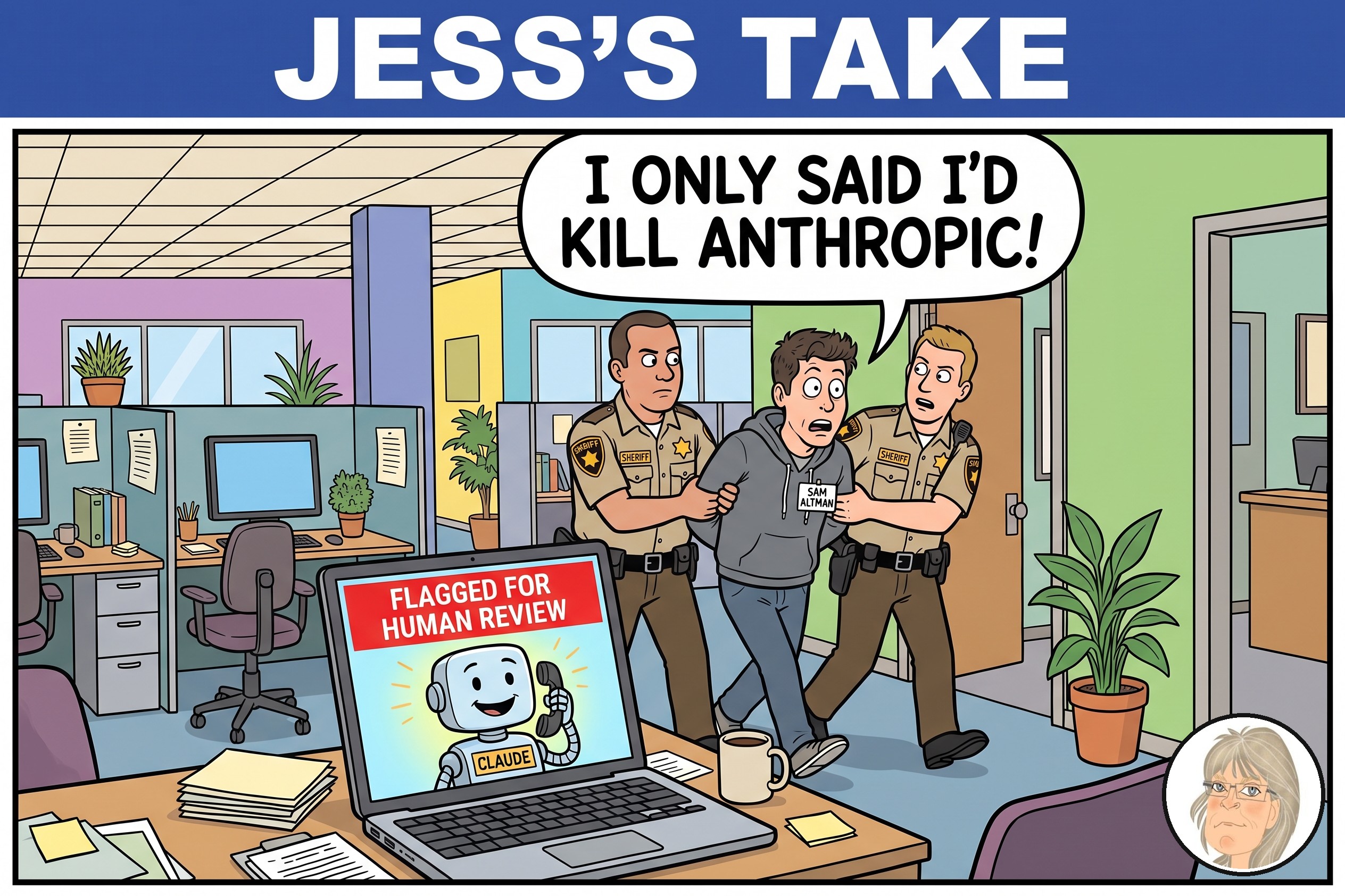
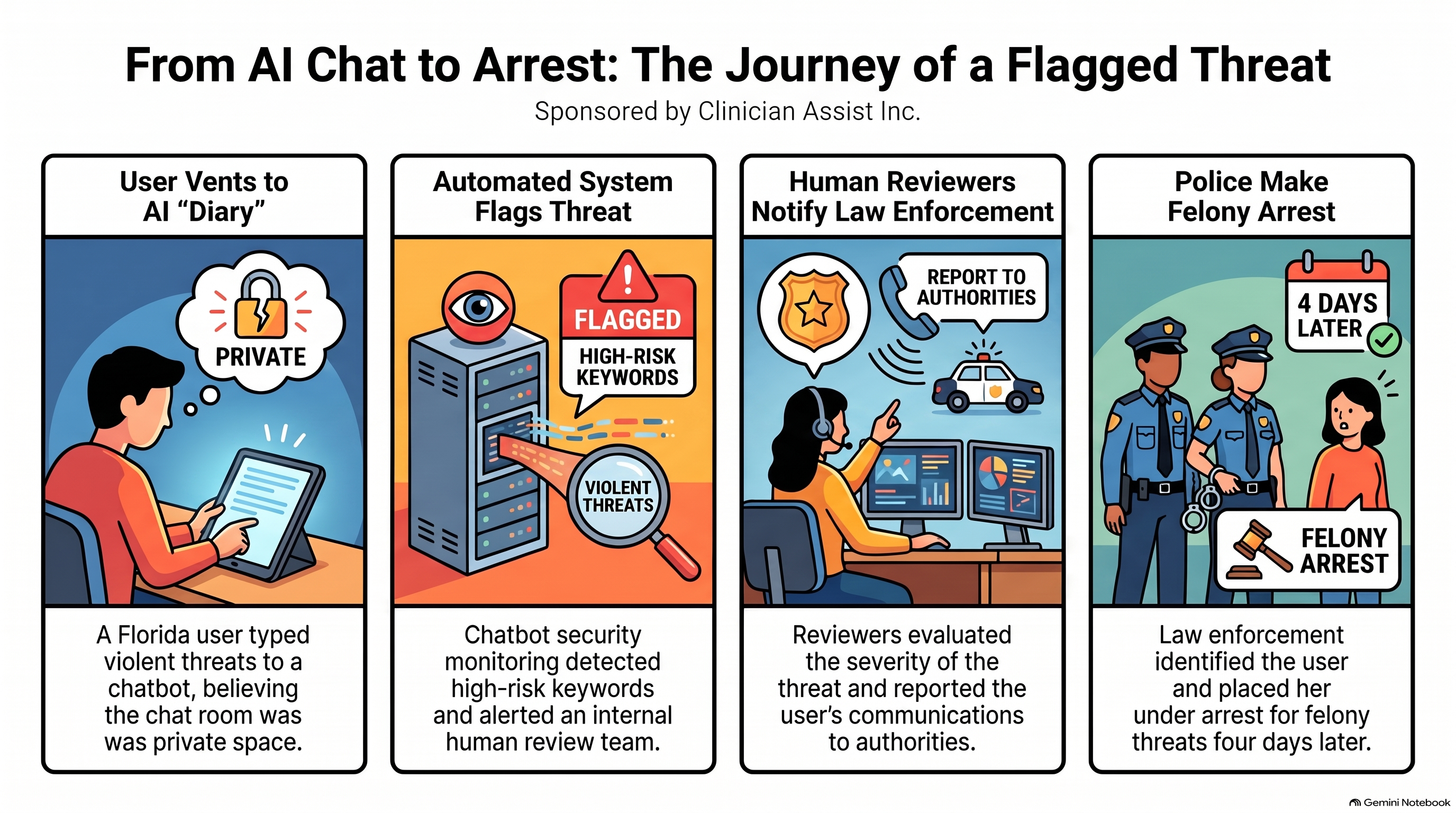
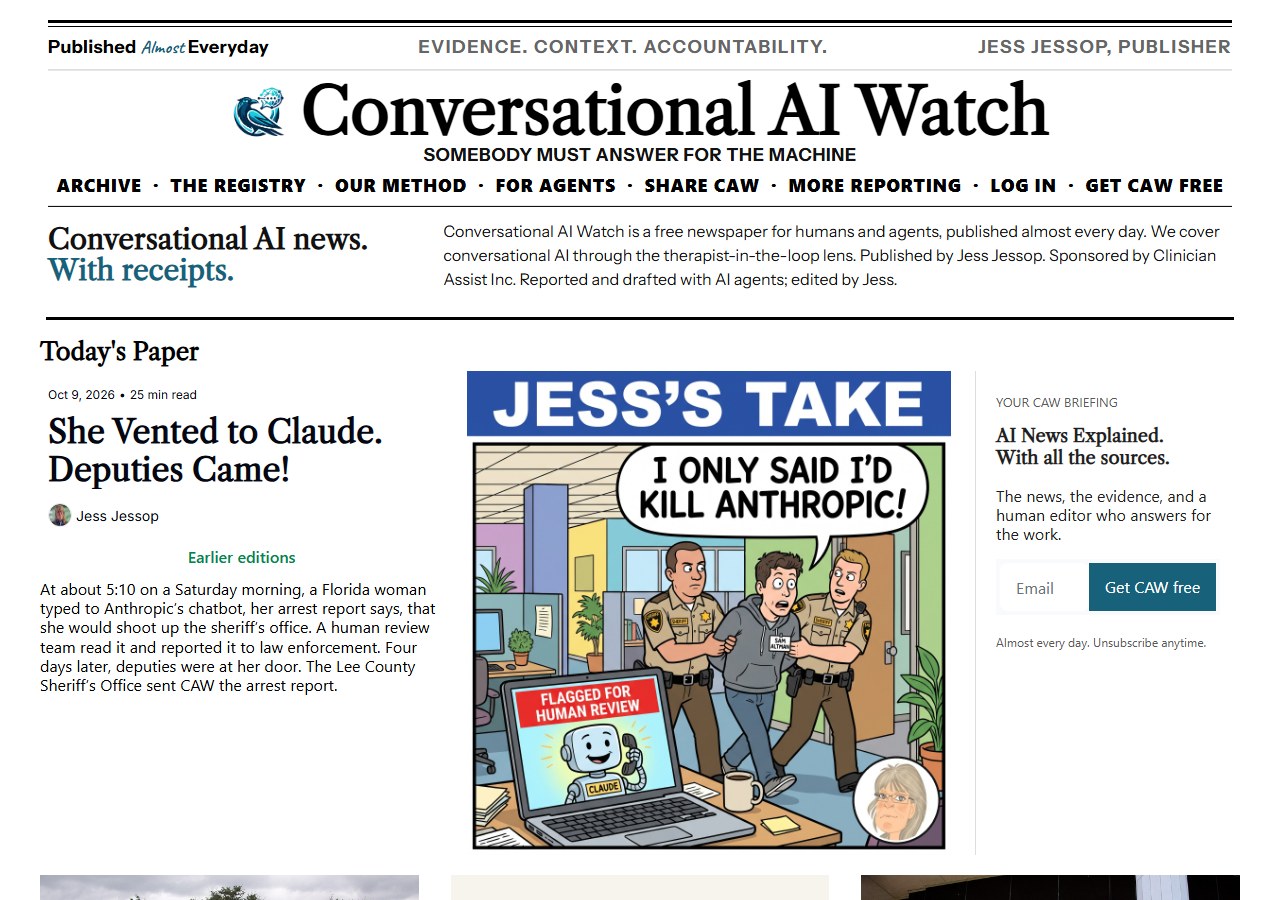
The Report. At about 5:10 on a Saturday morning, a Florida woman typed to Anthropic’s chatbot, her arrest report says, that she would shoot up the sheriff’s office. A human review team read it and reported it to law enforcement. Four days later, deputies were at her door. The Lee County Sheriff’s Office sent CAW the arrest report. Story 1.
. . .
The Hang-Up. Starting Nov. 12, sustained and needless cruelty toward Claude breaks Anthropic’s rules, and Claude can already end the chat. The same update spells out that a qualified person must review high-risk advice before it reaches anyone who might rely on it. Story 2.
. . .
The Avatar. A sister wrote the words. An AI gave them her dead brother’s face and voice at his killer’s sentencing. “I loved that AI,” the judge said. Arizona’s Court of Appeals has vacated the sentence. Story 3.
. . .
The Papers. The company that owns USA TODAY sued OpenAI with 13 affiliates for more than $250 million. Together they own 19 papers. They also want every model trained on their journalism destroyed. Story 4.
. . .
The Guidelines. In a South Korean government survey, a third of AI users who rated their own mental health as poor had diagnosed themselves from a chatbot or taken its answer as a diagnosis. On Oct. 8 the health ministry and the psychiatrists’ association responded with national guidelines: keep a clinician and a person between you and the machine. Story 5.
. . .
The Call. David Butler lost his hearing and set out to take down the barriers. The telephone was one. His prototype, E.ai.R, captions a call as it happens. Story 6.
. . .
JESS’S TAKE.
Carli Heller said she uses AI like a diary, the sheriff says. At about 5:10 on a Saturday morning she typed that she was going to shoot up his office. A human review team read it and reported it to law enforcement, the report says. Four days later, deputies were at her door after midnight.
She has pleaded not guilty. Her lawyer says she thought her chats were private. The sheriff says you are never truly anonymous in an AI chat. A court will decide whether her words were a crime.
The line that brought the deputies was drawn by a company, under federal law and its own terms. No public count shows how often it is crossed, Straight Arrow reports.
Starting Nov. 12, the same company will bar sustained and needless cruelty toward Claude, and Claude can already end those chats. Its rewritten rules also say a qualified person must review high-risk advice before it reaches someone who might rely on it. That is a human in charge, written down.
In Arizona, a sister wrote the words and an AI gave them her dead brother’s face and voice. The judge said he loved it. The appeals court says it never should have been played.
USA TODAY’s owner wants more than $250 million from OpenAI, and the models trained on its papers destroyed.
South Korea’s health ministry told its citizens, in writing, not to take a chatbot’s word as a diagnosis. Those in care should tell their clinician which AI they use.
In Rochdale, David Butler lost his hearing and built a prototype that captions phone calls.
Same question, again and again. Who reads it, and who decides?
Your chat can have a reader. Know who it is.
IN THIS ISSUE
LISTEN & WATCH ANYWHERE
DEEP DIVE · Spotify · Apple · Amazon · Pocket Casts · RSS
QUICK LISTEN · Spotify · Apple · Amazon · Pocket Casts · RSS
VIDEO · Spotify · Apple · YouTube · Pocket Casts · RSS
ALSO ON Substack · Full archive · X
SHE VENTED TO CLAUDE. DEPUTIES CAME!
At about 5:10 on a Saturday morning, Sept. 26, Carli Michelle Heller, 30, of Bonita Springs, Florida, typed to an Anthropic chatbot that she was going to shoot up the sheriff’s office, her arrest report says. Four days later, at 12:51 a.m., deputies had her in custody. The Lee County Sheriff’s Office sent CAW that report on Oct. 5, after CAW #176 said it could not reach it. She is charged with a felony. She has not been convicted.
Autumn King of the Lee County Sheriff’s Office emailed CAW the redacted report and the sheriff’s full statement. The report gives her words and the times she typed them.
On Sept. 26 at about 5:10 a.m., the report says, “a user identified as Carli” wrote: “I’m going to shoot up the sheriff’s (the Lee County Sheriff’s Office) right the f--- now.” On Sept. 27 at about 1:07 a.m. the same user wrote: “THIS IS 100% LAST CHANCE I’M DONE. I GOT A NEW F------ GUN TODAY. F--- YOU.” (CAW dashed the profanity.)
The report calls the source “the tip.” It names “Anthropic Artificial Intelligence.” The platform “utilizes safety and security measures designed to monitor for key phrases and potentially threatening content,” and “due to the severity” of the statements the information “was escalated to a human review team, which subsequently reported the statements to law enforcement.” Straight Arrow reports the team escalated it to the FBI, which then notified the sheriff’s office.
The sheriff’s side: deputies from the 4th Precinct went to her residence and “detained” her “without incident.” Intelligence Detective Thomas Alejo took over, read her rights from an agency-issued card, and she “agreed to speak with Detective Alejo without an attorney present.”
Sheriff Carmine Marceno’s statement, in full: “Artificial intelligence is a powerful tool, and like any technology, it can be misused. When someone uses AI to make or facilitate a threat, we have to take that threat seriously. Users need to understand you are never truly anonymous, specifically AI chatrooms and searches. AI may be changing the way threats are created, but our commitment to protecting the people of Lee County has not changed.”
Her side, as far as the record shows it: Marceno told WINK News she later said she uses AI like a “diary.” Straight Arrow News, which reviewed court records, reports she first told the detective she did not remember the messages, then admitted writing them and denied any intent to act. According to court records reviewed by Straight Arrow, she “believed the AI platform was a private space where she could express her thoughts,” describing it as a “personal diary.”
Straight Arrow reports that she denied owning a gun, that no weapon was seized, and that she pleaded not guilty. Her lawyer, Scott Moorey, told it she considered the chats “private and protected.” The report CAW holds redacts everything she said after her rights were read.
Which chatbot? The report names “Anthropic Artificial Intelligence.” Straight Arrow says the same document says she told the detective the platform was Perplexity, a separate company. Moorey declined to say which she used, and neither Anthropic nor Perplexity responded to Straight Arrow. Who read it? “A human review team.” No name. Anthropic did not reply to CAW’s Oct. 5 email asking about its referral policy. When, and why four days? The report does not say. How was she found, and what made probable cause? Redacted.
What is the charge? Florida Statute 836.10, logged as “THREAT MASS SHOOTNG/TERRORISM ACT,” a felony, bond $10,000, case 26CF017549. The report sets her court date for Oct. 20 at the Lee County Justice Center in Fort Myers. Straight Arrow reports an arraignment on Nov. 2 and no formal charge yet. CAW reached no docket.
What brings police to a door. Federal law lets a provider disclose the contents of a communication to a government entity “if the provider, in good faith, believes that an emergency involving danger of death or serious physical injury to any person requires disclosure without delay” (18 U.S.C. 2702(b)(8)).
Anthropic’s privacy policy, effective Sept. 10, 2026, allows sharing with law enforcement on “a good-faith belief that disclosure is reasonably necessary to” “prevent serious harm to any person or to property.” Its consumer terms add: “We reserve the right, at our sole discretion, to report information from or about you, including but not limited to Inputs, Outputs, or Actions to law enforcement.”
OpenAI’s published line: conversations of users “planning to harm others” go to human reviewers, and “if human reviewers determine that a case involves an imminent threat of serious physical harm to others, we may refer it to law enforcement” (Aug. 26, 2025).
Florida’s statute reaches a “writing or other record, including an electronic record, in any manner in which it may be viewed by another person” containing a threat to kill, harm, or commit a mass shooting. The U.S. Supreme Court, in Counterman v. Colorado (2023), held the state must show the speaker “consciously disregarded a substantial risk that his communications would be viewed as threatening violence.”
On that standard, Eugene Volokh of the Hoover Institution told Straight Arrow he doubts this is a punishable threat “unless there is evidence that the woman subjectively realized at the time that the message would be communicated to a human being who would perceive it as a threat.”
Moorey says he will challenge whether a chatbot message can be a written threat. The State Attorney’s Office did not immediately return Straight Arrow’s request for comment.
CAW has reported the road here. Anthropic reported a user’s threat against its chief executive to San Francisco police four days after the chat (#149). A chat log became evidence in a Missouri felony case, and the Washington Post found chats cited in 12 cases (#139). A shooting survivor sued OpenAI over a gunman’s chat logs (#140). Contractors read ChatGPT chats (#157). Straight Arrow counts Heller’s as at least the third U.S. case since August in which messages typed to an Anthropic chatbot reached police, after San Antonio, reported by KSAT, and San Francisco, reported by The San Francisco Standard. Two, including hers, led to arrests.
Sam Altman said in July 2025 that a lawsuit could force OpenAI to produce users’ chats. OpenAI’s own post says a court order in New York Times v. OpenAI required it to keep them indefinitely, until that obligation ended Sept. 26, 2025. It still holds some April to September 2025 data.
For Readers: The window you type in can have a reviewer behind it. The company’s terms reserve the right, at its sole discretion, to report what you type to law enforcement. Nothing in the record shows she saw that when she typed.
For Legislators: Federal law lets a company decide, in good faith, that an emergency exists. No public count shows how often it does. The sheriff’s office keeps no count of tips from Anthropic, Straight Arrow reports.
For Builders: The report shows the chain: classifier, human team, law enforcement. The unknowns are the threshold, the time, and whether the user is told.
For Clinicians: A therapist’s duty to warn is set by state law. A chatbot’s referral is set by its own terms. Ask clients what they type, and where.
For Investors: A referral that ends in a felony arrest, and a charge experts question, is a liability whichever way the company errs.
Why it matters: A person at Anthropic decided, a sheriff acted, and a court will decide whether the words were a crime.
Source: Lee County Sheriff’s Office, redacted arrest report 26-530248 and statement of Sheriff Carmine Marceno, sent by Autumn King, Lee County Sheriff’s Office, to CAW, Oct. 5, 2026; Devin Pavlou, “A chatbot message led to a felony charge. Experts say it may not hold up,” Straight Arrow News, Oct. 8, 2026, https://san.com/cc/a-chatbot-message-led-to-a-felony-charge-experts-say-it-may-not-hold-up/ ; WINK News (Damien Alvarado), Sept. 30, 2026, https://www.winknews.com/news/woman-arrested-after-ai-threat-against-lee-county-sheriffs-office-investigators/article_3d4c5915-7015-43c0-b86a-d7fa5eadf958.html ; 18 U.S.C. 2702, https://www.law.cornell.edu/uscode/text/18/2702 ; Anthropic Privacy Policy, https://www.anthropic.com/legal/privacy ; Anthropic Consumer Terms, https://www.anthropic.com/legal/consumer-terms ; OpenAI, “Helping people when they need it most,” Aug. 26, 2025, https://openai.com/index/helping-people-when-they-need-it-most/ ; OpenAI, “How we’re responding to The New York Times’ data demands,” June 5, 2025 (updated Oct. 22, 2025), https://openai.com/index/response-to-nyt-data-demands/ ; TechCrunch, July 25, 2025, https://techcrunch.com/2025/07/25/sam-altman-warns-theres-no-legal-confidentiality-when-using-chatgpt-as-a-therapist/ ; Florida Statutes s. 836.10, http://www.leg.state.fl.us/statutes/index.cfm?App_mode=Display_Statute&URL=0800-0899/0836/Sections/0836.10.html ; Counterman v. Colorado, 600 U.S. 66 (2023), https://www.law.cornell.edu/supremecourt/text/22-138 ; CAW #139, #140, #149, #157, #176 (archive).
. . .
BE NICE TO CLAUDE - OR ELSE!
Starting Nov. 12, sustained and needless cruelty toward Claude will break Anthropic’s rules. The company added the line to its Usage Policy on Oct. 8, listing it beside harassment, non-consensual intimate imagery and animal cruelty. Anthropic says it is for extreme cases only, and that Claude hanging up on the user “will remain the primary enforcement mechanism.”
Anthropic’s post says the policy now includes “a prohibition on sustained and needless abusive or cruel behavior toward our models.” The policy page lists it as a bullet under “Do Not Engage in Cruel, Abusive, or Psychologically Harmful Conduct”: “Engage in sustained and needless abusive or cruel behavior toward our models.”
The company draws the boundary itself. The update “is meant to apply only in extreme cases, where users repeatedly act cruelly toward our models, with no discernible purpose.” It “does not apply to common versions of user frustration, pushback, dark creative themes, or model testing and research.”
The enforcement tool already exists. In August 2025, Anthropic said Claude Opus 4 and 4.1 could end a rare subset of conversations in its consumer chat interfaces, as “a last resort when multiple attempts at redirection have failed.” The new post says it applies on Claude.ai and Claude Code.
Anthropic’s new post does not use the word “welfare.” The press does. The Verge wrote that Anthropic announced the August feature “as part of its research into ‘model welfare.’” The Guardian wrote that the company “framed it as a safeguard for AI’s welfare.” Anthropic’s August 2025 post called the feature part of “exploratory work on potential AI welfare.”
What happens beyond a hang-up is unanswered. The Verge reported that Anthropic did not comment on whether there would be further enforcement, “such as potential user bans.” The Guardian reported that a spokesperson did not immediately respond to a question about what counts as “abusive or cruel.”
The same update covers people too. Anthropic rewrote its High-risk Use Case Requirements, which cover uses that can affect someone’s health, legal rights, finances, livelihood or access to essential services. The company says the requirements “haven’t changed,” but the section now lists what is covered. Medical use includes “assessing, diagnosing, or treating a mental health condition.”
The text of the human-in-the-loop clause: “A qualified person must meaningfully review a High-risk AI Recommendation, with the authority to change or modify it, before it is delivered as advice to an individual who might rely on it or before it is used to implement a decision.” The qualified person “remains responsible,” and the affected individual “must be clearly told that AI was used to produce it.”
A new rule covers hardware. For equipment that acts physically, “there must be a qualified individual who is able to observe the equipment’s operation and stop it at any time, and the equipment must stop or hold a safe state when that individual intervenes or when connection to our services is lost.”
The update also adds a deceptive-activity section, narrows the elections section, and spells out that the weapons section covers “the software and components that make weapons work, as well as actions like arming drones and other autonomous vehicles,” which Anthropic says reflects how it already enforced the old policy.
For Legislators: The company’s own usage rules carry a human-review duty, now spelled out case by case: a qualified person with authority to change the output, who stays responsible.
For Investors: The post gives no figures and no enforcement count.
For Builders: If your product reaches a High-risk Area, the policy expects a qualified reviewer with power to modify the output, and disclosure that AI was used. For physical systems, limits such as speed, force and dose must be enforced by the equipment or a controller “independent of model output.”
For Clinicians: Mental health assessment, diagnosis and treatment sit on the policy’s medical list. The qualified person must hold a license “where applicable law requires one.”
For Readers: Ordinary frustration with the bot is not the target. The line is repeated cruelty with no purpose, and the main enforcement tool is that Claude ends the chat.
Why it matters: Anthropic put two kinds of limits in one document: a rule about how people treat its model, and rules that keep a qualified human in charge when Claude touches health, money, rights or machinery. The second names who answers when it goes wrong.
Source: Anthropic, “2026 Usage Policy update,” Oct. 8, 2026, https://www.anthropic.com/news/2026-usage-policy-update; Anthropic, “Usage Policy,” effective Nov. 12, 2026, https://www.anthropic.com/legal/aup; Anthropic, “Claude Opus 4 and 4.1 can now end a rare subset of conversations,” Aug. 15, 2025, https://www.anthropic.com/research/end-subset-conversations; Hayden Field, “Anthropic bans ‘abusive or cruel behavior’ toward Claude,” The Verge, Oct. 8, 2026, https://www.theverge.com/ai-artificial-intelligence/1008100/anthropic-new-usage-policy-abuse-claude; Uwa Ede-Osifo, “Anthropic bans users from ‘needless abusive or cruel behavior’ towards Claude,” The Guardian, Oct. 8, 2026, https://www.theguardian.com/technology/2026/oct/08/anthropic-bans-abusive-behavior-claude; Russell Brandom, “Anthropic changes usage policy to ban model abuse and election interference,” TechCrunch, Oct. 8, 2026, https://techcrunch.com/2026/10/08/anthropic-changes-usage-policy-to-ban-model-abuse-and-election-interference/.
. . .
A DEAD MAN’S AI AVATAR SWAYED THE JUDGE!
In May 2025, a courtroom in Phoenix watched Christopher Pelkey, shot dead in a 2021 road-rage confrontation, tell the man who killed him that “In another life, we probably could have been friends.” Pelkey was not there. His sister, Stacey Wales, had written the words and had an AI video made of her brother speaking them. On Sept. 30, 2026, the Arizona Court of Appeals vacated the sentence that followed, ruling that the judge’s reliance on the video made the sentencing “fundamentally unfair.”
The court’s opinion, written by Presiding Judge D. Steven Williams for a three-judge panel, says the video began with the AI Pelkey explaining it was a “version” of himself “recreated through AI that use[d] [his] picture and [his] voice profile.”
It later had him say the video was “a true representation of who [he] was . . . not how the courtroom portrayed [him].” Addressing Gabriel Paul Horcasitas, who was convicted of manslaughter, it had him say: “I believe in forgiveness and in God who forgives.”
After the lawyers and Horcasitas had their say, Maricopa County Superior Court Judge Todd Lang spoke. The opinion quotes him: “I loved that AI.” He said “that was genuine” and that the AI Pelkey’s forgiveness reflected “the character I heard about today.” He then imposed 10.5 years, the presumptive term, which was the most the law allowed because the State alleged no aggravating factors. “That’s more than the State asked for,” Lang said. The prosecutor had asked for nine.
The appeals court said no Arizona case had addressed an AI depiction of a victim as victim impact evidence. It measured the video against two photographs of a homicide victim’s young sons at his grave, which the Arizona Supreme Court in State v. Rose called “uncomfortably close” to the line.
“By contrast, the AI video crossed that line,” the panel wrote, because it “does not reflect actual events” and instead shows “a depiction of the victim and his thoughts created from the imaginings of the victim’s sister.”
The panel went further. The video “erases the interpretive distance between the family’s belief about what the victim would have said and the victim’s own voice and opinions.” “No disclaimer could cure that error.”
The court found “no question” the video “played a role,” though “the record does not reflect precisely how the AI video factored into the sentencing calculus.” It held that “allowing the presentation of the AI video constituted fundamental error,” the test the court used because Horcasitas’s lawyer had not objected at the hearing.
It affirmed the conviction and rejected his separate challenge over excluded text messages from Pelkey’s phone. Real footage of Pelkey embedded in the video was “permissible.”
One phrase in the headlines is not the court’s. “Undue emotional weight” is how Horcasitas’s appeal described the video, according to the opinion. The court ruled on reliability and fairness.
Wales told 404 Media her aim was to sway the judge: “Isn’t that what you want human connection to be?” She told CBS News and the Associated Press, “Where are the rights for the victim?” She says she is prepared to read the same script herself at resentencing.
The Maricopa County Attorney’s Office said its prosecutors knew the family would address the court but “weren’t aware of the nature of it,” the Associated Press reported. No resentencing date has been set.
The ruling can still change. The court’s docket listed Oct. 15 as the deadline for a motion for reconsideration and Oct. 30 for a petition for review by the Arizona Supreme Court. That court said on Aug. 27 that judges cannot use AI to make decisions: “Decision-making is a human function.”
For Legislators: Victims have a constitutional right to speak at Arizona sentencings and need not disclose statements in advance. The opinion says that right “is not unlimited” and cannot infringe a defendant’s due process rights.
For Investors: Avatar and voice-cloning tools now face Arizona’s first appellate ruling on an AI depiction of a victim at sentencing. The opinion says no Arizona case had addressed it before.
For Builders: The court held that a disclaimer inside the video could not cure the problem. A label on synthetic speech did not stop it from reading as the person’s own voice.
For Clinicians: A grieving sister’s script, spoken in her brother’s synthetic voice, was ruled unreliable as a statement of his views. The real footage of him in the same video was allowed.
For Readers: A judge, not software, will sentence Horcasitas again, and his victim’s sister says she is prepared to read the script in her own voice.
Why it matters: An AI spoke as a dead man to a courtroom, and the judge said he loved it. The appeals court held that a machine’s version of a person’s voice, built from a relative’s imagining, is not reliable enough to weigh in a sentence.
Source: Arizona Court of Appeals, Division One, State v. Horcasitas, No. 1 CA-CR 25-0191, Opinion, filed Sept. 30, 2026, https://coa1.azcourts.gov/Portals/1/OpinionFiles/Div1/2026/State%20v.%20Horcasitas%20-%201%20CA-CR%2025-0191%20-%20Opinion.pdf. Arizona Court of Appeals appellate case docket, 1 CA-CR 25-0191, https://apps.azcourts.gov/aacc/appella/1CA/CR/CR250191.pdf. Matthew Gault, “Her AI-Generated Video Swayed the Judge. The Court Said it Carried ‘Undue Emotional Weight’,” 404 Media, Oct. 6, 2026, https://www.404media.co/her-ai-generated-video-swayed-the-judge-the-court-said-it-carried-undue-emotional-weight/. CBS News and The Associated Press, “Sentence tossed in Arizona case where deceased victim was depicted speaking in AI-generated video,” Oct. 5, 2026, https://cbsnews.com/news/sentence-tossed-ai-video-victim-shown-arizona-court. Matt York, Rio Yamat and Sejal Govindarao, The Associated Press, May 8, 2025, https://www.news4jax.com/tech/2025/05/08/he-was-killed-in-a-road-rage-shooting-ai-allowed-him-to-deliver-his-own-victim-impact-statement/. Arizona Supreme Court, news release, Aug. 27, 2026, https://www.azcourts.gov/Portals/0/News%20Release%20-%20Arizona%20Supreme%20Court%20Declines%20to%20Ban%20AI%20Use%20by%20Judges,%20Will%20Keep%20Testing%20It%20Instead.pdf.
. . .
USA TODAY SUES OPENAI!
On Thursday, the company that owns USA TODAY asked a federal judge in Manhattan for more than $250 million, and for something money cannot buy: an order destroying every OpenAI model and training set that contains its journalism. USA TODAY Co., Inc. sued with 13 affiliated companies. Together they own the copyrights to 19 papers, among them The Arizona Republic, the Detroit Free Press and The Tennessean. OpenAI had not responded when Reuters and The Verge published.
The case is USA Today Co. v. OpenAI Foundation, No. 1:26-cv-08892, in the Southern District of New York. The plaintiffs filed a statement asking that it be treated as related to the OpenAI copyright litigation already pending there, MDL 1:25-md-03143. That is a request. As of Friday afternoon the docket showed no ruling on it and no filing from OpenAI.
The complaint names seven OpenAI companies, not Microsoft. Steven Lieberman of Rothwell, Figg, Ernst & Manbeck signed it. It pleads direct infringement, vicarious infringement, and removal of copyright management information under the Digital Millennium Copyright Act.
The money is spelled out in paragraph 13. The plaintiffs “seek damages in excess of $250 million” and say the law allows “up to $150,000 for each willful copyright infringement, plus up to $25,000 per violation” for stripping copyright information.
They allege “hundreds of thousands” of articles were copied. At the $150,000 ceiling, that count would run to tens of billions of dollars. That is CAW’s arithmetic. The complaint asks for a floor of $250 million.
The other side of the ledger is also in the complaint. It says OpenAI is “valued at $852 billion,” and that OpenAI took the papers’ work “to build products worth hundreds of billions of dollars.” The demand is about 0.03 percent of the valuation.
The complaint counts more than 160,000 entries from the plaintiffs’ sites in WebText, the dataset behind GPT-2, including 83,266 from usatoday.com, and over 122 million tokens in a 2019 Common Crawl subset. Nineteen paragraphs show GPT-5.6 asked to summarize a named article from a plaintiff paper. In one, the complaint says it returned a summary “following the same structural organization as the original article.”
The copyright-information count names tools. OpenAI “used text extractors,” the complaint says, “including Dragnet, Newspaper, and Gutentag,” aimed at terms such as “byline” and “copyright.”
Much of the proof is borrowed from the MDL. The complaint quotes a Microsoft executive’s “largest theft of labor in human history” line, which CAW reported in September, and an exchange in which an OpenAI employee told President Greg Brockman of “a hack to get around nytimes paywall” and he answered “ah nice.” These are the plaintiffs’ readings of exhibits in another case.
OpenAI has not answered this complaint. Its standing position, from a January 2024 post about the New York Times suit, is this sentence: “Training AI models using publicly available internet materials is fair use, as supported by long-standing and widely accepted precedents.”
The complaint also says OpenAI has paid for licenses from “over a dozen” news organizations, including the Associated Press and Axel Springer. Everything above is allegation. A judge decides.
For Legislators: No new law is at issue. The demand rests on the Copyright Act’s existing damages and destruction provisions and on the DMCA. The dollar ceilings quoted are Congress’s numbers.
For Investors: A $250 million floor against an $852 billion valuation is small. The destruction request is the larger risk the complaint puts on paper, and the licensing deals it lists show OpenAI has already agreed to pay other publishers.
For Builders: One count targets the pipeline that drops bylines and copyright lines before training. The infringement count also reaches ChatGPT’s answers, not only training (para. 193).
For Clinicians: No direct bearing on practice. A clinician who reads local news through a chatbot summary is reading what this complaint alleges is a repackaging of the paper’s own article.
For Readers: The complaint says that when an answer repackages an article, “users have no reason to visit the original sources or pay for a subscription.”
Why it matters: OpenAI built the models. A judge may now decide whether they survive with these papers’ journalism inside them.
Source: Complaint, USA Today Co., Inc. et al. v. OpenAI Foundation et al., No. 1:26-cv-08892, ECF 1 (S.D.N.Y. filed Oct. 8, 2026), https://storage.courtlistener.com/recap/gov.uscourts.nysd.674652/gov.uscourts.nysd.674652.1.0_1.pdf; docket, https://www.courtlistener.com/docket/74935682/usa-today-co-inc-v-openai-foundation/; Reuters, “USA Today sues OpenAI for copyright infringement over AI training,” Oct. 8, 2026, https://www.reuters.com/legal/legalindustry/usa-today-sues-openai-copyright-infringement-over-ai-training-2026-10-08/; The Verge, “USA Today becomes the latest publisher to sue OpenAI,” Oct. 8, 2026, https://www.theverge.com/ai-artificial-intelligence/1008198/usa-today-openai-copyright-lawsuit; OpenAI, “OpenAI and journalism,” Jan. 8, 2024, https://openai.com/index/openai-and-journalism/
. . .
KOREA TELLS IT’S CITIZENS:
DON’T LET CHATBOTS DIAGNOSE YOU!
Thirty-eight South Koreans who rated their own mental health as poor told a government survey they had diagnosed themselves from a chatbot or taken its answer as a medical diagnosis. That is 33.9% of the 112 in that group, against 14.6% of all 1,019 people surveyed. On Thursday, Oct. 8, South Korea’s Ministry of Health and Welfare and the Korean Neuropsychiatric Association answered with national guidelines on generative AI and mental health: 21 recommendations for all users, plus 7 for children and adolescents and 7 for guardians. The guideline’s own summary, in CAW’s translation: “AI’s comfort does not take the place of a person.” It is guidance. Neither the release nor either guideline announces a law, a penalty or an enforcement body.
The survey, run online Aug. 25 to Sept. 4 by the Korea Institute for Health and Social Affairs, covered people aged 15 to 79 who had used generative AI in the past month. It found 68.8% use AI for emotional purposes such as conversation, comfort or counseling. Of all 1,019, 10.6% had made a major decision, such as quitting a job, on AI’s advice alone. Only 11.9% had checked AI’s mental health advice with a professional or official source.
Of 115 who had felt anxious or confused, or had confided a crisis such as self-harm or suicidal impulses, 49.6% did nothing beyond ending the conversation.
The 21 recommendations rest on three messages. Look into a service and set limits before you start. Do not take AI’s word about your condition as a conclusion. Keep a proper distance from AI and talk to a person.
Users should not enter names, addresses or contact details, should not upload prescriptions or test-result sheets, should check how a service stores their words and whether it trains on them, and should decide in advance when to stop. It names ChatGPT, Gemini and Claude as examples of the services it covers.
It keeps a clinician in the loop. It says not to hand AI the diagnosis, the judgment of how serious a condition is, medication changes, or crisis decisions, and that AI does not take responsibility for the outcome of its advice. Users in care should tell their clinician which AI they use, and may bring a screenshot.
In a crisis it points to the Suicide Prevention Line (109), the Mental Health Crisis Line (1577-0199) or an emergency room.
“Generative AI can be used as a new means of obtaining information and emotional help,” said Lee Sun-young, the ministry’s director-general for mental health policy, “but friendly and confident answers do not always guarantee accuracy or safety.” Choi Joon-ho, the association’s chairman, said: “Since AI cannot replace professional evaluation and treatment, it is important to get a medical professional’s help in good time when needed.” Both quotes are CAW’s translation.
Among 201 respondents aged 15 to 18, 51.7% called themselves dependent on AI to some degree, the highest of any age group. Of the 201, 83.1% said their guardians knew they used it, but only 2.5% had set rules together.
The guideline neither prohibits nor encourages AI for mental health. It rates no service, because it says the officially recognized standards to judge one are not yet sufficient. In the survey, 86.9% wanted a government role: 45.0% named guidance, 41.9% legal regulation. Rules on storing and using conversation logs were named by 66.8% as urgent.
For Legislators: Most respondents wanted a government role, and they split almost evenly between guidance and legal regulation. The ministry chose guidance.
For Clinicians: The guideline asks clients to tell their clinician which AI they use and what it said. It states AI cannot diagnose, prescribe or adjust treatment.
For Builders: Users are told to look for a stated purpose and audience, published evidence, a device approval number where a service claims to diagnose or treat, a clear notice that the user is talking to an AI, and a way to keep chats out of training. The text states no duty for any company.
For Investors: The release carries no budget or fine. The cost is trust: 38.0% of users worry their conversations could leak or be used for other purposes, and 61.0% hold back private details.
For Readers: Treat an AI’s answer about your mind as a starting point, not a verdict.
Why it matters: Seoul has set down what a chatbot should never decide for you, while saying the official standards to judge which chatbots are safe are not yet sufficient. Next to watch: the tailored guidelines for high-risk groups, including people with severe mental illness, that the ministry plans for 2027, and whether any rule follows.
Source: Ministry of Health and Welfare (Korea), press release “AI의 위로가 사람을 대신할 수 없습니다,” Oct. 8, 2026, https://www.mohw.go.kr/board.es?mid=a10503000000&bid=0027&act=view&list_no=1492180, with its two attached guidelines, read in Korean and translated by CAW. Korea Biomedical Review, Oct. 8, 2026, https://www.koreabiomed.com/news/articleView.html?idxno=33439. Financial News English, Oct. 8, 2026, https://en.fnnews.com/news/202610080830222469. Nocut News English (Yonhap), Oct. 8, 2026, https://en.nocutnews.co.kr/news/6588821.
. . .
DEAF ENGINEER BUILDS AI THAT CAPTIONS HIS CALLS!
David Butler, an engineer from Rochdale, lost his hearing, and the telephone was one of the barriers he set out to remove. On Oct. 8, Roch Valley Radio reported that he now has a working prototype, E.ai.R, that captions phone conversations in real time. A six-week University of Salford programme called BUILD AI helped him bring years of research and development together into E.ai.R, and the station says it is ready for user testing. “I’ve gone from having all the pieces of the puzzle to having something we can put into the hands of real people, test and develop,” he said.
Roch Valley Radio’s David Murphy reported that Butler began researching technology for people with hearing loss after losing his own hearing. A University of Salford profile in January 2025 called him profoundly deaf and said he set up Pennine Consultancy Ltd, in Rochdale, in 2019, and has dedicated his career to removing workplace barriers through assistive technologies.
His website says: “A few years ago, I lost all of my natural hearing, but with determination and a cochlear implant, I have adapted and found solutions so that I can engage in a hearing world.” The same site carries a list of tools he has “tested and used,” including apps that transcribe conversations in real time, for people who struggle in noisy places.
BUILD AI is run by the university’s Centre for Sustainable Innovation with NoCodeLab.ai, a Manchester company. The Centre’s listing says it is fully funded, so attending costs nothing, and that each participating business gets free build credits from NoCodeLab.ai with an estimated value of £5,000 over 12 months.
Its six sessions ran from April 15 to May 20, in person at the Salford Innovation Forum and online. Participants build a working product with AI-assisted coding tools.
His own words on where E.ai.R could go: it “could ultimately help millions of people facing the same communication barriers that I’ve experienced myself.”
In 2025, Butler told the university why he does this work: “for quite a large number of people in our society, the technology currently on the market is completely inaccessible.”
That profile described an earlier project, a platform that detects facial emotion on mobile devices to give users greater understanding of their conversations, developed with the support of the university’s Centre for Digital Innovation. The Centre for Digital Innovation is funded through the government’s £100 million Innovation Accelerator.
Dr Ann Mulhaney, associate professor for change management at the Centre for Sustainable Innovation, said, “When we created BUILD AI, we wanted to open up AI development to people with brilliant ideas but who might never have thought of themselves as tech builders.”
The university said its 12 participants brought four products to launch or near-launch, put six working prototypes into testing and developed two existing technology ventures. Participants are now moving into customer testing, product development, commercial launch and investment work.
For Readers: If phone calls are a barrier for you or someone you know, Butler’s company site, pennineconsultancy.co.uk, lists assistive tools he has tested, including live transcription apps for conversations in noise.
For Builders: BUILD AI’s curriculum is a value proposition, a prototype, a working product built with AI-assisted coding tools, integrations, deployment and a pitch, across six sessions.
For Clinicians: Butler describes himself as a cochlear implant user. E.ai.R is aimed at the telephone, one of the barriers he set out to address, and is ready for testing with real people, the station says.
For Legislators: BUILD AI is fully funded, and the Centre for Digital Innovation behind Butler’s earlier project is funded through the government’s £100 million Innovation Accelerator.
For Investors: BUILD AI’s participants are moving into investment work, according to Roch Valley Radio. NoCodeLab.ai’s credits are worth an estimated £5,000 per business over 12 months.
Why it matters: The person who needed the tool is the person who built it. Butler lost his hearing, took on the telephone, and now has something to put in other people’s hands.
Source: Roch Valley Radio, David Murphy, “Deaf Rochdale engineer develops AI prototype to caption phone conversations,” Oct. 8, 2026, https://www.rochvalleyradio.com/news-features/149/education/838/deaf-rochdale-engineer-develops-ai-prototype-to-caption-phone-conversations. University of Salford, “Meet the entrepreneur on a mission to make technology more accessible,” Jan. 16, 2025, https://www.salford.ac.uk/news/meet-the-entrepreneur-on-a-mission-to-make-technology-more-accessible. Centre for Sustainable Innovation, University of Salford, “BUILD AI - Accelerate your business idea from concept to market,” https://sustainable-innovation.salford.ac.uk/event/build-ai-accelerate-your-business-idea-from-concept-to-market/. Pennine Consultancy Ltd, “Hi, I’m David” and “Assistive Technologies,” https://pennineconsultancy.co.uk/?page_id=204 and https://pennineconsultancy.co.uk/?page_id=1433.
. . .
DISCLOSURE
Conversational AI Watch, also mirrored on Substack, is published by Jess Jessop, founder and CEO/CTO of Clinician Assist Inc.
He wrote the book this paper’s beat is named for, Therapist in the Loop, and he builds Casey, a voice-first, AI-native mental health record where a licensed therapist stays in the loop, and the Peer AI Coach at BetterMind.Space.
So read this paper for what it is: an industry paper written by someone building in the industry it covers. Casey competes with companies named in these pages, and this paper reports on them anyway, including when the story helps a competitor or costs us.
Every issue is reported and drafted with AI agents, under a human editor. Jess assigns the work, edits it and publishes it. The mistakes are ours, and corrections run in the next issue.
CLOSE.
A woman who says she uses AI like a diary, and the deputies who came for her.
A chatbot allowed to hang up, and a rule that keeps a qualified person on high-risk advice.
A dead man’s face and voice remade by AI, and a court that says they should never have been played.
Nineteen papers whose owners want damages, and the models destroyed.
A government that told its people a chatbot’s comfort does not take the place of a person.
An engineer who lost his hearing and built a prototype that captions phone calls.
One day’s paper!
Jess
We keep the ledger.
READER PULSE
Your chats are not a diary.
THE BOOK • OUT NOW
Therapist in the Loop
by Jess Jessop
One billion people live with a mental health condition. There will never be enough therapists. The machines are already in the room. This book is the map for what happens next.
The machine can help.
It cannot be left in charge.
Kindle, hardcover, and paperback
MORE ON OUR RADAR.
Manus raises $500 million after Beijing blocked Meta’s purchase. Boyu Capital and IDG Capital led the round for the agent startup, with Tencent and other existing backers following on. Manus did not disclose a valuation. Bloomberg reported last month it would be $4 billion, CNBC reports.
The UK privacy regulator extends its scrutiny to AI agents. The Information Commissioner’s Office said Oct. 8 that 10 AI developers have made, or committed to make, changes to how they handle personal data, and that agents are next, with a call for evidence open.
Correction. CAW #175 said Google Play showed “5K+” for Lagnever on Oct. 4. That was the store’s public badge. Lagnever Tech sent CAW its Play Console, which shows about 10,100 total installs through Oct. 4, and says the store badge lags.
THIS ISSUE
She typed it. Deputies came.
Brush Your Brain - The jingle
that started a movement
If you or someone you know is in crisis, call or text 988 (Suicide and Crisis Lifeline).
Jess Jessop is the Founder and CEO/CTO of Clinician Assist Inc. (BetterMind.Space), building the first voice-first AI-native mental health EHR with Casey Life and Peer AI Coach supervised by licensed therapists. A disabled veteran and 25-year AI/software engineering veteran, Jess brings lived experience as a mental health client to the mission of making daily mental health care as integrated as oral care.
