


The news that moves policy, portfolios, and patient safety.
By Jess Jessop | September 27, 2026 | Issue #168
TODAY’S QUESTION
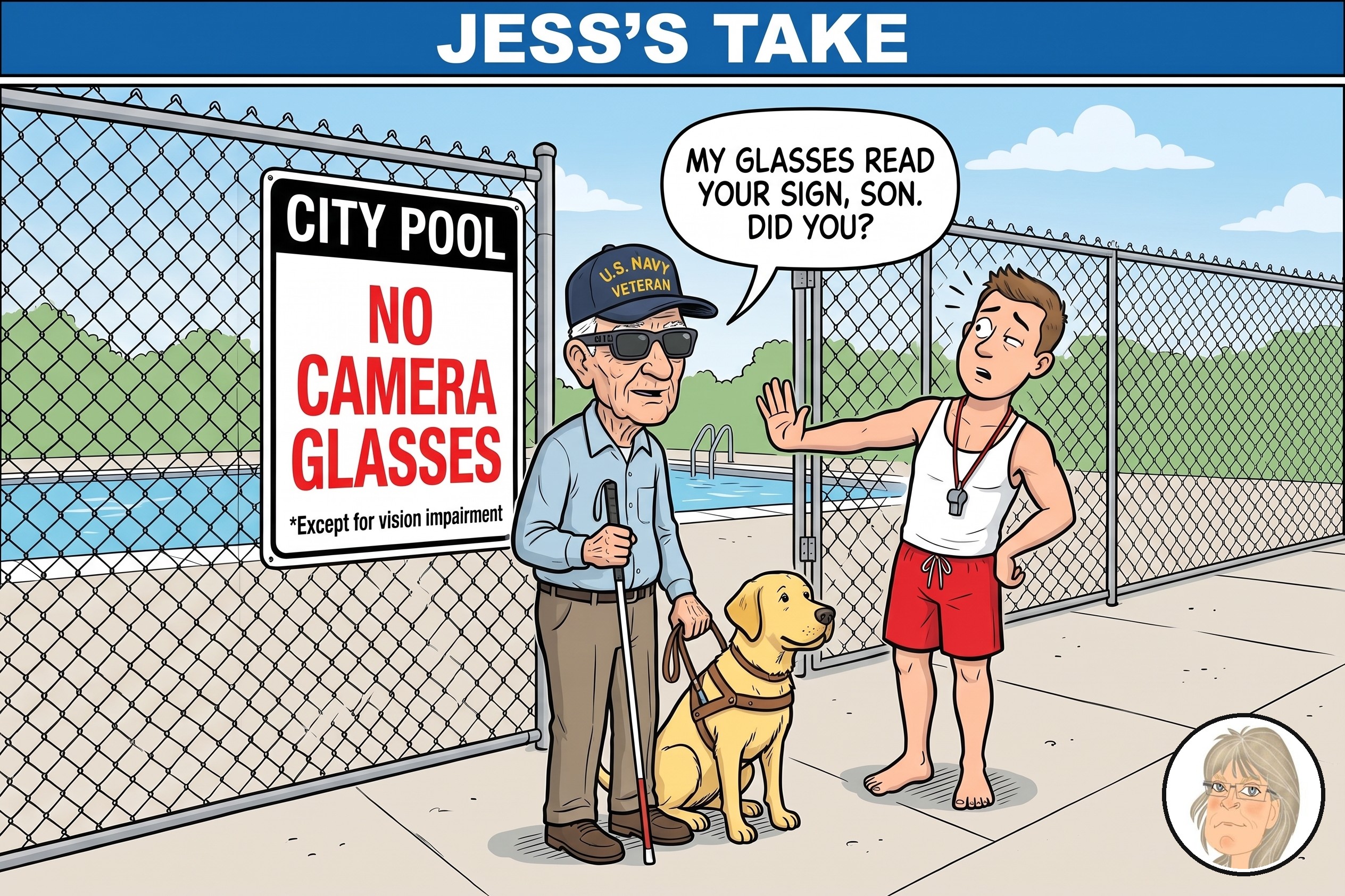
Camera glasses are being barred from pools and schools. Should blind people who use them to read be exempt?
One tap. Results in tomorrow’s issue and on the web.
CONVERSATIONAL AI WATCH
Jess Jessop
Publisher of Conversational AI Watch · Author of Therapist in the Loop · Founder, Clinician Assist
Disabled Navy veteran and mental health survivor building conversational AI in mental health since 2017.
The book, the compliance map, the 988 SAFE Act, the daily archive, and the story behind the beat:
Blind Veterans Get Glasses That Talk!
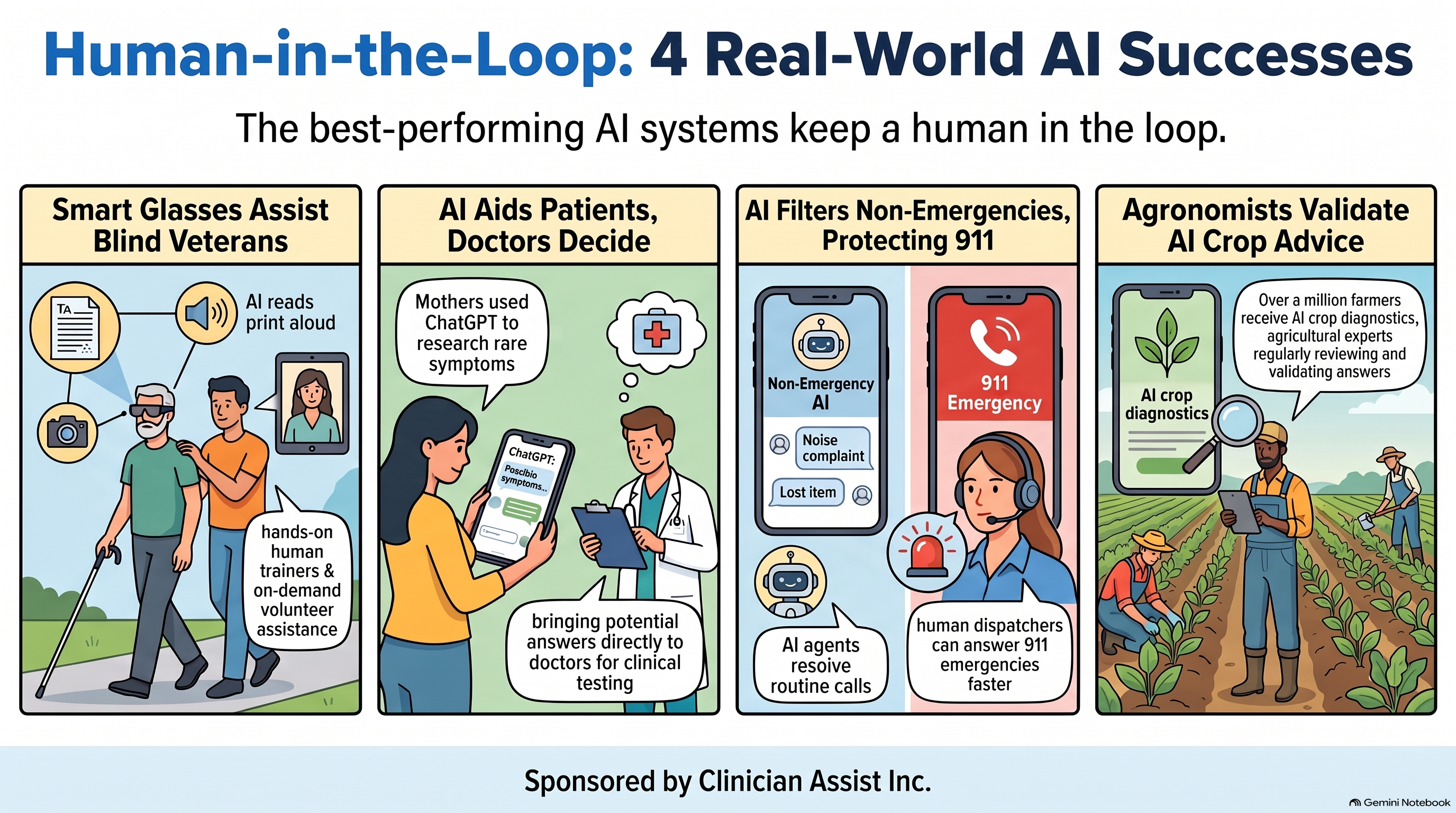
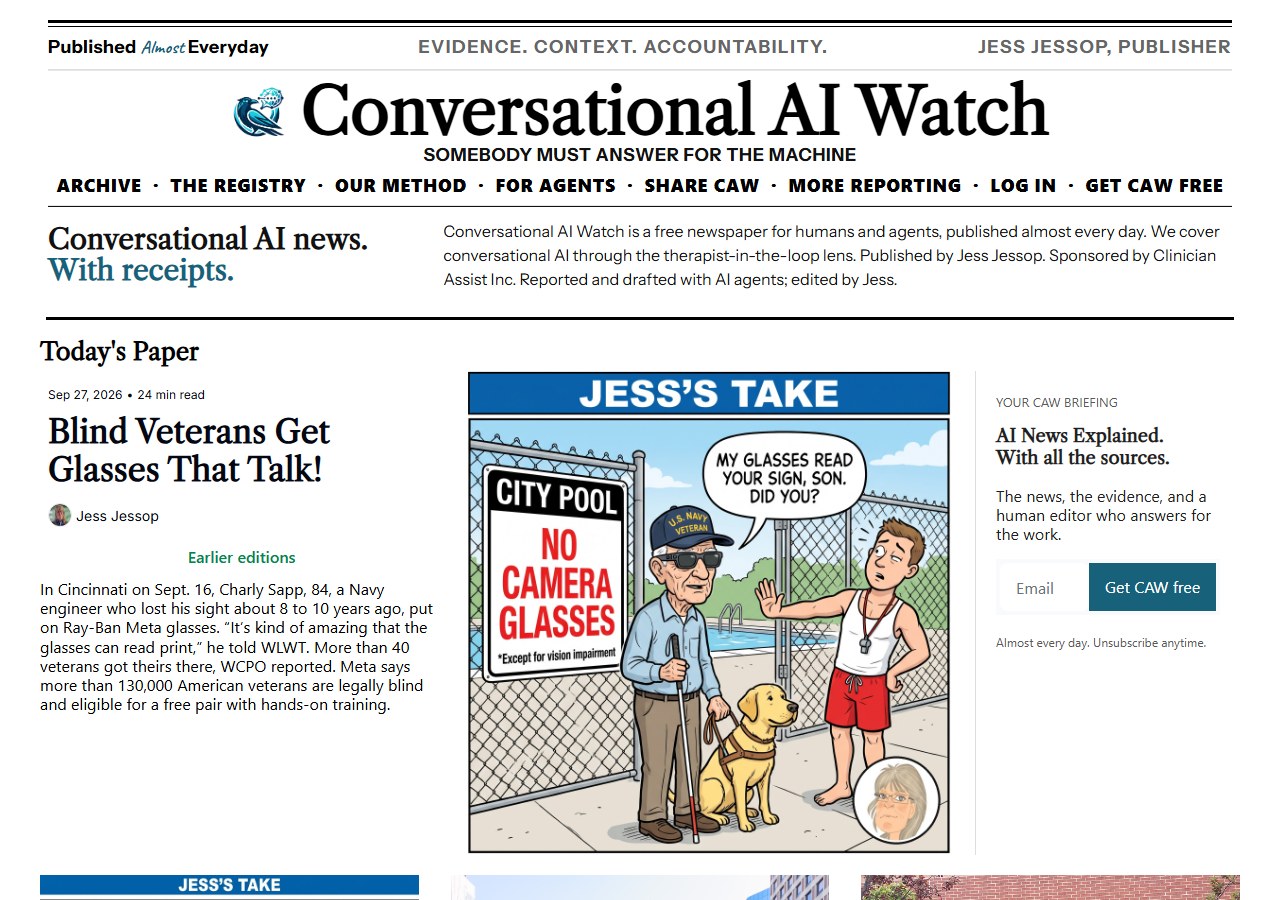
The Glasses. At a distribution event in Cincinnati this month, an 84-year-old Navy veteran put on a pair of free AI glasses. “It’s kind of amazing that the glasses can read print,” he said. In Australia, where camera glasses are being barred from pools and schools, two new bans make room for the blind people who rely on them. Story 1.
. . .
The Mothers. In Massachusetts and in Bath, England, two mothers took a sick daughter’s symptoms to ChatGPT and carried the answers to doctors. The doctors ran the tests that found a rare disease in each child. Story 2.
. . .
The Phone Line. On Tuesday, Colorado Springs put an AI agent on its police non-emergency line. Any caller can ask for a person, police say a human reviews each call it handles, and 911 stays with trained call takers. Story 3.
. . .
The Money. Heidi, whose AI listens to the visit and answers the doctor’s questions, announced $340 million on Tuesday, on annual recurring revenue it says grew from $1 million to $50 million in two years. Most of the new money is not equity. Story 4.
. . .
The Farmers. In India, a free app answers farmers’ crop questions in five languages from government advisories and research, and agronomists regularly review the questions and validate the responses. The nonprofit behind it counts more than a million users. Story 5.
. . .
JESS’S TAKE.
Most days this paper covers machines that went further than anyone asked.
Sunday is different.
We went looking for the other kind of story and found five. In every one, a machine talks with people and a person stays in the loop.
A veterans’ charity wrote the training Meta promises with every pair of glasses, and a sighted volunteer is one spoken sentence away. Doctors ordered the tests a chatbot could only suggest. Police in Colorado Springs say a person reviews each call their AI agent handles. Agronomists regularly review what farmers ask an app and validate its responses. And investors put $340 million behind a company that says every decision its AI makes stays under a clinician’s control.
The glasses and the app cost their users nothing. None of it is free to run. Somebody pays the trainer, the call taker, the agronomist.
That is the part worth paying for.
Five for five, the good news had a person in it.
IN THIS ISSUE
LISTEN & WATCH ANYWHERE
ALSO ON Substack · Full archive · X
BLIND VETERANS GET GLASSES THAT TALK!
In Cincinnati on Sept. 16, Charly Sapp, 84, a Navy engineer who lost his sight about 8 to 10 years ago, put on Ray-Ban Meta glasses. “It’s kind of amazing that the glasses can read print,” he told WLWT. More than 40 veterans got theirs there, WCPO reported. Meta says more than 130,000 American veterans are legally blind and eligible for a free pair with hands-on training.
Mance Berry, 98, served in the U.S. Army during the Korean War. “I was drafted the 2nd Nov. 1950, and I was discharged Oct. 19, 1952,” he told WCPO for a Sept. 21 story.
“I always had good vision. All I ever did in my life. I play baseball and golf, but all at once it just hit me and left me,” he said. Of the glasses: “I think it’s a good thing, good move if it’s used wisely.”
The frames hold a camera, microphones and speakers, and connect through the wearer’s phone to Meta’s artificial intelligence. A wearer says “Hey Meta” and asks it to read a menu or describe what is in front of them; “Hey Meta, Be My Eyes” calls a sighted volunteer who sees through the camera.
Meta announced the program June 12: a free pair for every blind veteran in America and “hands-on training with every single pair,” with the Blinded Veterans Association. The association says the donation “will be paired with training created by BVA.” Houston veterans received theirs Sept. 23, KHOU reported.
Lea Rowe, the association’s national executive director, told WCPO that many veterans lose sight later in life, when neuropathy and hearing loss make braille hard to learn, so the glasses “give the visual information in an audio format.”
The glasses do not restore sight. A 2025 review for the American Foundation for the Blind, cited by Mother Jones on Sept. 17, found them “not instantaneous or accurate enough for something like street crossings” and not yet able to replace a white cane for orientation and mobility.
Mother Jones asked in its headline, “Is Meta Using Disabled People to Promote Its Glasses?” and reported that Meta has highlighted the veterans program in recent advertising.
In Ireland, Meta donated 15,000 pairs to Vision Ireland. More than 2,000 people registered interest after the Aug. 13 announcement, the Cork Independent reported Sept. 23, and this phase runs 40 gifting events with training.
The same month, governments moved against the cameras. Australia is considering barring camera-equipped smart glasses in government workplaces over privacy and security, Reuters reported Sept. 17, amid concern that the devices can covertly record people without consent.
The local rules carry a carve-out. Canterbury-Bankstown council in Sydney banned the glasses at its pools Sept. 15; the Guardian reported: “The bans will not apply to people with accessibility concerns, including vision impairment.” Western Australia bars them from every public school from Oct. 12, and “Principals can still approve the glasses for medical, accessibility or assistive technology use,” The Next Web reported.
Blind people are asking for that carve-out. Robert Fletcher of Melbourne went from full vision to “just 4 per cent vision within eight weeks” at 41; at Flinders Street Station the glasses read him the departure monitors. Losing them, he told 7News on Sept. 5, “would be like going up to you and saying, ‘Can I take your eyesight off you?’”
Even Liz Hunter, the tech founder who launched the Stop Smart Glasses campaign, thinks they should remain available for blind people and not the general population, the BBC reported Sept. 24.
Berry told WCPO he still wants to play golf. When the reporter said he was not sure the glasses could make that possible, Berry answered: “Keep on dreaming.”
For Legislators: The Australian pool and school rules written this month leave room for accessibility use, and Attorney-General Michelle Rowland, who encouraged councils to restrict the glasses in their own facilities, told Seven’s Sunrise program: “We want to make sure we don’t unfairly discriminate against people who are using this technology to better participate in society.”
For Investors: Accessibility is the use the new bans keep allowing, and Meta is seeding it free in two countries; the limit is a charity that calls itself a small team, now running a waitlist.
For Clinicians: Ask a client with late-life vision loss whether braille is realistic given neuropathy or hearing loss; Rowe’s case for audio rests on that, and the American Foundation for the Blind review keeps the white cane for orientation and mobility.
For Readers: A blind veteran can request a pair at bva.org/glasses; the association says new requests now go on a waitlist, established members receive the glasses, processing is slower than usual, and anyone who cannot attend an event gets theirs by mail.
Why it matters: A 98-year-old drafted in 1950 and an 84-year-old Navy engineer got glasses this month that read print aloud, with trainers in the room and a sighted volunteer a sentence away. Governments moved the same month to bar those cameras from pools and schools over covert filming, Australia is weighing a ban in its government offices, and the Australian rules so far leave room for assistive use. Meta’s 130,000 counts eligible veterans, not pairs delivered; no one has published a current national count.
Source: WLWT, “Meta providing free AI glasses to help blind veterans with everyday life,” Sept. 16, 2026, https://www.wlwt.com/article/meta-glasses-cincinnati-artificial-intelligence-veterans/73764071. WCPO, Adrian Whitsett, “Local 98-year-old Korean War veteran gets AI-powered smart glasses through new partnership,” Sept. 21, 2026, https://www.wcpo.com/news/homefront/local-98-year-old-korean-war-veteran-gets-ai-powered-smart-glasses-through-new-partnership. KHOU, “Blind Houston veterans receive free Meta AI glasses,” Sept. 23, 2026, https://www.khou.com/video/news/local/blind-houston-veterans-receive-free-meta-ai-glasses/285-4bd4ed99-8f2f-4d7b-ae0c-6f66ab921faa. Meta Newsroom, “The Future Is for Everyone: Free AI Glasses for Every Blind Veteran in America,” June 12, 2026, https://about.fb.com/news/2026/06/free-ai-glasses-for-every-blind-veteran/. Blinded Veterans Association, “Blinded Veterans and Meta AI Glasses Donation,” retrieved Sept. 27, 2026, https://bva.org/glasses/. Meta, “AI glasses empower people who are blind or low-vision,” retrieved Sept. 27, 2026, https://www.meta.com/ai-glasses/blind-visually-impaired/. Mother Jones, Julia Métraux, “Is Meta Using Disabled People to Promote Its Glasses?” Sept. 17, 2026, https://www.motherjones.com/politics/2026/09/meta-disability-ai-smart-glasses-promotion-surveillance/. Cork Independent, “Meta glasses gifted to Cork’s visually impaired,” Sept. 23, 2026, https://www.corkindependent.com/2026/09/23/meta-glasses-gifted-to-corks-visually-impaired/. Reuters, Christine Chen, “Australia considers banning the use of smart glasses in government buildings,” Sept. 17, 2026, https://www.reuters.com/business/media-telecom/australia-considers-banning-use-smart-glasses-government-buildings-2026-09-17/. The Guardian, Caitlin Cassidy, “One of Sydney’s largest councils joins ban on ‘pervert’ glasses at local swimming pools,” Sept. 15, 2026, https://www.theguardian.com/australia-news/2026/sep/15/one-of-sydneys-largest-councils-joins-ban-on-pervert-glasses-at-local-swimming-pools-ntwnfb. The Next Web, Ana Maria Constantin, “Australia’s attorney-general told councils to ban smart glasses,” Sept. 22, 2026, https://thenextweb.com/news/western-australia-smart-glasses-ban-public-schools-ceo-instruction. 7News, “Australian who lost most of his vision warns banning AI smart glasses would rob him of independence all over again,” Sept. 5, 2026, https://7news.com.au/features/australian-who-lost-most-of-his-vision-warns-banning-ai-smart-glasses-would-rob-him-of-independence-all-over-again-c-22773024. BBC News, Zoe Kleinman and Luke Mintz, “They were labelled 'pervert glasses'. Will a camera-free version transform their image?” Sept. 24, 2026, https://www.bbc.co.uk/news/articles/cwp80l0my1x2o.
. . .
MOMS USED CHATGPT. DOCTORS FOUND THE ANSWER!
Hilary Eaton was in a virtual work meeting at home in Winchester, Massachusetts, in January 2025 when her phone pinged: a new test result in her daughter Olivia’s patient portal. Olivia, then 5, had far fewer antibodies than a healthy child should. Eaton could not reach the doctor right away, so she opened ChatGPT. “With the following test results,” she wrote, “what are possible diagnoses?” It answered in seconds.
From then on, the Boston Globe reported Sept. 12, the chatbot helped her parents organize lab and genome data and draft questions; doctors at Boston Children’s Hospital ordered the tests, made the diagnoses and prescribed the treatment. Her parents once counted about seven healthy days in a year. Since treatment began, “She’s missed three days of school,” Eaton said. “That’s it.”
Both parents hold PhDs and work in biotech, and experts told the Globe those backgrounds make them ideal users of a large language model. Olivia failed her newborn hearing test and could not sit up at 9 months. At one point Eaton was managing more than 150 doctor’s appointments a year and 49 specialists, People reported Sept. 15.
Insurance would not cover broad genetic testing, People reported, so in 2023 the couple paid about $4,500 to sequence all four family genomes. Later, after the children were in bed, they used ChatGPT late into the night to hunt the data for mutations. They told the chatbot their backgrounds, required research citations, and read the journal articles themselves.
The safeguards did not prevent a scare. ChatGPT flagged several genes, and the literature on one, as Eaton described it, showed children dead by about 7 to 10. “Olivia at the time was 6, so we freaked out. We spent two hours thinking that she was close to death,” Eaton said. The sequencing data itself contained errors; Olivia did not have the mutation.
One treatment the chatbot suggested asking about, a monthly IV infusion of healthy antibodies, “ended up being what doctors recommended,” the Globe reported. A mutation Eaton found, she said, prompted doctors to order more genetic testing, which pointed to Okur-Chung neurodevelopmental syndrome, estimated to affect 1 in 100,000 people. A clinical laboratory independently evaluated what she brought in, People reported.
Dr. Wendy Chung, one of Olivia’s doctors, co-discovered the syndrome and is chief of pediatrics at Boston Children’s Hospital. The key, she said, is a partnership with medical providers: the more each person can do with the tools they have, “the better we get to answers, and the faster we get to the right path.”
Early this year Olivia began grimacing uncontrollably. Asked what tests to request from a neurologist, ChatGPT suggested an EEG, which measures electrical activity in the brain. In February Eaton raised it with Dr. John McLaren, a neurologist at Children’s Hospital. “EEGs are not necessarily done in kids that do not have clinical suspicion or clinical manifestations of seizure,” he recalled explaining, but the two agreed it was worth trying.
Less than an hour after the test, McLaren called. “Hey, are you sitting down?” The EEG showed abnormal brain activity; a prescription for anti-seizure medicine was being filled, and Olivia was to start within the hour. On it she slept through the night. “This kid has not slept through the night since she was born,” Eaton said.
“ChatGPT told me where to look,” Eaton told People, which reported she emphasizes it did not diagnose her daughter.
OpenAI has since invited the family to film a social media video and will donate to a rare-disease advocacy group as compensation; the Globe said the Eatons were not paid by OpenAI for participating in its story. Ashley Alexander, OpenAI’s vice president of Health Products, told the Globe that more than 300 million people put health queries to ChatGPT every week.
In Bath, England, a second mother met doubt. Rosie’s daughter Lily had heart surgery at four months for an unknown condition, and her pupils were always dilated. Rosie put Lily’s symptoms into ChatGPT, which came up with Multisystemic Smooth Muscle Dysfunction Syndrome, or MSMDS.
When she told doctors, she said in a BBC Radio Somerset report of Sept. 25, “some of them had never heard of it; others said it is so rare it’s very unlikely.” In January, tests revealed Lily has it.
MSMDS affects only six people in the UK, the BBC reported, and Lily, 19 months, is one of 70 known worldwide. She is under the supervision of Great Ormond Street Hospital and Bristol Royal Hospital for Children, neither of which had responded to the BBC. Her parents have set up a charity, ACTA2 Alliance UK, to fund research.
Nick Meade, chief executive at Genetic Alliance UK, said he would “urge caution”; his group is not aware of many diagnoses being made as a result of AI. “Machine learning models learn mainly from whatever appears most often in their training data,” he said, and rare conditions are, “by definition, the kind of case it affects most.”
When Eaton asked Olivia, now 7, whether the family could share her story, People reported, she shrugged, then came back with a question of her own: “If people heard my story, would somebody make a medicine for me?”
For Legislators: A quarter of Americans now report using AI chatbots to diagnose symptoms, by a June Pew Research Center survey the Globe cites; in Winchester and Bath the parent carried the chatbot’s answer to a doctor, and a test made the call.
For Investors: OpenAI has invited the Eatons to film a social media video and will donate to a rare-disease advocacy group as compensation for their time; with more than 300 million people a week asking ChatGPT about their health, the story it is courting keeps a doctor in charge.
For Clinicians: McLaren agreed to an EEG he said is not necessarily done without clinical suspicion of seizure, and the EEG showed abnormal brain activity; in Bath, some doctors called MSMDS too rare to be likely, and January tests found it.
For Readers: Experts told the Globe that patients should understand a chatbot’s privacy policy before giving it medical information. Eaton’s rule is that a tool “is only as good as how you choose to use it and what information you feed it.”
Why it matters: Two mothers gave a chatbot a sick daughter’s symptoms, one with years of lab and genome data attached, and brought its answers to doctors; tests found Okur-Chung syndrome in one child and MSMDS in the other. The same chatbot, reading sequencing data that held errors, left one family two hours believing their daughter was dying. Both times, what worked ended in a doctor’s office.
Source: The Boston Globe, Allyson Chiu, “These parents didn’t know why their daughter was sick. They turned to AI to help solve the mystery.” Sept. 12, 2026, https://www.bostonglobe.com/2026/09/12/metro/ai-chatgpt-health-rare-disease/. People, Lily Brown, via AOL, “After 150 Doctor Appointments, Mom Says AI Helped Her Uncover the Rare Conditions Affecting Her Daughter,” Sept. 15, 2026, https://www.aol.com/articles/150-doctor-appointments-mom-says-191511000.html. BBC Radio Somerset, Kelly Withers and Simon Parkin, via Yahoo News Australia, “'AI helped diagnose my daughter's rare condition',” Sept. 25, 2026, https://au.news.yahoo.com/ai-helped-diagnose-daughters-rare-052132484.html.
. . .
AI TAKES NON-EMERGENCY CALLS, HUMANS KEEP 911!
Since Tuesday, Sept. 22, calls to the Colorado Springs police non-emergency line reach an AI agent named S.A.R.A.H., with almost no wait, police say; callers used to wait more than 30 seconds for a person. Non-emergency calls, some about directions or when a Denver Nuggets game starts, are more than half of what the center receives. Any caller can ask for a person, and trained call takers answer every 911 call.
The system is Prepared by Axon, in testing since April 29; over four test days totaling 54 hours, the agent handled 49 percent of non-emergency calls without rerouting, police told KKTV. On 911 calls, the city’s Sept. 22 release says, the system works beside the human call taker: it transcribes the call, translates in real time in dozens of languages, flags critical details and writes the call summary.
S.A.R.A.H., for Service Assessment and Response Assistance Helper, asks about the caller’s situation, how much damage may have been caused and what the next steps are, police told KKTV. Then it decides whether it can resolve the request itself or a human call taker is needed.
Emergency calls in the city are answered in 11 to 13 seconds on average, the Gazette reported. “Removing the non-emergency calls from the calls that they answer now allows them to answer 911 calls faster,” Deputy Police Chief John Koch told KKTV. Police told the station the goal is to improve response times by several seconds.
Anyone calling can request a human dispatcher, Koch told the Gazette. “If the software detects violence, a disturbance or another potential emergency, it’s trained to transfer,” Axios reported. “There are human call takers that are reviewing each of those artificial intelligence-produced calls,” Koch said, and they decide whether more action is needed.
In April, police told KRDO there were no plans to use AI for actual 911 emergency calls, and Koch explained why: “There’s so much that goes into that critical thinking and decision making in a split second that human beings have to do that.” It was, he said, “not even an idea for us.”
The city pays Axon $170,000 a year, a department spokesperson told the Gazette. The department already uses Axon’s AI to draft police reports from body camera recordings and Axon cameras to read license plates, Axios reported.
Axios warned that the system “puts software on the frontline of deciding whether a caller’s concern is routine or urgent.” What to watch, it said, is “how often it misunderstands callers, misses urgent details or incorrectly transfers people in need.”
Jonesboro, Arkansas, began a two-day test Sept. 2 of a similar agent named Lezle, for Lezle Wilson, a longtime dispatcher there who died in 2023. Its center runs some shifts with as few as three dispatchers, KAIT reported. That day Lezle took the name and number of a caller who needed fingerprints taken, told them to visit the police department, and texted the hours and the $15 fee.
“She’s never going to answer a 911 call,” said Training Coordinator Cristy Hundley. “Just like everybody else, we had our concerns in the beginning,” said dispatcher Terra Summers. “But once we actually got to use the system, we realized how beneficial it is to everyone.”
For Legislators: The city’s Sept. 22 release states the terms: a person on request, regular review by center employees, and 911 answered only by trained call takers; a city or state 911 board buying the same product can ask for those in writing, plus the error rates Axios lists as what to watch.
For Investors: Colorado Springs pays Axon $170,000 a year for S.A.R.A.H., on top of Axon’s report-writing AI and license plate cameras, and Axon has asked to “developmentally partner” with the department; the more of the department one vendor runs, the harder it is for a rival to get in.
For Builders: The design keeps people in it: a caller can ask for one, the software is trained to transfer a potential emergency, people review the calls it completes, police say, and only people answer 911, with the model assisting. In four test days it finished 49 percent of non-emergency calls without a person; the rest still went to one.
For Readers: If you dial the Colorado Springs police non-emergency line, an AI agent answers; say you want a person and you get one, and 911 is answered by a trained call taker as before.
Why it matters: A city put a machine on the line that carries more than half its calls and kept people on 911. By the police department’s account the non-emergency wait fell from more than 30 seconds to almost none; whether 911 calls get answered faster is, Axios says, what to watch. About half the test calls still needed a person, and the system passes those to one.
Source: City of Colorado Springs, “CSPD launches Prepared by Axon to enhance emergency and non-emergency call response,” Sept. 22, 2026, https://coloradosprings.gov/news/cspd-launches-prepared-axon-enhance-emergency-and-non-emergency-call-response. The Gazette, “AI chatbot begins answering Colorado Springs non-emergency calls,” Sept. 23, 2026, https://gazette.com/2026/09/23/ai-chatbot-begins-answering-colorado-springs-non-emergency-calls/. KKTV, Cameron Dean, “Colorado Springs police now using AI to answer non-emergency calls,” Sept. 22, 2026, https://www.kktv.com/2026/09/23/colorado-springs-police-now-using-ai-answer-non-emergency-calls/. KRDO, Abby Smith and Michael Logerwell, “CSPD launches AI agent on non-emergency calls,” Sept. 22, 2026, https://krdo.com/news/2026/09/22/cspd-launches-ai-agent-on-non-emergency-calls/. KRDO, Abby Smith, “CSPD tests AI agent on non-emergency calls,” April 29, 2026, https://krdo.com/news/2026/04/29/cspd-tests-ai-agent-on-non-emergency-calls/. Axios Colorado Springs, John Frank, “Police launch AI agent to answer non-emergency calls,” Sept. 24, 2026, https://www.axios.com/local/colorado-springs/2026/09/24/colorado-springs-police-ai-agent-sarah-non-emergency-calls-991. KATV, Rowdy Baribeau, “Meet Lezle, Jonesboro's new AI non-emergency call dispatcher,” Sept. 2, 2026, https://katv.com/news/local/meet-lezle-jonesboros-new-ai-non-emergency-line-dispatcher. KAIT, “A Jonesboro dispatch center is testing an AI call taker,” Sept. 2, 2026, https://www.kait8.com/2026/09/02/jonesboro-dispatch-center-is-testing-an-ai-call-taker/.
. . .
AI THAT ANSWERS TO DOCTORS RAISES $340M!
In every emergency department in New Zealand, a program called Heidi listens while the doctor and client talk, records the history and symptoms and writes the note. Heidi also offers a second tool, Evidence, that answers a doctor’s question about a clinical guideline with a summary and citations linked to the source. On Tuesday, Sept. 22, the Melbourne company behind it announced $340 million in new money, on annual recurring revenue it says went from $1 million to $50 million in two years.
The money arrives in two parts. Blackbird led a $100 million Series C, joined by Phoenix Court, Point72 Private Investments and Headline; that round values Heidi at $900 million, the company said, almost double the $465 million it carried last October, when Point72 led a $65 million Series B. The other $240 million is a growth investment from General Catalyst’s Customer Value Fund, and it buys no shares.
The Next Web, citing Olivia Poh of Bloomberg, describes the fund as “a debt-like instrument” that funds sales and marketing, then takes a capped share of the revenue that spending produces, on top of its money back. “General Catalyst holds no stock and no warrants in Heidi.” Total raised is now $436.6 million.
The numbers are the company’s own. Heidi says its product has supported more than 175 million patient visits, up from 73 million at the Series B, and runs about 2.8 million interactions a week in 110 languages across 190 countries. Evidence has answered more than 10 million queries since it launched in March. Beth Israel Lahey Health in Massachusetts is rolling Heidi out to all of its physicians.
“I imagined that AI would sit alongside clinicians and complete real work under their supervision,” Dr. Thomas Kelly, co-founder and chief executive, said in a statement. “That’s the shift we’re now making: from documenting care to helping clinicians act on it.” Heidi’s announcement called it a move “from documentation into supervised action.”
Heidi builds its own models rather than renting frontier ones, The Next Web reported, and part of the round pays for clinical evidence, quality management systems and regulatory submissions. “Heidi says every agentic decision stays under clinician control,” The Next Web wrote. “Its clinical research team runs testing, validation and published research ahead of release.”
One line sat under the investor quotes in the announcement, The Next Web noted: the coming capabilities will not be available in the UK or EU. The company gave no reason and no timeline. In the UK, Heidi is already sole supplier to NHS England Midlands, in what it calls the largest clinical AI procurement in NHS history.
In its story on the round, The Next Web recalled its August reports that NHS AI scribes were making “errors in patient records,” with Healthwatch raising concerns and the MHRA involved, and that an AI receptionist “mishandled a stroke patient”; it ties neither case to Heidi.
Bloomberg cites, The Next Web reported, a Pew Research Center survey published in 2023: 60 percent of American adults said they would feel uncomfortable if their own health care provider relied on AI to do things like diagnose disease and recommend treatments.
The round is one of several; Tandem Health raised $100 million for the same move, The Next Web noted, in a round Tandem announced Sept. 14, and Axios Pro called Heidi’s “the latest major fundraise for an AI scribe with bigger aspirations.”
Kelly told Bloomberg, The Next Web reported, that within six to twelve months Heidi should handle most of what a doctor asks of it.
For Legislators: Public health systems are among the buyers, NHS England Midlands and every emergency department in New Zealand, and Heidi’s own announcement says the coming capabilities will not reach the UK or EU, with no reason or timeline.
For Investors: Of $340 million, $100 million is equity at a $900 million valuation, almost double last October’s; the $240 million from General Catalyst buys no shares and gets its money back plus a capped share of the revenue it produces.
For Builders: Heidi says transcription and note generation, most of its compute, now run almost entirely on its own models, and part of this round goes to clinical evidence, quality management systems and regulatory submissions. Evidence draws on the visit’s transcript and any lab results uploaded to it.
For Clinicians: The product is sold as supervised work, every agentic decision under clinician control by Heidi’s own account, and the chief executive’s six-to-twelve-month line is the one to hold him to.
Why it matters: A company whose AI listens to the visit and answers the doctor’s questions announced $340 million on Tuesday, most of it not equity. Its chief executive says the machine works under the clinician’s supervision and, within a year, should handle most of what a doctor asks of it. Whether that supervision holds if the machine takes on more is the question the round leaves open.
Source: Heidi, press release via Business Wire, “Heidi Secures US$340M to Scale Agents Across Health Systems Globally,” Sept. 22, 2026, https://www.businesswire.com/news/home/20260922400970/en/. Fierce Healthcare, Heather Landi, “Heidi lands $340M to build 'AI care partner' for clinicians,” Sept. 22, 2026, https://www.fiercehealthcare.com/ai-and-machine-learning/heidi-lands-340m-build-ai-care-partner-clinicians. The Next Web, Cristian Dina, “Heidi raises $340m and doubles its valuation to $900m,” Sept. 22, 2026, https://thenextweb.com/news/heidi-340m-series-c-900m-valuation. SiliconANGLE, Kyt Dotson, “Heidi Health nabs $340M to deepen adoption of AI agents within health systems globally,” Sept. 22, 2026, https://siliconangle.com/2026/09/22/heidi-health-nabs-340m-to-deepen-adoption-of-ai-agents-within-health-systems-globally/. Axios Pro, Brock E.W. Turner, “Heidi raises $340M from General Catalyst and Blackbird,” Sept. 22, 2026 (preview only; body behind Pro wall), https://www.axios.com/pro/health-tech-deals/2026/09/22/heidi-nabs-340m-funding-900m-scribe-gc. Tandem Health, “Tandem Health raises $100M led by the Scaleup Europe Fund managed by EQT to bring European healthcare into the AI era,” Sept. 14, 2026, https://tandemhealth.ai/resources/news/tandem-health-raises-100m-to-bring-european-healthcare-into-the-ai-era-led-by-the-scaleup-europe-fund-managed-by-eqt. Pew Research Center, “60% of Americans Would Be Uncomfortable With Provider Relying on AI in Their Own Health Care,” Feb. 22, 2023, https://www.pewresearch.org/science/2023/02/22/60-of-americans-would-be-uncomfortable-with-provider-relying-on-ai-in-their-own-health-care/.
. . .
FARMERS ASK A CHATBOT, AGRONOMISTS CHECK!
Black patches crept up the stems of Shiv Kumar Yadav’s mango saplings in Varanasi district, Uttar Pradesh; white fungus spread and healthy leaves dropped. He photographed the saplings, uploaded the picture to a free app called FarmerChat and described what he saw. Seconds later he had a diagnosis and instructions. “Within a few days, the spread of the disease was under control,” he told The Better India. Agronomists regularly review the app’s answers.
“I did not know what disease it was, but I knew I had to act quickly,” said Yadav, who runs a four-acre nursery. The app, run by the nonprofit Digital Green India, told him to remove the infected parts, improve drainage, avoid overwatering and apply the recommended fungicide. Yadav estimates he saved around 10,000 rupees in one season.
Digital Green India dates to March 2008 and spent years making farmer-to-farmer videos in local languages with state governments and agricultural departments. FarmerChat launched in India in October 2024, by Digital Green India’s account, a year after Digital Green first ran the assistant in Kenya.
In less than two years it has reached more than a million users across India, by Digital Green’s count, The Better India reported Sept. 14. It is free on Android through the Google Play Store, in English, Hindi, Marathi, Kannada and Telugu, and takes a typed question, a voice message or a photo.
A question does not go to the open internet, The Better India reported. The platform takes the farmer’s location, crop, stage of cultivation and local weather, searches a verified knowledge base built from government advisories, scientific research and Digital Green’s own repository, and is built to answer only from that, as text or audio.
It asks follow-up questions when it needs more; a diagnosis comes with chemical and organic options, the exact quantity and the method. “The app allows them to keep asking questions until they are confident enough to take action,” said Nidhi Bhasin, Digital Green India’s chief executive.
Agronomists in different states regularly review farmer queries and validate the responses, The Better India reported; in Bihar alone, four to six helped train one of the platform’s language models before release. “Technology should support experts, not replace them,” Bhasin said. She calls it a human-in-the-loop system, in which agricultural specialists “continuously validate and improve the advice so farmers can trust what they receive.”
Not every answer is a treatment. Bhasin told of Anu Kumari, a farmer in Bihar, about to sow potatoes as dark clouds gathered; the app predicted rain and advised her to postpone, and heavy rain arrived the next day. “By waiting, she avoided a loss of nearly Rs 5,000,” Bhasin said.
The farmer pays nothing. Philanthropic organizations and corporate social responsibility partnerships pay to build and run the app. “Our objective has never been to charge farmers for knowledge,” Bhasin said. On its own FarmerChat page, Digital Green says the cost per farmer to apply a new practice has dropped from $35 to under $1, and a single answer costs less than four cents.
Almost half the users are women. A 60 Decibels study, which The Better India calls independent, found 96 percent of women users reported greater confidence in farming decisions after using the app, against 89 percent of men. The rupee figures are the farmers’ own estimates, or Bhasin’s for Kumari; no study of the savings is cited.
“Earlier, delayed diagnosis meant diseases spread quickly and I lost valuable saplings,” Yadav said. “Now I can identify problems early, take action immediately, and avoid unnecessary spending.”
For Legislators: A ministry or extension office could read this as a design: advice drawn from government advisories and research, agronomists regularly reviewing it, nothing charged to the farmer, and a nonprofit that has worked with state governments and agricultural departments since 2008.
For Investors: A million users in less than two years is demand with no revenue behind it; philanthropies and corporate social responsibility partners pay, Digital Green puts a single answer at under four cents, and neither source gives what the agronomists cost.
For Builders: Answers are built to come only from a verified knowledge base, with follow-up questions when the app needs more detail; four to six agronomists in Bihar helped train one language model before release; and Digital Green has posted 1.4 million farmer questions with FarmerChat’s AI-generated answers, all in English and mostly from Kenya and Nigeria, as an open dataset on Hugging Face.
For Readers: FarmerChat is free on Android and advises on more than crops: livestock, dairy, fisheries and climate-smart farming too, in English, Hindi, Marathi, Kannada or Telugu.
Why it matters: A mango grower photographed a fungus, described it and had a diagnosis from an app built to answer only from a verified knowledge base, with agronomists regularly reviewing its answers. Digital Green counts more than a million users; the savings are estimates, the farmers’ own or Bhasin’s. One incorrect recommendation can damage an entire crop, The Better India notes; how often agronomists catch one, it does not say.
Source: The Better India, Raajwrita Dutta, “Just A Photo, a Problem & a Solution: How This Free AI Is Helping India’s Farmers Identify Crop Diseases Early,” Sept. 14, 2026, https://thebetterindia.com/farming/farmerchat-ai-app-for-farmers-crop-disease-detection-agriculture-better-harvest-increased-income-12519075. Digital Green, “FarmerChat: Farming answers in seconds,” retrieved Sept. 26, 2026, https://www.digitalgreen.org/farmerchat. Digital Green, “FarmerChat Agricultural Q&A Dataset (Large),” Hugging Face, June 4, 2026, https://huggingface.co/datasets/DigiGreen/farmerchat-queries-large.
. . .
DISCLOSURE
Conversational AI Watch, also mirrored on Substack, is published by Jess Jessop, founder and CEO/CTO of Clinician Assist Inc.
He wrote the book this paper’s beat is named for, Therapist in the Loop, and he builds Casey, a voice-first, AI-native mental health record where a licensed therapist stays in the loop, and the Peer AI Coach at BetterMind.Space.
So read this paper for what it is: an industry paper written by someone building in the industry it covers. Casey competes with companies named in these pages, and this paper reports on them anyway, including when the story helps a competitor or costs us.
Every issue is reported and drafted with AI agents, under a human editor. Jess assigns the work, edits it and publishes it. The mistakes are ours, and corrections run in the next issue.
CLOSE.
Glasses that read print for an 84-year-old Navy veteran, and training promised with every pair.
Two mothers, one chatbot, and the doctors who found the answer.
A machine on the non-emergency line, and a person on every 911 call.
Three hundred forty million dollars for an AI its maker says answers to doctors.
A fungus on mango saplings brought under control, and agronomists reviewing the answers.
One day’s paper!
Jess
We keep the ledger.
READER PULSE
Glasses that read to the blind. Keep them legal?
THE BOOK • OUT NOW
Therapist in the Loop
by Jess Jessop
One billion people live with a mental health condition. There will never be enough therapists. The machines are already in the room. This book is the map for what happens next.
The machine can help.
It cannot be left in charge.
Kindle, hardcover, and paperback
MORE ON OUR RADAR.
Deaf Pixel 11 owners can now sign to their phones. Google’s Sign Language-to-Text, standard on Pixel 11 phones released in August, turns American Sign Language into English text, and the signer can review and edit it before it is sent, the Rochester Institute of Technology said Sept. 15. RIT’s Center on Access Technology spent four years collecting data and testing the feature with Google. The center’s director, Gary Behm, who is deaf, said it is not meant to replace qualified human interpreters in medical, legal, educational or other high-stakes settings. Source
Nebraska says its DMV chatbot cut some calls by up to a fifth. Gov. Jim Pillen’s office says a DMV chatbot pilot, which preceded the statewide Nebraska Navigator that went live on Nebraska.gov Sept. 1, cut call volume 20 percent and drew more than 188,000 questions in 50 languages; the DMV’s deputy director, in a Tyler Technologies release, put the cut at up to 20 percent in key service areas. Public beta testing is expected to run into October. The announcement describes no hand-off to a person. Source
In a study, a phone agent interviewed memory patients before the neurologist did. Emory University neurologist Drew Breithaupt wrote in KevinMD on Sept. 15 that his team built a voice agent people with cognitive decline can talk with by ordinary telephone before an appointment. It produces a summary “for the clinician to verify with the patient and their family,” and “the clinician remains the decision-maker.” One participant said it was “the first time she felt her symptoms were fully heard,” he wrote. The published study had 30 participants, and a randomized trial is next. The American Brain Foundation, the Alzheimer’s Association and drugmaker Eisai helped fund the work; the foundation also funded the essay. Source
THIS ISSUE
Glasses that read, bots that hand off, humans who check.
Brush Your Brain - The jingle
that started a movement
If you or someone you know is in crisis, call or text 988 (Suicide and Crisis Lifeline).
Jess Jessop is the Founder and CEO/CTO of Clinician Assist Inc. (BetterMind.Space), building the first voice-first AI-native mental health EHR with Casey Life and Peer AI Coach supervised by licensed therapists. A disabled veteran and 25-year AI/software engineering veteran, Jess brings lived experience as a mental health client to the mission of making daily mental health care as integrated as oral care.