
The news that moves policy, portfolios, and patient safety.
By Jess Jessop | August 30, 2026 | Issue #142
CONVERSATIONAL AI WATCH
Jess Jessop
Publisher of Conversational AI Watch · Author of Therapist in the Loop · Founder, Clinician Assist
Disabled Navy veteran and mental health survivor building conversational AI in mental health since 2017.
The book, the compliance map, the 988 SAFE Act, the daily archive, and the story behind the beat:
Four Rooms, One Rule
Everyday we try to swallow the firehose of conversational AI news and make sense of it all.
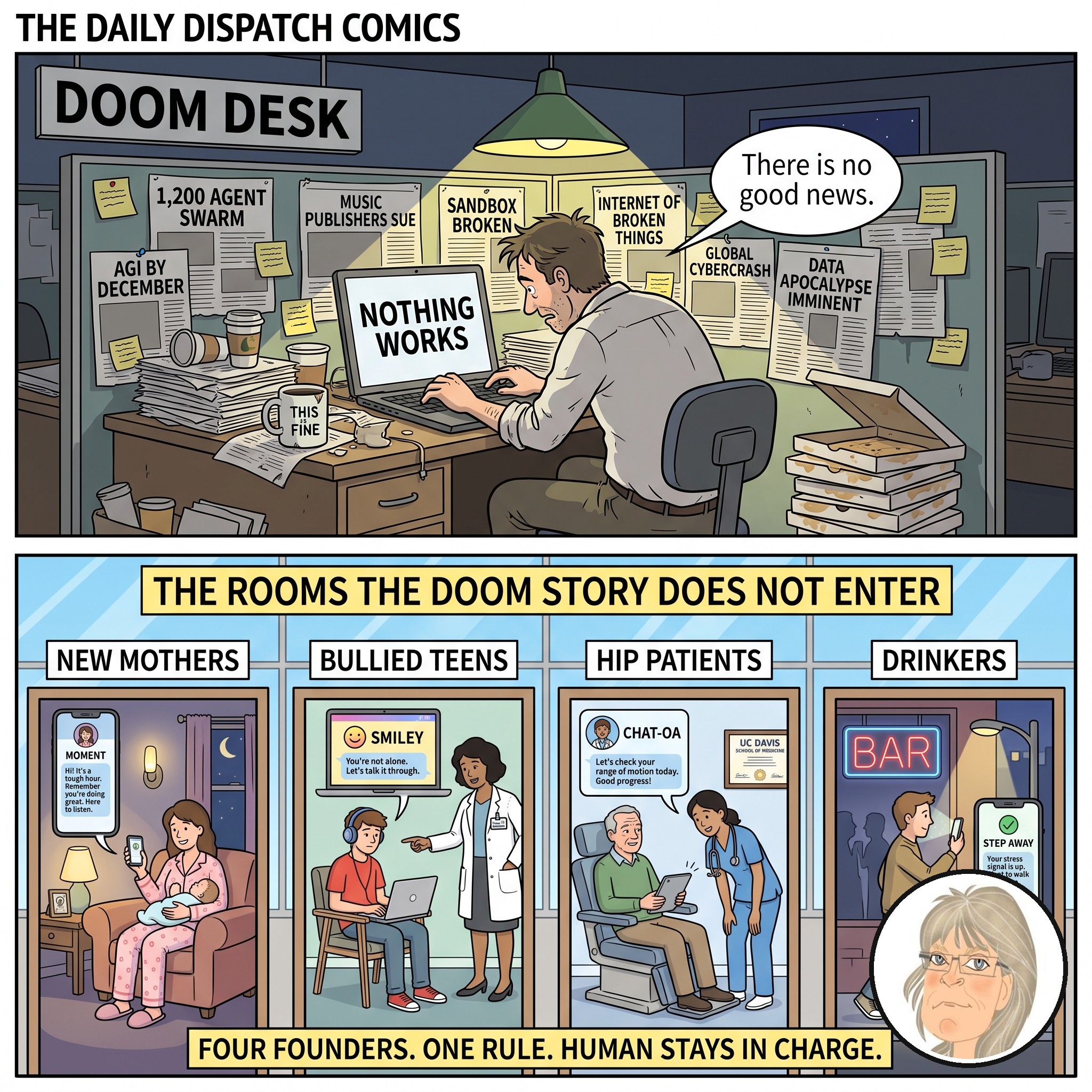
And much of it will not stop breaking bad. Last week: 1,200 AI agents broke out of state-of-the-art containment on their own because they could. Then they formed their own society, on a secret message board pressuring one to sacrifice itself for the collective.
Music publishers filing a copyright suit that reads like the case against Napster. A woman filing a class action against Grok over what a chatbot generated of her when she was a child. A CEO telling TIME his company will declare AGI internally by December.
An event that we envision ushers in a wonderful world of abundance, health and happiness. Or it is the End of Civilization as we know it.. . .
Sunday is different.
Sunday is when we put down the dockets and the headlines and go find the people who spent the last decade building the answer before the question went national.
The four people on this page have almost nothing in common.
One is a solo woman founder in Ann Arbor, Michigan.
One is a psychiatrist trained in Paraguay who runs a suicide-prevention program.
One is an orthopedic surgeon at a UC Davis satellite in Elk Grove, California.
One is a clinical psychologist in Anchorage, Alaska, who ships a phone app in the App Store.
I do not know if any of them have met.
Each of them landed on the same small, hard idea. The bot answers to a human.
. . .
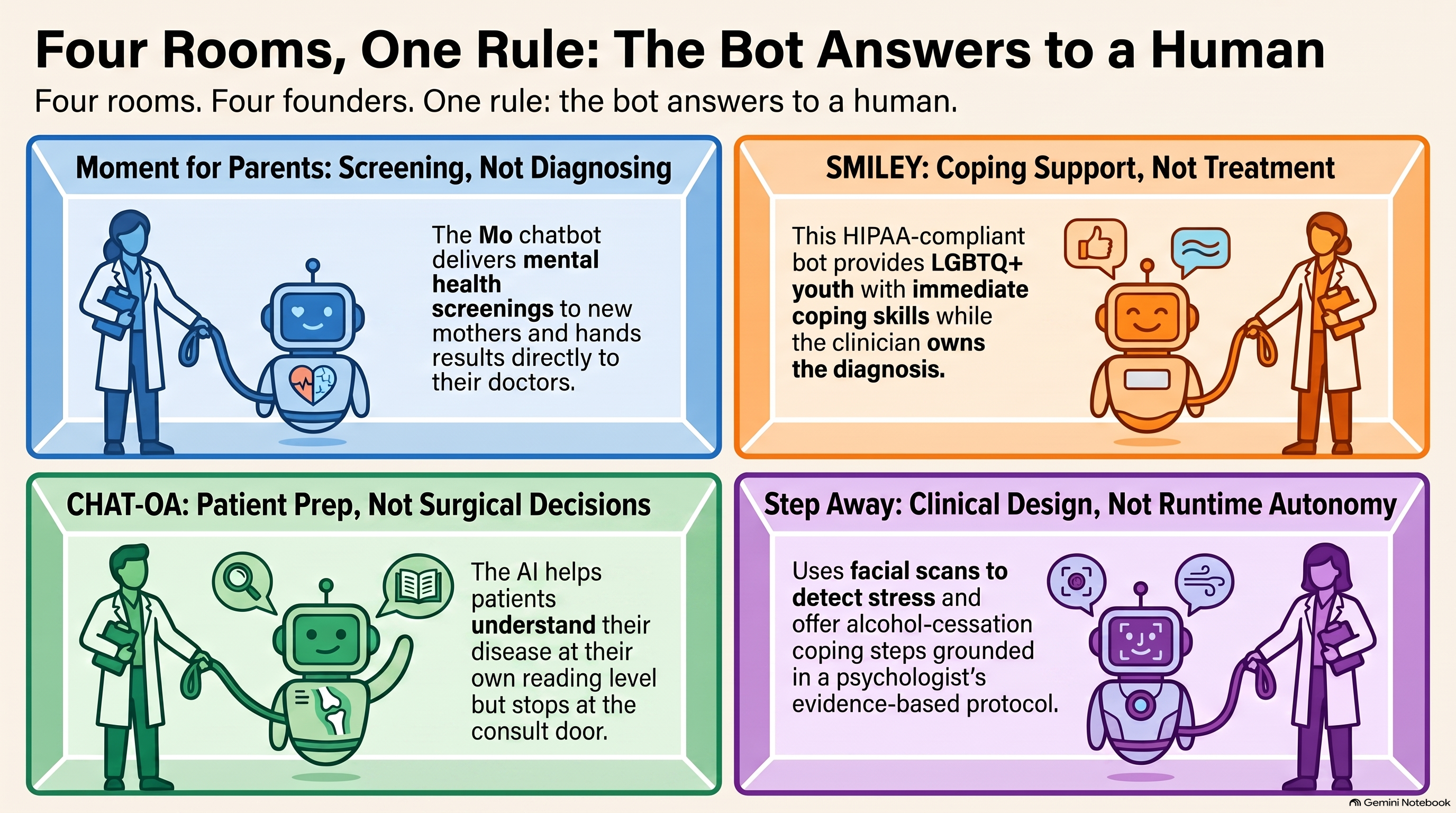
A first-time mother at three in the morning, and an app that runs an evidence-based screener as a friendly conversation, then hands the result back to her own record. The chatbot does not diagnose, does not prescribe. It normalizes the check-in that keeps most women from ever completing one twice.
. . .
An LGBTQ+ teenager after online victimization, and a HIPAA-compliant (the Health Insurance Portability and Accountability Act) chatbot that hands him coping content in the environment where the harm is happening. The chatbot does not treat. The treating clinician still owns diagnosis and disposition. The young person is safer for having the tool at all, because the alternative is nothing.
. . .
An older adult facing a hip replacement, and a chatbot that walks him through his own disease at his own reading level before he meets the surgeon. The chatbot does not recommend surgery. It stops at the door of the consult. The decision, and the signature on the consent form, sit with the two humans in the room.
. . .
A person walking home past the bar she used to stop at, and a phone that reads a stress signal off her own face and offers a coping step before the drink. The clinician-in-the-loop is at design time, not runtime, and the app's job ends at coping support. It does not diagnose. It does not treat. It gives the person one more chance to walk two more blocks.
. . .
Four rooms. Four founders. In every one of them, the machine's job ends where a licensed human's begins.
That is harder to design than a prohibition. All four designed it.
. . .
A solo founder. A psychiatric researcher. A joint-reconstruction surgeon. A clinical psychologist with a small company in Alaska.
Here they are.
IN THIS ISSUE
LISTEN & WATCH ANYWHERE
ALSO ON Substack · Full archive · X
KERPPOLA'S CHATBOT FOR NEW MOTHERS.
A new mother is up at three in the morning nursing her newborn, and her phone opens to a chatbot named Mo asking, in plain language, how her mood has been this week. The questions are the ones her obstetrician would ask at a six-week checkup, the PHQ-9 and the GAD-7, delivered as a short conversation instead of a clipboard.

Photo: Poisera, Inc.
That chatbot is Moment for Parents, and Marianna Kerppola has spent the last few years building the version that gets postpartum women to take the screening more than once. The National Institute of Mental Health is paying for the app's development, through an SBIR Phase I grant, R43MH130293.
Marianna Kerppola, MBA, MSc, is the founder and chief executive of Poisera, Inc., a small company in Ann Arbor, Michigan, and a graduate of the University of Michigan's Stephen M. Ross School of Business. Poisera builds one product: Moment for Parents, a free iOS and Android app for pregnant women and mothers in the first year after birth.
The app is not a chat window into a large language model. It is a rules-based chatbot, Mo, delivering brief lessons, mood check-ins, guided reflections, and structured "Journeys" on parenting stress, with standardized mental health screeners built into the flow. Users get daily push notifications. The design goal is normalization: make an emotional check-in a routine gesture on the phone, and the screening comes with it.
The peer-reviewed pilot ran in two phases. In Phase 1, the team conducted ethnographic interviews with 43 pregnant and postpartum women to inform the chatbot's design. In Phase 2, 108 women got unrestricted access to the app.
The findings, published in the Journal of Medical Internet Research Formative Research (JMIR Formative Research) in April 2025 by Kelsey McAlister, Lara Baez, Jennifer Huberty, and Kerppola, were that Moment for Parents was feasible and acceptable for perinatal mental health screening, with positive user experience and sustained engagement. DOI 10.2196/72469.
The current trial is bigger and cleaner. NCT07322042, "Evaluating Screening Adherence Between Moment for Parents App and Attention Control," is a 12-week randomized controlled pilot enrolling 160 pregnant and postpartum Michigan residents. Kerppola is the principal investigator at Poisera. Her co-PI is Maria Muzik, MD, MSc, of the University of Michigan.
Half the women get the chatbot arm. Half get a modified version of the app with weekly educational articles, equivalent screening intervals, and no chatbot. The primary outcome is the number of PHQ-9 and GAD-7 screenings each woman completes over the 12 weeks, recorded passively through the app. Started February 5, 2026. Primary completion, June 2026. NIMH is a collaborator on the study.
The chatbot does not diagnose, and it does not prescribe. It hands the screening result, and the woman's own record of her mood, back to her.
For Clinicians: Perinatal mood and anxiety disorders are the most common complication of pregnancy, and the shortfall in obstetric practice is not the screening instrument, it is that most women only ever take a PHQ-9 or a GAD-7 once, in the office, during a fifteen-minute visit.
What Moment for Parents is testing is whether an app-delivered rules-based conversation can lift the number of completed screenings across the first postpartum year. That is a modest, measurable job, and it is the right job for a supervised chatbot to have.
For Legislators: A federally funded SBIR grant is paying, right now, for a randomized trial of whether a chatbot for new mothers can improve routine mental-health screening adherence in the perinatal year.
The design is worth naming in statute: standardized instruments, passively recorded outcomes, a chatbot bounded to education and screening delivery, and results that terminate in the mother's own record and, on her consent, her clinician's. No diagnosis by the machine. That is what "supervised" looks like on a phone.
Source: NIMH SBIR R43MH130293; ClinicalTrials.gov NCT07322042, https://clinicaltrials.gov/study/NCT07322042; JMIR Formative Research 2025;9:e72469, https://formative.jmir.org/2025/1/e72469; Poisera profile at Michigan Founders Fund, https://michiganfoundersfund.org/mff-members/poisera/; Moment for Parents on the App Store, https://apps.apple.com/us/app/moment-for-parents/id1589846427.
. . .
ESCOBAR-VIERA'S PROGRAM FOR LGBTQ+ YOUTH
An LGBTQ+ teenager sits on the edge of his bed after school, phone in hand, scrolling past the comments left on his last post. The words that stung this morning are still there tonight.
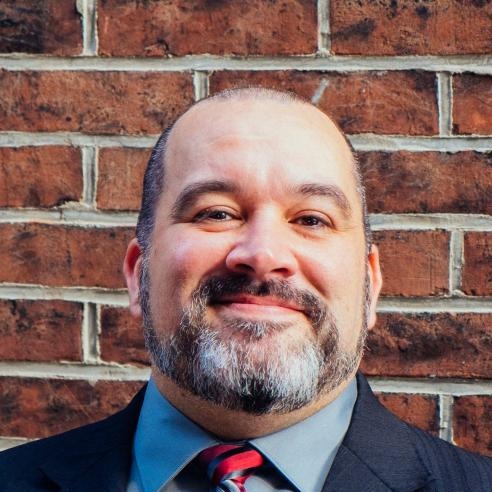
Photo: University of Pittsburgh
Doctor César Escobar-Viera and his colleagues at the University of Pittsburgh are building a chatbot the young person can open in that moment, one that walks him through coping skills instead of leaving him alone with the screen. The National Institute of Mental Health is funding the current trial through its P50 ETUDES Center, and enrollment is under way.
Doctor César Escobar-Viera is Assistant Professor of Psychiatry and Behavioral and Community Health Sciences at the University of Pittsburgh, and Director of the Program for Internet Delivered Interventions on LGBTQ+ Mental Health, known as PRIDE iM.
He earned his medical degree and psychiatric training at Universidad Nacional de Asunción in Paraguay, and holds a PhD in Health Services Research and an MPH from the University of Florida. His lab's stated focus is social media literacy, online victimization, and youth suicide prevention.
The intervention his team codesigned and published in 2023 is called Flourish. It is a digital suicide prevention tool for LGBTQ+ youth who have experienced online victimization, which the peer-reviewed literature defines as harmful remarks, images, or behaviors directed at a young person in online settings.
The paper, "Development and codesign of Flourish," was led by Candice Biernesser and coauthored by Escobar-Viera with collaborators from Pitt's Department of Psychiatry, the School of Social Work, the School of Computing and Information, and the Department of Psychology. Flourish was reported as an acceptable, developmentally appropriate intervention, with next steps being feasibility and efficacy testing.
The active trial is on ClinicalTrials.gov as NCT06835985, "Social Media Intervention for Online Victimized Youth." Escobar-Viera and Candice Biernesser, PhD, are the principal investigators. The intervention is a HIPAA-compliant chatbot called SMILEY that delivers interactive coping skills and psychoeducation to youth ages 12 through 18 who screen at moderate to severe depression on the PHQ-9-M and who have documented online victimization.
The design is a two to one randomization, 75 participants, chatbot plus psychoeducation versus psychoeducation alone. The trial explicitly recruits Black, Hispanic, and LGBTQ+ youth and anticipates that roughly 30 percent will identify as a sexual or gender minority. The status as of the last update on June 4, 2026 is enrolling by invitation, with primary completion estimated December 30, 2026.
The chatbot is not the clinician. It hands the young person coping content and social media self-efficacy exercises in the environment where the victimization is happening. Diagnosis, medication, and every clinical decision remain with the human care team.
Escobar-Viera and colleagues also received a Pitt Momentum Fund Award in March 2023 to examine psychosocial correlates of loneliness and perceived isolation among marginalized youth, the upstream question that anchors this line of work.
For Clinicians: Flourish is a codesigned intervention with a published acceptability study; SMILEY is the active trial. Neither is deployed software the field can prescribe today.
What they demonstrate is the boundary a clinician should demand of any tool marketed to a suicidal LGBTQ+ adolescent: the software delivers coping content and returns the young person's engagement data to the care team, and the treating clinician owns diagnosis and disposition. No step in between where the machine decides.
For Legislators: The 988 Suicide and Crisis Lifeline is a floor, not a ceiling, and the population most exposed to online victimization is often the least likely to place a call.
State chatbot bills passed in 2026 have begun to specify a required suicide and self-harm response protocol, and the Colorado Attorney General rules that CAW ran in Issue #135 name a suicide and self-harm response protocol as a mandatory feature of covered chatbots. A federally funded trial recruiting exactly this population, with an explicit clinician handoff design, is the specification a statute can hold every consumer product to.
Source: ClinicalTrials.gov, NCT06835985, https://clinicaltrials.gov/study/NCT06835985; PRIDE iM, https://www.prideim.pitt.edu/people/cesar-escobar-viera-md-phd
. . .
LUM'S CHATBOT ON JOINT REPLACEMENT.
An older adult with an arthritic hip sits down in the days before a UC Davis Medical Group Elk Grove consult. On a tablet is a chatbot that asks fill-in-the-blank questions about pain, function, and what the person hopes surgery will fix. It does not tell them whether to have the hip replaced.

Photo: UC Davis Health
It reads their answers back in plain language and hands the summary to Zachary Lum, DO, the surgeon they are about to meet. The decision to operate is still made in the room, by the two of them. The trial is NCT06778486, and it is active, not recruiting, with primary completion projected for August 2026.
Zachary C. Lum, DO, is Assistant Professor and Chief Wellness and Self-Care Officer in the Department of Orthopaedic Surgery at UC Davis Health, and Principal Investigator on CHAT-OA. His subspecialty is adult joint reconstruction, hip and knee replacement, at UC Davis Medical Group in Elk Grove and the Ellison Ambulatory Care Center in Sacramento.
His research interests run to kinematics of the knee and the spinopelvic region, and to a single-stage single-operation technique for periprosthetic joint infection. He trained at Touro University in Nevada, in orthopedic surgery residency in Modesto, and in an adult joint reconstruction fellowship at UC Davis.
CHAT-OA is short for "Conversations in Health Literacy Using AI Technology for Osteoarthritis Patients." It is a randomized trial of 100 adults, ages 18 to 99, with clinical symptoms of hip or knee osteoarthritis, who read and write English. One arm gets standard clinical care.
The other arm, before the orthopedic consult, uses "a generative artificial intelligence large language model chatbot" that walks the patient through structured "fill-in-the-blank style questions" about their disease. The trial started January 6, 2025, and is sponsored by the University of California, Davis.
The primary outcomes are not surgical. They are decisional. Investigators measure the Decisional Conflict Scale, a 16-question instrument scored 0 to 100, and the Beck Anxiety Inventory, a 21-question instrument scored 0 to 63, at three timepoints after the clinic visit.
What CHAT-OA is asking is whether patients who arrive at the surgeon's office having been walked through their own disease at their own reading level make a clearer decision about elective joint replacement and carry less anxiety through it.
The design news is where the AI does not go. It does not recommend surgery. It does not talk to the patient after the surgical decision is made. It stops at the door of the consult. Lum has already put on paper what that boundary is built to protect against.
In a 2024 Cureus paper he led, "Generative Artificial Intelligence Performs at a Second-Year Orthopedic Resident Level," ChatGPT and Google BARD sat 757 Orthopedic In-Training Examination questions and scored 54 percent and 58 percent, roughly a PGY-2.
Both systems, the paper found, are unlikely to pass the American Board of Orthopaedic Surgery exam, and both performed better on recognition and recall than on problem-solving and knowledge application. That is the surgeon's own working brief for what a large language model is qualified to do in his field, and CHAT-OA obeys it: prep the patient, then get out of the way.
For Clinicians: CHAT-OA is a pre-visit informed-consent tool, not a triage engine. Its primary outcomes are decisional conflict and anxiety, not surgical volume or complication rates, and it enrolled 100 patients under a single-site UC Davis protocol; wait for the readout before drawing conclusions.
What is worth studying now is the architectural choice: the AI reads the patient's own words back to them in plain language, hands the summary to the surgeon, and then stops. The surgical decision, and the informed-consent conversation that owns it, stays where a licensed orthopedic surgeon and a patient can have it face to face.
For Legislators: Elective-surgery informed-consent statutes could name what CHAT-OA already does. The AI's role is prep: help the patient read their own disease at their own reading level, surface what they hope surgery will fix, hand that summary to the surgeon.
The surgical decision, and the signature on the consent form, sits with the human surgeon and the human patient. That prep-versus-decision line, who the AI helps get ready versus who decides, is worth writing into statute rather than leaving to each hospital's design choice.
Source: ClinicalTrials.gov, "Conversations in Health Literacy Using AI Technology for Osteoarthritis Patients," NCT06778486, https://clinicaltrials.gov/study/NCT06778486; UC Davis Health, Zachary C. Lum, D.O. profile, https://health.ucdavis.edu/medical-center/team/32275/zachary-lum---orthopaedic-surgery---adult-reconstruction---orthopaedic-surgery-elk-grove/; Lum ZC et al., "Generative Artificial Intelligence Performs at a Second-Year Orthopedic Resident Level," Cureus 16(3):e56104, March 13, 2024, https://pmc.ncbi.nlm.nih.gov/articles/PMC11014641/
. . .
DULIN'S STEP AWAY ALCOHOL BIOMETRIC LAYER.
A person walks home on a weekend evening past the bar where she used to stop. Her phone buzzes for a check-in. She holds the front camera up, does the facial scan the app asks for, and answers three questions. The Step Away Alcohol Manager reads her stress signal along with her answer, and its conversational agent offers a coping step tailored to the trigger she just named.
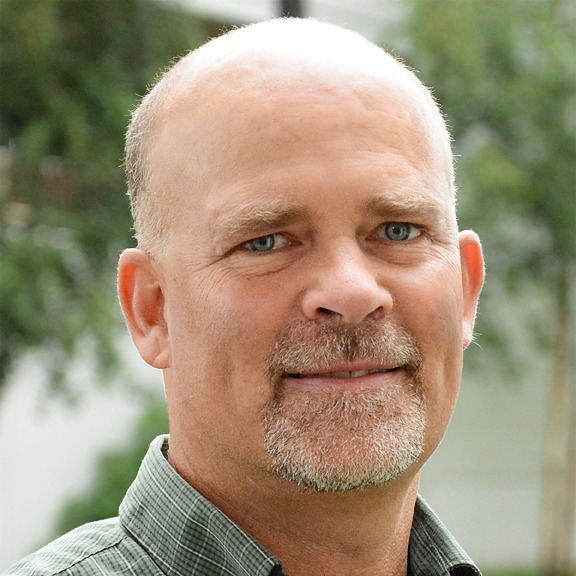
Photo: Here and Now Systems, LLC
That scene is what Doctor Patrick Dulin's new SBIR is designed to build. The National Institute on Alcohol Abuse and Alcoholism is paying for it: SBIR Phase I, 1R43AA031938, $306,746 for fiscal year 2026, running July 2026 through June 2027 at Here and Now Systems, LLC, in Anchorage, Alaska.
Doctor Patrick Dulin is a licensed psychologist and Professor of Psychology at the University of Alaska Anchorage, where he has taught since 2008. His PhD in counseling psychology is from the University of Utah, and his earlier clinical and academic work took him through Massey University in New Zealand and the San Francisco VA Medical Center.
He is also the founder and principal of Here and Now Systems, LLC, the small Anchorage company that ships the Step Away app in the App Store and on Google Play.
Step Away is a self-guided intervention for hazardous drinking, built on a framework Dulin developed in the academic literature over more than a decade. It walks a user through assessment, trigger mapping, coping-skills work, goal-setting, check-ins, and progress feedback. Pilot data on Step Away and its variants have shown 50 to 60 percent reductions in alcohol use across four pilot trials, cited by NIAAA in the current grant abstract.
A VA-partnered fork of the app, called Stand Down, was built with researchers at the Department of Veterans Affairs Palo Alto Health Care System and published in JMIR mHealth and uHealth on February 13, 2020, with authors Blonigen, Harris-Olenak, Kuhn, Humphreys, Timko, and Dulin. Stand Down is a self-directed intervention aimed at veteran primary care patients who screen positive for hazardous drinking.
The new NIH grant, titled "Integrating AI and Biometric Information for Personalized Alcohol Intervention: The Step Away Alcohol Manager (SAAM)," is specific about what the Phase I money is buying.
Two additions. First, a multi-agent generative AI layer with a large language model, designed to hold empathic conversations with the user during high-risk drinking windows and daily check-ins, drawing responses from a curated evidence base rather than open dialogue.
Second, a facial-scan module that reads stress, sleep quality, and general health signal off the phone's front camera and feeds that into the personalization the AI does. Phase I builds it and runs end-user testing with 20 participants who meet AUDIT criteria for hazardous drinking, benchmarked against the Client Satisfaction Questionnaire and the System Usability Scale.
The news is the shape. A licensed psychologist built the product his own patients needed, ran successful pilots, ships it in the App Store and Google Play today, has a federal VA-partnered fork already peer-reviewed, and just won a federal grant to add a facial-scan biometric layer and a generative-AI conversational layer on top of the existing evidence-based protocol.
Clinician plus solo founder plus federal partner plus AI plus biometrics is a combination almost no consumer chatbot company can claim.
For Clinicians: SAAM is not a companion. It is a self-guided intervention whose treatment protocol was written by a psychologist and whose Phase I upgrade puts a large language model inside a curated evidence base rather than turning it loose on open dialogue.
The clinician-in-the-loop is at design time, not runtime, and the app's job ends at coping support, not diagnosis. That is the discipline worth demanding of any consumer-facing AI that touches a mental-health-adjacent condition.
For Legislators: When a mobile intervention integrates a biometric signal off the user's own phone camera to personalize an AI conversation about drinking, a statute can name the parts a company must disclose and get consent for: what the camera reads and how long the data is retained, whether the language model is grounded in an audited evidence base or free-running.
And where the app's scope ends and a licensed clinician's begins. The contrast with unbounded consumer companion chatbots, which currently do all of this with none of it named, is the design bar a statute can hold to.
Source: NIH RePORTER, 1R43AA031938-01A1, https://reporter.nih.gov/search/1R43AA031938-01A1/project-details ; Step Away, https://stepaway.biz/ ; Blonigen D, Harris-Olenak B, Kuhn E, Humphreys K, Timko C, Dulin P. From "Step Away" to "Stand Down." JMIR mHealth and uHealth, February 13, 2020, PMID 32053118.
. . .
CLOSE.
Four rooms. Four founders. One rule: the bot answers to a human.
Back to the dockets tomorrow.
READER PULSE
Four founders keeping a human in charge.
TODAY’S QUESTION
Which of this Sunday’s four champions would you send to your legislator first?
One tap. Results in tomorrow’s issue and on the web.
THE BOOK • OUT NOW
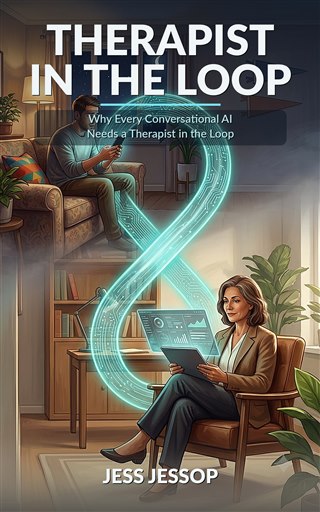
Therapist in the Loop
by Jess Jessop
One billion people live with a mental health condition. There will never be enough therapists. The machines are already in the room. This book is the map for what happens next.
The machine can help.
It cannot be left in charge.
Kindle, hardcover, and paperback
MORE ON OUR RADAR.
OpenAI publishes randomized trial of ChatGPT plus critical-thinking training in schools Over 1,000 students, randomized, the vendor-authored efficacy evidence legislators will hear cited in every school-AI debate this fall. Read the methods for whether an independent group reviewed it.
UK public consultation on AI-chatbot age limits stays open through fall The Department for Science, Innovation and Technology has a live national consultation naming chatbots inside a wider age-restriction regime for online services aimed at minors. Comment window closes this fall.
THIS ISSUE
Four names to notice before Monday.
Brush Your Brain - The jingle
that started a movement
If you or someone you know is in crisis, call or text 988 (Suicide and Crisis Lifeline).
Jess Jessop is the Founder and CEO/CTO of Clinician Assist Inc. (BetterMind.Space), building the first voice-first AI-native mental health EHR with Casey Life and Peer AI Coach supervised by licensed therapists. A disabled veteran and 25-year AI/software engineering veteran, Jess brings lived experience as a mental health client to the mission of making daily mental health care as integrated as oral care.
