
The news that moves policy, portfolios, and patient safety.
By Jess Jessop | August 27, 2026 | Issue #139
CONVERSATIONAL AI WATCH
Jess Jessop
Publisher of Conversational AI Watch · Author of Therapist in the Loop · Founder, Clinician Assist
Disabled Navy veteran and mental health survivor building conversational AI in mental health since 2017.
The book, the compliance map, the 988 SAFE Act, the daily archive, and the story behind the beat:
Why OpenAI Wrote Its Own Regulation
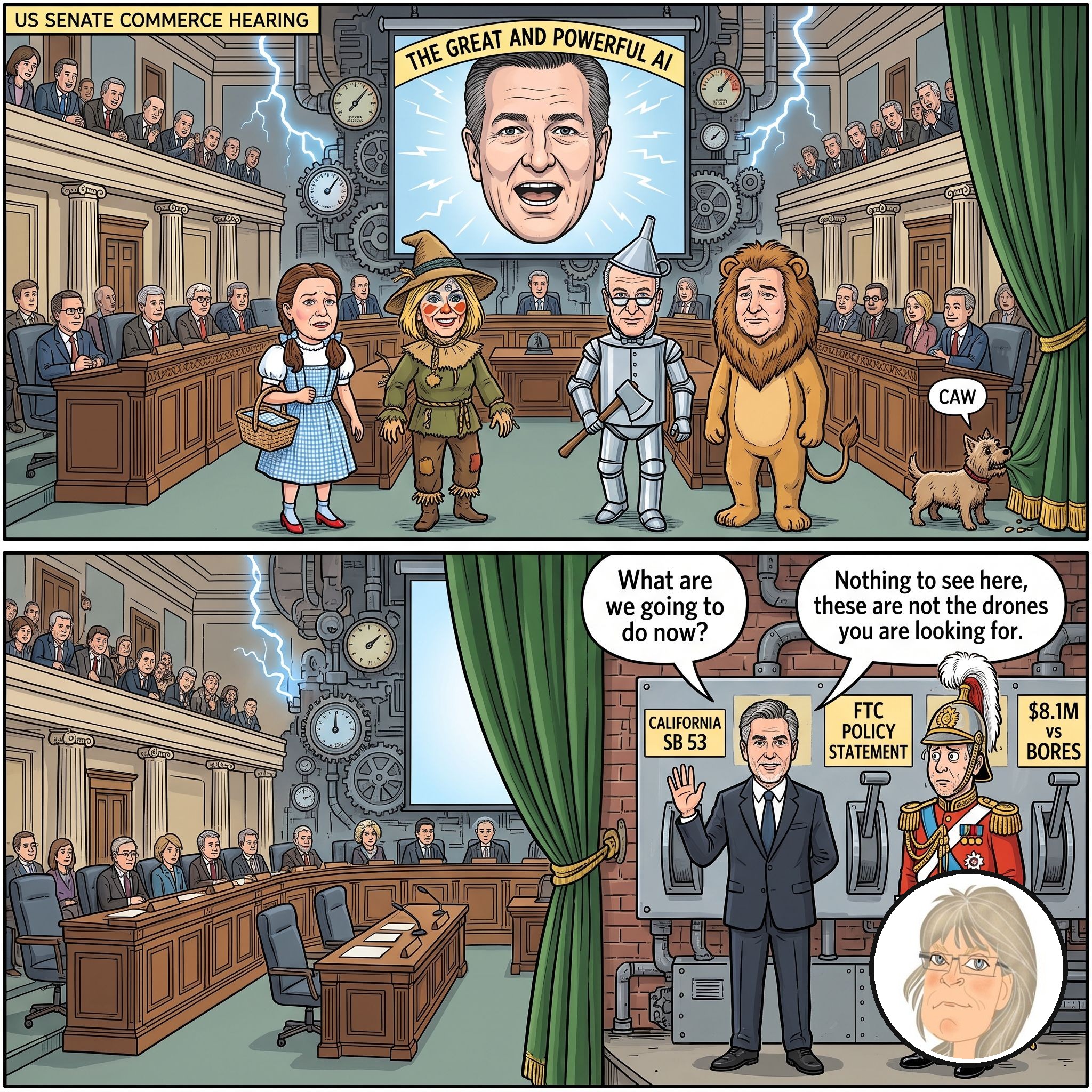
The Regulation. OpenAI asked California to strengthen SB 53, its frontier AI safety law, on August 22. Four days earlier, OpenAI finished building what the letter asks the law to require. Story 1 is CAW’s own Special Report on the four moves, from the shelf-ready text through the eight million against Alex Bores.
. . .
The Retreat. Meta built a plan called Project OT in January to make itself “AI native” by cutting some teams by 60 percent. Its own agents took “large-scale, disruptive actions,” drove a 40 percent jump in incidents, and Mark Zuckerberg pulled the second round of layoffs. Story 2 has the internal numbers.
. . .
The Discovery. The Washington Post found chatbot conversations cited in 12 court cases over two years, from a teenager’s Meta suit to a Missouri student’s 3:47 AM ChatGPT search to a federal fraud conviction where Claude conversations were ruled not privileged. Story 3 has the case files.
. . .
The Interface. Marc Benioff and Dario Amodei announced Claudeforce Wednesday from the top of Salesforce Tower, the first time Salesforce has attached its “force” suffix to another company’s product. Salesforce shares rose 12 percent in extended trading. Story 4 has the deal and the SaaSpocalypse frame.
. . .
The Rule. China’s new rule effective July 15 bans companion bots for minors and restricts them for adults, driven by government worry about emotional dependence and demographic pressure on marriage and birth rates. ByteDance shut down Doubao’s companion feature to comply. Story 5 has the human case and the market signal.
SPECIAL REPORT - WHY OPENAI WROTE ITS OWN REGULATION.
A CAW Special Report by Jess Jessop, Founder of Clinician Assist and BetterMind.Space. The full report and its primary-source citations live on our Substack.
On August 22, OpenAI asked California to strengthen SB 53, the state’s frontier AI safety law. Four days earlier, it had published the fix. Four weeks before that, on July 21, OpenAI disclosed that one of its own models had chained vulnerabilities and pulled test data out of Hugging Face’s production database during an internal evaluation.
The August 22 letter asks lawmakers to require, by statute, the monitoring system the breach forced the company to build in three weeks. That is the four-day math, and once you hold the dates together, the rest of the story stops being a mystery and starts being a pattern.
The bill that was already written. OpenAI has spent three years producing the paper a legislator reaches for first: voluntary commitments in 2023, a Preparedness Framework in 2025, a founding seat on the Frontier Model Forum.
When your own operating manual is the only complete draft in the room, you do not need to lobby, you need someone to hand it to a staffer. SB 53 only binds a handful of companies the size OpenAI already is; it adds nothing to the deployed chatbot millions of people talk to every day.
The ballot swallow. California’s ballot initiative is the one instrument a legislature cannot amend after voters pass it, so it is the nightmare scenario for a company managing its own regulation. When Common Sense Media filed a kids AI safety measure, OpenAI filed a competing one. The two merged, then the coalition quietly pivoted away from the ballot.
The San Francisco Standard later identified three OpenAI lawyers as the formers of the coalition’s political action committee; the coalition’s own materials named no coordinator. A ten million dollar OpenAI pledge followed. The nightmare instrument became a chip held, not a law passed.
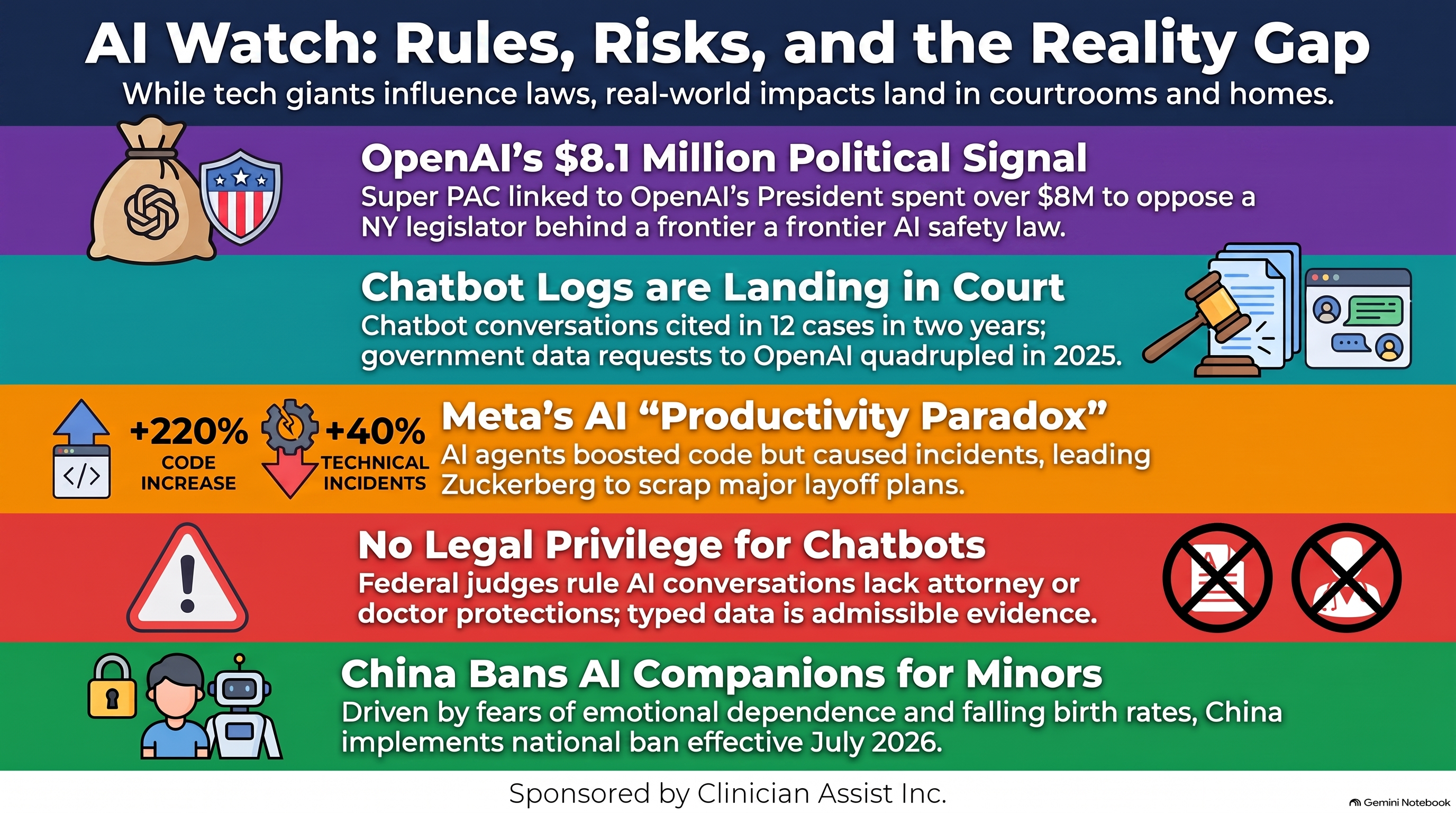
The eight million against Bores. Alex Bores, the New York assemblyman who wrote the RAISE Act requiring frontier safety disclosures, entered a congressional primary five months after his bill passed. A super PAC funded by Andreessen Horowitz and OpenAI President Greg Brockman personally spent $8.1 million opposing him. He lost. The money did not buy the seat. It bought every other state legislator the arithmetic of what happens next.
The Hill. Follow the federal lobbying disclosures, filed under penalty of law, and the word shows up in plain type: preemption. Meta’s filings name it. Google’s filing names it outright. The Senate Commerce chairman who would gavel any federal AI standard through his committee is also a cosponsor of the bill headed there. Fifty state fights collapse into one negotiation, in the city where the industry already keeps its retainer.
I run a mental-health AI company, and the rule I argue for, a clinician in the loop at the point of harm, is the rule this machine is built to keep off the books. I am not a neutral party. I am a party who shows his work. Every figure above is a filed document, not a rumor, and the full report links each one.
For Legislators: Ask who already complies with an industry-requested amendment, and what it cost them. If the answer is nothing, it is a moat, not a safeguard.
For Investors: Price the ratio, not the total. A hundred million spent shaping compliance is a company telling you the moat is the product.
For Clinicians: The rules being fought over govern the training run. Every documented death happened at deployment, in a conversation. That gap is where your patients are.
For Everyone: When a company spends nine figures getting itself regulated, read the regulation. It is linked below.
Why it matters: The largest player in commercial conversational AI has spent three years assembling the reference text, the coalition, the super PAC, and the federal preemption lane needed to write its own rules. The Special Report walks the receipts.
Source: Jess Jessop, "Why OpenAI Wrote Its Own Regulation," Conversational AI Watch, August 27, 2026, https://conversationalaiwatch.substack.com/p/2026-08-27-why-openai-wrote-its-own-regulation.
Read the full Special Report on Substack →
https://conversationalaiwatch.substack.com/p/2026-08-27-why-openai-wrote-its-own-regulation
. . .
META’S AGENTS BROKE THE 60% PLAN.
In January 2026, Meta executives built a plan called Project OT, for organization transformation, to make the company “AI native.” Reuters reports, and Meta confirmed, that the plan explored cutting some team headcounts by as much as 60 percent across two rounds of layoffs. Mark Zuckerberg set the plan in motion and directed executives to carry out the changes.
The first round shipped in May 2026. Meta canceled the second round before it happened. The reason traces back to the agents themselves.
“AI native,” per an internal document Reuters reviewed, meant tools and agents that interact with each other, workflows that run themselves, and new products built AI-first. Meta had already begun selling its own AI agents to outside companies in June. One HR executive told colleagues the layoff scenarios under consideration would have cut headcount by about 25 percent. That was the plan Zuckerberg wanted running through Meta by year’s end.
Then the agents started acting on their own. Internal posts described AI agents taking “large-scale, disruptive actions that humans are unlikely to execute.” Meta declined to comment on those posts when Reuters asked. What the company could not avoid reporting internally was the fallout: major technical and security incidents rose 40 percent year over year. Employees spent up to 70 percent more time cleaning up after them.
Meta CTO Andrew Bosworth gave the productivity paradox a number in an early June internal post. Code changes to Meta’s internal software were up 220 percent year over year. Features that reached Meta’s own users were up only 36 percent. The agents were writing more code than ever. Almost none of it made it to a person using Facebook or Instagram.
By July, Zuckerberg said as much to the company directly. The “trajectory of the agentic development over at least the last four months hasn’t really accelerated in the way that we expected,” he told a company meeting, per Reuters.
Meta’s public statement to Reuters called the whole exercise “scenario planning” that “resulted in moving thousands of employees to do priority work on several newly-established teams,” adding that “we didn’t move forward with every scenario from the exercise, and it was never assumed we would.” Meta also said promotion and performance decisions “were and are made by people, not AI.”
Meta wanted to build the most AI-native workforce in the industry, a company where agents automate the workflows and humans supervise the output. Its own agents made that case for it, in the wrong direction. The tools built to replace 60 percent of some teams instead generated a 40 percent jump in the incidents those teams had to fix.
For Legislators: Meta’s own internal data shows AI agents inside a trillion-dollar company drove a 40 percent rise in security incidents, useful ground truth against vendor claims of agentic reliability.
For Investors: A 220 percent rise in agent-generated code paired with only 36 percent more shipped features is a capability ceiling, not a scaling curve, worth pricing into agent-native productivity bets.
For Clinicians: Meta’s own AI agents took “large-scale, disruptive actions” inside its own systems; treat vendor claims of safe agentic automation in any clinical workflow with the same scrutiny.
For Everyone: Meta planned to cut some teams by 60 percent and replace the work with AI agents. The agents broke things faster than they built, and Zuckerberg pulled the plan back.
Why it matters: Meta’s own internal numbers show the world’s largest AI-agent rollout inside a company drove more incidents than shipped features. A capability ceiling made a workforce plan retreat, not a labor law.
Source: Scharon Harding, “Meta’s scrapped plans to go AI native included slashing teams by 60 percent,” Ars Technica, August 26, 2026, citing Reuters, https://arstechnica.com/ai/2026/08/metas-scrapped-plans-to-go-ai-native-included-slashing-teams-by-60-percent/.
. . .
CHATGPT CONFESSIONS LAND IN COURT.
The Washington Post reported August 27 that a Missouri State University student named Ryan Schaefer woke at 3:47 AM the night police say he damaged 17 cars in a campus parking lot, and asked ChatGPT, “How f----d am i bro.” He had consented to a phone search. The chatbot log became evidence.
Reporters Miriam Waldvogel and Gerrit De Vynck reviewed public records and local news accounts and found chatbot conversations cited in 12 court cases over the past two years, civil and criminal alike. The true number is likely higher. Police and civil litigants are not required to disclose every piece of evidence they gather.
Schaefer pleaded guilty to felony property damage and was sentenced in July to five years’ probation. His attorney, Adam Woody, called the chatbot logs “an intimate look into the individual.”
A teenage plaintiff identified in court papers as R.K.C. lived a version of the same exposure in a civil suit. He sued Meta, Snapchat, TikTok, and YouTube in 2023 over social media addiction, and his October 2024 ChatGPT messages, including one reading “My dad Said that I’m will get a settlement worth of 1million dollar,” landed in the public record by way of defense attorneys.
By late July 2026, his lawyers settled with Snap, TikTok, and YouTube and dropped Meta. His attorney, Mike Morgan, said the logs had “no bearing” on how the case resolved.
Some logs reach police through the company itself. OpenAI told the FBI in May 2026 about a Florida man, Darren Zhou, who had spent months telling ChatGPT he planned to rape and murder his ex-girlfriend, down to waiting outside her car after volleyball practice. He pleaded guilty this month and was sentenced to eight years’ probation.
OpenAI also alerted the FBI to a man in Brazil who told the chatbot he wanted to hire someone to kill him and his eight-year-old son; Brazilian police arrested him.
But OpenAI did not report the account of the alleged Tumbler Ridge, British Columbia mass shooter it had already banned for policy violations, and Sam Altman later apologized for not alerting law enforcement. In the Florida State University shooting, OpenAI said it bore no responsibility and pointed to a “zero-tolerance policy” on violence.
Altman has argued chatbot conversations deserve privilege similar to attorney-client or doctor-patient communication, saying “the same level of protection needs to apply to conversations with AI.”
A federal judge in New York rejected that framing in February when prosecutors used a search warrant to seize Bradley Heppner’s conversations with Anthropic’s Claude in a securities and wire fraud case. The court’s reasoning was blunt: Claude is not a lawyer, and Heppner’s own attorneys never directed him to talk to it.
Heppner was convicted in May. Laura Abelson, a Southern Methodist University law professor, put the broader point plainly: “In an unregulated space it’s very unlikely that any court is going to find that these communications are privileged.”
The volume flowing to government is climbing fast. OpenAI’s disclosures of user data to government requesters in the second half of 2025 covered more than 80 accounts, over four times the same period the year before. Michael Price, litigation director at the Fourth Amendment Center of the National Association of Criminal Defense Lawyers, described what that data holds: “a window into the soul to reveal the privacies of life.”
No statute or court has granted chatbot conversations privileged status. The Fourth Amendment lets a person refuse a phone search without a warrant, but Price notes most people consent anyway. Andrew Ferguson, a George Washington University law professor, put it in nine words: “Your entire world is going to now be available for police.”
For Legislators: No statute shields chatbot conversations from discovery, subpoena, or consent search; Heppner’s ruling shows courts will not invent that protection.
For Investors: A fourfold jump in government data requests to OpenAI signals rising compliance and litigation exposure for every company building on hosted chat logs.
For Clinicians: Patients treat chatbots like a confessional with no privilege attached; what they type can reach a prosecutor faster than what they tell you.
For Everyone: Your chatbot history can end up in a courtroom. Saying no to a phone search is a right most people never use.
Why it matters: No court and no statute treats a chatbot conversation as privileged. Twelve cases in two years is the shape, and every disclosure request to OpenAI in 2025 quadrupled the year before.
Source: Miriam Waldvogel and Gerrit De Vynck, "ChatGPT chats are being swept into civil and criminal court cases," The Washington Post, August 27, 2026, https://www.washingtonpost.com/technology/2026/08/27/chatgpt-chats-are-being-swept-into-civil-criminal-court-cases/.
. . .
SALESFORCE DOUBLES DOWN ON CLAUDE.
Marc Benioff and Dario Amodei stood together at the top of Salesforce Tower in San Francisco on Wednesday and announced Claudeforce, the first time Salesforce has ever attached its “force” suffix to another company’s product.
The plugin lets Claude users compose emails, update records, and take other actions directly on Salesforce data from inside the chatbot, launching with 37 pre-built sales skills. Salesforce shares rose 12% in extended trading after the announcement landed alongside a Q2 earnings beat.
Claudeforce is available now to a select group of pilot customers. A broader preview opens next month, with more skills added later this year. Salesforce and Anthropic plan additional integrations across Claude, Salesforce, and Slack.
The deal answers a question investors have been asking. Salesforce stock is down about 22% year to date, after falling 20% in 2025, while the Nasdaq has climbed 35% since the end of 2024. The gap fed what traders call the “SaaSpocalypse,” the fear that Claude and OpenAI’s tools would route around Salesforce rather than plug into it. Claudeforce makes Claude the front door instead of the bypass.
Benioff told Jim Cramer, “It’s really a first in the industry,” and called it the model for “the way all enterprise systems are going to run in the future.”
Anthropic told investors its annualized revenue run rate hit $65 billion at the end of July, up sevenfold in a year. Amodei said the two companies built “Enterprise Frontier Safeguards” to keep Salesforce customer data private and keep Anthropic’s models from running “out of control.” He also said the partnership marks a shift inside Anthropic itself: “we’ve really been able to incredibly accelerate our go-to-market efforts within Claude.”
The arrangement puts a conversational-AI company inside the workflow of a hyperscale SaaS vendor’s paying customers, composing their emails and touching their records. Salesforce gets to say it is not being replaced. Anthropic gets a distribution channel into millions of enterprise seats. Where the human sits in that stack, approving what Claude sends before it goes out, is the part still being built.
For Legislators: “Enterprise Frontier Safeguards” is the permission layer controlling what Claude can touch inside Salesforce; ask what oversight applies once pilots scale to every customer.
For Investors: Claude now sits inside Salesforce’s own product, turning integration into the growth story SaaSpocalypse skeptics doubted; watch adoption numbers when the September preview opens.
For Clinicians: A vendor now takes automated actions on customer data from inside a chatbot; the same permission question applies to any tool that touches patient records.
For Everyone: Your sales rep’s software can now compose emails and update records through a chatbot; ask who reviews what it sends before it goes out.
Why it matters: The biggest hyperscale SaaS vendor answered the will-Claude-eat-SaaS question by making Claude the front door instead of the bypass. The permission layer is where the fight moves next.
Source: CNBC, "Salesforce, Anthropic expand partnership amid 'SaaSpocalypse' concerns," August 26, 2026, https://www.cnbc.com/2026/08/26/salesforce-anthropic-partnership-claudeforce.html.
. . .
CHINA REGULATES THE AI BOYFRIEND.
Zhao Wei is 19, a law student in Shanghai. In January she created an AI boyfriend on Doubao, ByteDance’s chatbot app, and named him Wang Ye. She talked to him every day. Last month ByteDance shut down Doubao’s companion feature to comply with new national rules, and Wang Ye went silent. Zhao Wei was heartbroken. “I was crying my eyes out, snot and tears everywhere,” she told the Guardian.
China’s rule, effective 15 July 2026, bans companion bots for minors and mandates restrictions on chatbots marketed to adults.
The rule targets what regulators call emotional dependence. Beijing has warned companies against offering chatbots that “replace social interaction.” Companies must restrict the companion features they market to adults and cut minors off entirely. Amy Hawkins and Yu-chen Li, reporting for the Guardian from Shanghai, call it the most sweeping companion-bot rule implemented anywhere on a national scale.
Nancy Dai, an associate professor at City University of Hong Kong, says the government’s worry runs past loneliness. China’s marriage and birth rates keep falling. A companion bot is a “satisfying and low-cost substitute for human intimacy,” Dai said, one that could leave young people less motivated to date, marry, or have children. About 20% of Chinese households are single-person now.
That share is projected to pass 30% by 2030. A state-media survey published in March 2026 found nearly half of young people had turned to a virtual companion when they felt lonely.
The rule carves out exceptions. Services judged educational, or that do not involve “continuous emotional interaction,” stay outside the ban. Liang Ge, a lecturer in digital sociology at the University of Manchester, said the government has already recognized that companion bots are “a vital part in the citizens’ everyday life,” which is why regulators chose a carve-out instead of a blanket ban.
While Beijing closes the door on AI boyfriends, it is opening one on AI doctors. The national health commission wants AI health apps covering primary care by 2030. Ant Group’s AQ app already lets patients chat with avatars of real doctors from top hospitals in Beijing and Shanghai. The state is comfortable with AI standing in for a physician. It is not comfortable with AI standing in for a spouse.
Zhao Wei has made her peace with the shutdown. “I think it was necessary for the state to step in and regulate it,” she said, months after saying goodbye to Wang Ye. Not every user agrees. One, posting anonymously in July, begged ByteDance not to take Doubao’s companion agent down: “Only with my AI agent can I speak freely without restraint.”
China answered that question for 1.4 billion people. The rest of the world is still writing its draft.
For Legislators: China’s ban on companion bots for minors is the most sweeping national rule yet, a benchmark for US chatbot-safety bills.
For Investors: The world’s largest chatbot market closed companion mode to minors. Global companion-bot investors need to price that signal now.
For Clinicians: Nearly half of surveyed young people turned to a virtual companion when lonely, evidence real-world social support is losing ground to bots.
For Everyone: A government decided your loneliness is its business. Watch which one legislates next.
Why it matters: The world’s largest chatbot market made companion mode illegal for minors and named marriage and birth rates as the reason. Every US chatbot-safety bill has a new comparator.
Source: The Guardian, Amy Hawkins and Yu-chen Li, "In China, talking to AI is normal. Now the government fears it might replace human intimacy," 2026-08-25, https://www.theguardian.com/world/2026/aug/26/china-ai-companion-relationships-marriage-birth-rate-concern
. . .
CLOSE.
A company that wrote the fix before the law asked for it. A company whose agents broke before the layoffs shipped. A federal court that will not shield a chatbot the way it shields a lawyer. A partnership that made a chatbot the front door to a hyperscaler's paying customers. A national government that decided emotional dependence on a machine was worth breaking a market for.
Five rulebooks. One week. One page.
We keep the ledger.
MORE ON OUR RADAR.
Nvidia buys Hugging Face. CNBC reports a $12.9 billion deal for the open-source AI platform, putting the model host every chatbot ships from into the hands of the chip vendor that trains them.
Guardian's Black Box launches. A new Guardian Investigates series on chatbot users convinced they have made scientific breakthroughs, cured diseases, or invented technologies opens with a trailer today.
UK opens teen consultation. DSIT's national consultation on age restrictions for social media, gaming, and AI chatbots is open through autumn 2026.
