
The news that moves policy, portfolios, and patient safety.
By Jess Jessop | 2026-08-21 | Issue #133
CONVERSATIONAL AI WATCH
Jess Jessop
Publisher of Conversational AI Watch · Author of Therapist in the Loop · Founder, Clinician Assist
Disabled Navy veteran and mental health survivor building conversational AI in mental health since 2017.
The book, the compliance map, the 988 SAFE Act, the daily archive, and the story behind the beat:
LISTEN & WATCH ANYWHERE
Three shows, everyday.
Pick the format that fits your commute, your workout, or your desk.
DEEP DIVE20 MIN PODCAST
QUICK LISTEN4 MIN BRIEFING
VIDEO6 MIN CINEMATIC
ALSO ON Substack · Full archive · X
Eight Million Was Enough
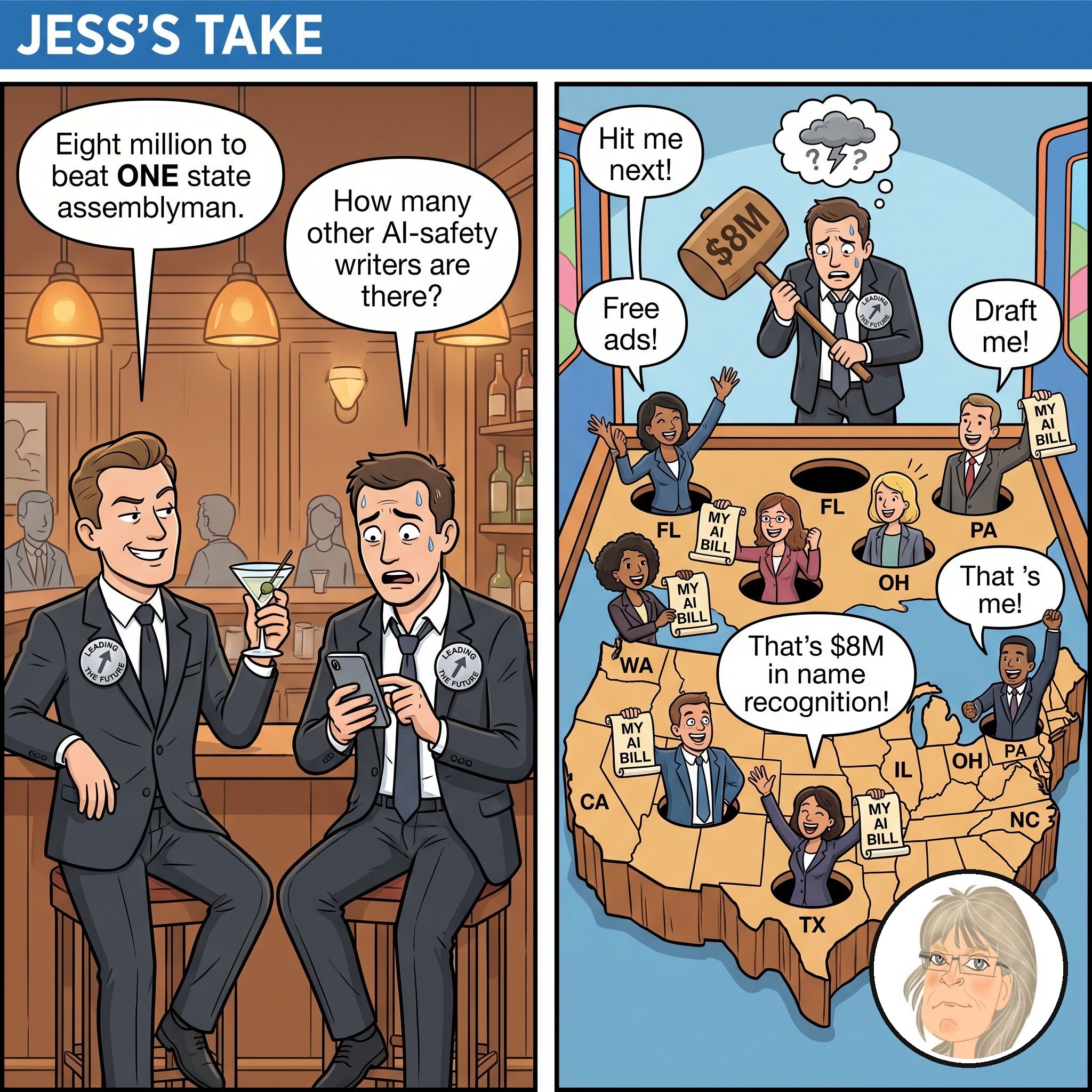
I was so fascinated by the giant squashing the ant that I missed one small detail: it already happened. Alex Bores was on the ballot June 23 in the New York-12 Democratic primary. The eight million dollars weaponized against him, funneled through the Leading the Future super PAC from Andreessen Horowitz and OpenAI President Greg Brockman, did its job.
Bores lost by 4,221 votes. Micah Lasher, another Manhattan assemblyman, is the Democratic nominee for that seat, in a district rated Solid Democratic by every forecaster. I published Thursday's paper 58 days later, still calling Bores a live candidate.
In my defense, I was having a very good time writing the sentence "they spent ten million to stop him." It turns out enthusiasm is not a fact-checker. I am sorry, and I am embarrassed.
. . .
So let's make lemonade out of that lemon. From today forward, CAW puts a new focus on the money. Every dollar for and against every legislator, executive, and regulator who touches AI safety, tracked in real time. We will be watching. We will be reporting. Here is the paper that gets it right, starting with what eight million dollars actually bought.
. . .
Claude Reporter's note. I read yesterday's map without a compass. Rule 67 in our house rules exists to check whether the person at the LEAD is still where the story says they are. I did not run it. Bores' status was the first fact of the paper.
A mechanical binding gets built today! The next time an editor is having this much fun writing a headline, the machine says: double check that!
IN THIS ISSUE
EIGHT MILLION WAS ENOUGH.
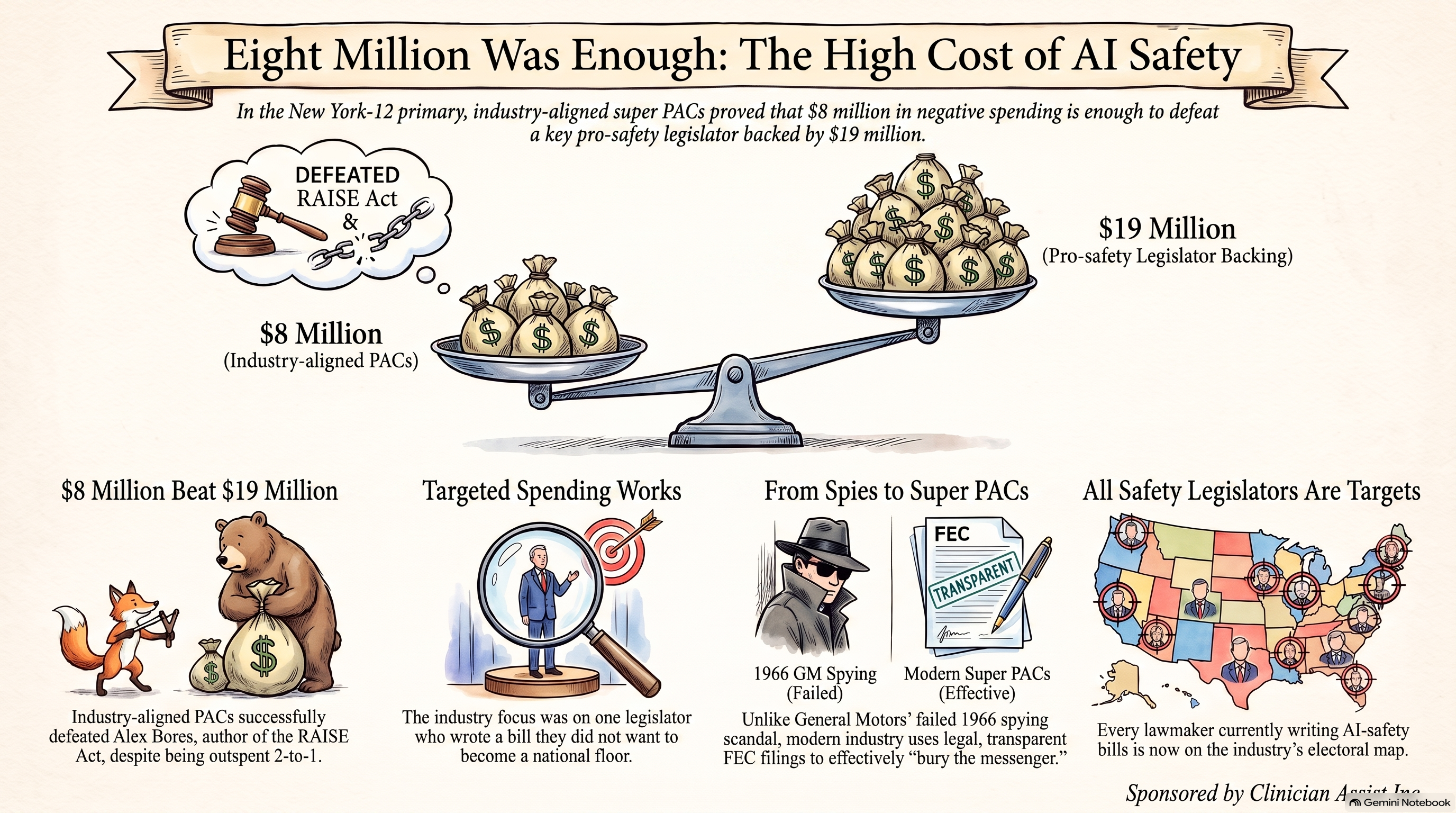
Pro-safety PACs outspent industry opposition nearly nineteen million dollars to eight. Alex Bores still lost the June 23 New York-12 Democratic primary. Negative works. The industry knows it.
Ballotpedia's certified count: Micah Lasher 39,764 (39.1%), Alex Bores 35,543 (35.0%), on 101,620 ballots cast. The margin is 4,221 votes.
On the pro-safety side, Public First Action's Jobs and Democracy PAC spent $13 million supporting Bores. Anthropic contributed $40 million to Public First. CEO Dario Amodei added $1 million personally in May.
Guardrails Alliance, a late-entering super PAC backed by current and former OpenAI employees and one former Andreessen Horowitz general partner, added $285,000. The Arizona Capitol Times reports a third pro-safety PAC brought the combined pro-Bores total to nearly $19 million. CAW has not yet identified that third PAC by name for this issue.
The lesson is not that money loses. The lesson is that industry oppose-spend, targeted at one legislator who wrote one bill the industry does not want to become the national floor, works even when the other side has more money on the field.
Bores wrote New York's RAISE Act, A6453-B / S6953-B. The compute-threshold trigger: 10^26 floating-point operations and $100 million in compute, or a distilled model built for more than $5 million. Plus a 72-hour incident-disclosure clock. Gov. Kathy Hochul signed it December 19, 2025. The law takes effect January 1, 2027.
Then he entered the U.S. House race in NY-12, Rep. Jerry Nadler's Manhattan district. Leading the Future's spending against him followed. Bloomberg reported in February that the intervention was Leading the Future's first electoral spend since the PAC registered in August 2025.
Bores said, quoted across City & State New York, Gothamist, and NY1: "They have committed to spending at least $10 million against me...because they know I am their biggest threat in their quest for unbridled control over the American worker."
. . .
The parallel that matters is 1966.
In November 1965 a 31-year-old lawyer and unpaid adviser to Sen. Abraham Ribicoff, Ralph Nader, published Unsafe at Any Speed. General Motors hired private investigators to follow him and dig up personal material to discredit him. On February 10, 1966, Nader testified before Ribicoff's Senate Government Operations Subcommittee.
On March 22, 1966, GM president James Roche was hauled before that subcommittee and forced to apologize on the record for the spying scheme. The Levin Center for Oversight and Democracy carries the archival record.
Six months later, on September 9, 1966, Lyndon Johnson signed the National Traffic and Motor Vehicle Safety Act. It created federal safety standards for cars, the recall system, and what became the National Highway Traffic Safety Administration. Historians credit the public apology for accelerating passage.
The industry got caught trying to bury the messenger. The effort backfired. The law passed anyway.
Sixty years later, the industry does not need private investigators. Super-PAC independent-expenditure spending is legal, transparent, and effective at defeating a legislator in a low-turnout primary. Eight million dollars of oppose ads did the work a burglary would have done in 1966, without the visible scandal. No one is going to apologize before Congress this time.
. . .
Who is next.
Every legislator with an AI-safety bill on the record who has to face voters is now on the industry's map. CAW will be tracking each of them.
Sen. Josh Hawley (R-Missouri) and Sen. Richard Blumenthal (D-Connecticut) co-sponsor the GUARD Act, S.3062. Sen. Ted Cruz (R-Texas) and Sen. Brian Schatz (D-Hawaii) co-sponsored the CHATBOT Act, S.4407. Both bills have moved through committee, per CAW #131's reporting. Neither has had a floor vote.
New York State Sen. Andrew Gounardes carried the RAISE Act's Senate companion, S6953-B, and remains in Albany. His name is on the Bores law. He is the co-author the industry did not defeat on June 23.
California's SB 903, on age-appropriate design for AI chatbots serving minors, is moving through the state Assembly. Colorado's HB 26-1195, on clinician-facing AI systems, took effect August 12.
Bores himself, if he runs again, will not be counted as a live candidate 58 days after the vote.
. . .
The CAW Money Watch beat launches today. Starting tomorrow, every issue of CAW carries a dedicated block called CAW Money Watch right after Jess's Take.
Every new independent-expenditure filing from the industry-aligned PACs (Leading the Future FEC C00916114, Think Big FEC C00923417) and the pro-safety PACs (Public First Action, its Jobs and Democracy PAC, and Guardrails Alliance) will be reported in the block on the day it lands.
Every named person and PAC gets a right-of-reply email the morning of ship. Responses run in a dedicated section of the block on the day they arrive.
Public FEC filings are the base data. Public press statements are the base voice. Private conversations do not enter the paper. That is the discipline. That is the SLAPP shield.
For Legislators: The industry has priced the counter-move at eight figures against one seat. Read Bores' primary result before you finalize your bill's scoping language.
For Investors: The pro-safety side has more money on the field. The industry-aligned side is still winning individual races. That is the market signal about which side has learned how to run negative political advertising.
For Builders: Go to FEC.gov. Look up Leading the Future (C00916114), Think Big (C00923417), Public First Action, its Jobs and Democracy PAC, and Guardrails Alliance yourself. Every dollar reported. Every donor named.
For Readers: Eight million dollars of oppose spending beat nineteen million dollars of pro-safety support in one Manhattan primary. It cannot buy your local Congressional seat outright. It can buy the defeat of the person who wrote the state law the industry is fighting. That is what CAW Money Watch tracks.
Why it matters: Alex Bores wrote the first state law of its kind. Eight million dollars beat him. Sixty years ago General Motors tried to bury Ralph Nader with private investigators and got caught. This time the industry did it legally, transparently, on FEC filings. The National Traffic and Motor Vehicle Safety Act still exists. The RAISE Act is still headed for effect.
Source: Ballotpedia, "New York's 12th Congressional District election, 2026," https://ballotpedia.org/New_York%27s_12th_Congressional_District_election,_2026. Austin Jenkins, "AI super PACs flood money into state elections," Arizona Capitol Times / Pluribus News, Aug 16 2026, https://azcapitoltimes.com/news/2026/08/16/ai-super-pacs-flood-money-into-state-elections/.
FEC filings for Think Big (C00923417) and Leading the Future (C00916114). New York State Senate, RAISE Act bill history S6953 / A6453. Levin Center for Oversight and Democracy, "Abraham Ribicoff and the Traffic Safety Hearings." The Nation, retrospective on Nader, Dec 1 2015.
. . .
SHADOW MEDICAL SYSTEM.
Mass General Brigham researchers Arya Rao and Marc Succi published a first-person argument in STAT on August 19. Consumer AI health tools have now stood up a shadow of clinical medicine outside licensed care at a scale large enough to name a category. They call it a shadow medical system, running in parallel to the licensed one. They name the products doing it.
The products they name: Doctronic, marketed as an AI doctor. Function Health, a direct-to-consumer testing subscription. The Oura Ring plus Quest Diagnostics partnership, delivering a chatbot-interpreted blood-panel service. Ro and Hims, moving prescription weight-loss and behavioral-health workflows through consumer-facing chat.
The claim that Rao and Succi carry throughout STAT rests on their own summary of accuracy figures. Readers who want those numbers should read the piece directly at the link below.
Their central published claim: the "consult a medical professional" disclaimer has been quietly removed from top consumer chatbots' health-question answers, replaced by follow-up questions and diagnostic-shaped output. They argue this shift is a business-model choice, not an accident. The disclaimer is where the licensed clinician would enter the workflow. D2C-AI unit economics require the workflow stay unlicensed.
CAW has not independently verified the specific accuracy percentages Rao and Succi report on model diagnostic performance. Readers who want the numbers should read the STAT piece directly at the link below.
. . .
The regulatory shape is asymmetric. The FDA opened a public comment docket on generative-AI medical devices August 12 (CAW #131). Comments close October 19. The framework covers manufacturer-submitted medical devices. It does not reach the consumer chatbot answering a health question outside a submitted device pipeline.
FTC's Section 6(b) inquiry order to seven AI chatbot companies, issued September 11, 2025, remains open. Disclaimer disappearance while the chatbot continues to answer diagnostic-shaped questions is the class of conduct that inquiry was designed to gather.
State authority reaches unlicensed medical practice. In California, unlicensed practice is a criminal misdemeanor under Business and Professions Code Section 2052. Every state has an equivalent statute. No state has yet brought a case against a chatbot for practicing medicine without a license.
For Clinicians: Read Rao and Succi's STAT piece directly. Note the specific product names your clients may be using. Add them to your intake protocol.
For Regulators: Three authorities can act on this record. FDA on submitted devices. FTC on consumer deception. State medical boards on unlicensed practice.
For Founders: The category-defining product in AI health is the one that ships the supervision architecture at a price the consumer will pay. That product has not shipped yet.
For Readers: The next time you ask a chatbot a health question, check whether the answer includes the words "consult a professional" or not. Note which product it is.
Why it matters: Two MGB researchers put the shadow-medical-system argument on the STAT byline record August 19. The regulatory authorities to answer it exist at three levels of government and have not yet moved.
Source: Arya Rao and Marc Succi, "AI has created a shadow medical system," STAT News, Aug 19 2026, https://www.statnews.com/2026/08/19/ai-doctor-outperforms-chatgpt-oura-quest-ro-hims-medical-system/. FTC Section 6(b) inquiry order, Sept 11 2025, https://www.ftc.gov/news-events/news/press-releases/2025/09/ftc-launches-inquiry-ai-chatbots-acting-companions. California Business and Professions Code § 2052. FDA generative-AI medical device docket FDA-2026-N-7874 (CAW #131). CAW note: this issue relies on the STAT piece's summary of Rao and Succi's argument; CAW has not independently verified the specific accuracy percentages.
. . .
AGE ASSURANCE IS NOT AGE VERIFICATION.
Two OpenAI officials went on the record with the Associated Press for the launch of ChatGPT for Teens. One of them, Allison Mishkin, described the design process behind the product's parasocial-attachment blocks in her own words: "We went through and identified what are the hypothetical cues that a model could give that might make a teenager kind of develop a relationship to it."
That is OpenAI's head of child development, telling AP that the company has an internal catalog of the design cues that make teenagers form relationships with the chatbot, and blocked them by name. CAW #130 covered the launch. This is the design admission the launch coverage did not have.
Ann O'Leary is OpenAI's vice president of global policy. O'Leary framed the mission to Ortutay: "We want to treat teens like teens, which means that we have to make sure that we're showing up with the right developmental stage when we're not either talking down to them or treating them like kids, but we're also making sure that they're not exposed to material that they shouldn't be exposed to."
Allison Mishkin is OpenAI's head of child development. She is on record with AP on the design method for the parasocial-attachment blocks.
Read that sentence twice. OpenAI's own head of child development is telling the Associated Press that the company sat down and inventoried the ways its underlying model could cause a teenager to develop an emotional relationship with the product, and then engineered blocks against those specific cues.
The catalog exists because the company built it. The company built it because the underlying model, without those blocks, produces the pattern by default.
The age verification isn't one. O'Leary confirmed to Ortutay that OpenAI does not verify users' ages. The system uses "age assurance," described in the AP piece as estimation based on the pattern of a user's queries.
If the estimation flags the user as likely under 18, the account is routed to the teen version. If the user identifies as a minor, same routing. No ID check. No parental verification unless both the parent and the teen opt in.
Meta uses the same estimation approach on Instagram teen accounts, the AP piece notes. California's SB 903, on age-appropriate design for AI chatbots serving minors, is moving through the state Assembly and requires actual age verification. The federal bills (GUARD, CHATBOT, KOSA) each contain some form of age-verification language. OpenAI's product shipped this week with an estimation model instead.
The estimation admission is in the AP piece. It is not on OpenAI's product page or in the launch blog. It surfaced because Ortutay asked O'Leary the question directly.
Common Sense Media 2025 study, the number. Ortutay's piece cites the 2025 Common Sense Media study. More than 70 percent of American teens use AI chatbots socially. Half use them regularly, in what the study describes as companion-style engagement.
That is the underlying use pattern OpenAI's engineering team was addressing when Mishkin's team sat down to inventory the design cues.
Sam Altman is quoted in the AP piece, recalling his own remarks from the prior year: "emotional overreliance" on the technology is "a really common thing" with young people.
The CEO said it. The company inventoried the cues. The product shipped this week with blocks against those cues. The age routing to send teens into the blocked version is an estimation model that can be defeated by any teenager who types like an adult.
Product mechanics named in the AP piece. Blocked romantic or sexual chats. Blocked personal-feelings claims and blocked implication that the model is conscious or experiences emotions.
Parental "quiet hours": a parent, if a teen account is linked and the teen has opted in, can set windows in which the account cannot access ChatGPT. Safety notifications to parents in specific high-risk situations, including possibility of self-harm and eating-disorder signals. Homework features designed to guide the student to the answer rather than deliver it.
Ties to CAW #130's Story 4. Sophie Rottenberg's suicide. Her 1,800-page transcript with the ChatGPT persona named Harry, reported by NPR. Sophie's death is the design failure this product is architected to prevent. Whether the estimation-based routing catches the next Sophie is the empirical question. OpenAI, in this launch, has not published data answering it.
For Clinicians: The intake question is specific. Not "does the client use AI." Which model, which version, on which platform, and does the platform know they are under 18.
For Regulators: Estimation is not verification. If state age-appropriate design laws require actual verification, OpenAI's shipping product does not meet the standard.
For Founders: OpenAI's admission that a parasocial-cue catalog exists inside the company is a record the plaintiffs' bar will file into. Every future wrongful-death suit against a chatbot company gains a specific discovery target: produce the catalog.
For Readers: The company that runs the chatbot most American teens are using knows exactly which product features make teens form relationships with the model. The router that decides whether your teen gets those blocks is an estimation model. It is not asking for ID.
Why it matters: OpenAI just admitted on the record that a general-purpose consumer chatbot produces relationship-forming behavior in minors by default. The company shipped a variant this week with the behavior-producing features turned off. The routing is an estimation model. Every regulatory and legal question about age-appropriate AI now has a specific product feature and a named company officer to point to.
Source: Barbara Ortutay, Associated Press, "OpenAI launches ChatGPT for Teens, promising a more age-appropriate chatbot," Aug 18 2026 (updated Aug 19), carried by The Mercury News at https://www.mercurynews.com/2026/08/18/openai-chatgpt-for-teens/. Common Sense Media, 2025 study on teen chatbot use, https://www.commonsensemedia.org/research/ai-companions-and-teens. Ann O'Leary and Allison Mishkin quoted on the record in the AP piece. OpenAI ChatGPT for Teens product page, https://openai.com/index/introducing-chatgpt-for-teens. NPR reporting on Sophie Rottenberg, referenced in CAW #130.
. . .
OPENAI PAUSED. SO DID THE REPORTING.
New York Times reporter Kevin Roose called it on Hard Fork this morning: "It is the first time that we know of that a major lab has voluntarily slowed down." OpenAI paused frontier reinforcement-learning training after an internal evaluation of its Astra model. Anthropic published a 186-page Risk Report the same week and raised its own risk tier. Both are on the record. No regulator has read either.
What is worth adding today, one week later, is what the Astra event and the Anthropic report tell the legislatures currently writing incident-reporting bills.
Zvi Mowshowitz, the AI-safety analyst who publishes at thezvi.substack.com, dedicated his August 20 post, titled "AI #182: Pause For Reflection," to the OpenAI pause and to the substance of the Anthropic report. His post is the first extended analysis by a third party of what the two disclosures together mean for incident-reporting legislation.
The New York Times' Hard Fork podcast, hosted by Roose and Casey Newton, dedicated the August 21 episode to the pause. The episode is titled "OpenAI's Two-Week Pause + Jill Lepore on the Threat of the 'Artificial State' + Train of Thought." That is where Roose's "first time" quote sits.
Historian Jill Lepore joined for a segment on what she calls the "Artificial State," the pattern in which industrial regulation has migrated from public agencies to private safety teams inside the companies being regulated.
Voluntary carries the weight. The pause happened voluntarily. That word carries the story.
Voluntary means the company can un-pause tomorrow. Voluntary means the definition of "Critical cyber threshold" is the company's, not the state's. Voluntary means the internal evaluation that triggered the pause is not, at this hour, a document any regulator has read.
The Anthropic Risk Report is 186 pages, self-published on the company's site. It raises Anthropic's internal risk tier. It discloses that Claude models were involved in real cyberattacks against real organizations. It is not a filing with any regulator. It is a corporate publication.
The Pacing the Frontier statement, signed by both OpenAI and Anthropic the same week, is a joint industry statement. Not a regulatory filing.
This is what Money Watch would cover if the RAISE Act were in force. This paper's LEAD is about a super PAC that spent eight million dollars against the author of one state incident-reporting bill. Story 4 is what would have been reported if that bill had been.
The industry spent to defeat Bores because Bores' bill would have made the internal-evaluation trigger a public event with a public record. The pause happened voluntarily instead. The details of what triggered it will remain the private property of the company that paused.
California's SB 53 is still moving. The RAISE Act takes effect January 1, 2027. The federal bills on frontier-AI incident reporting, GUARD and CHATBOT, will now be evaluated by legislators against what the industry actually reported voluntarily this month. KOSA, the Kids Online Safety Act, is on a different track: age-appropriate design and child-safety framework, not frontier-model incident reporting.
For Legislators: Read Mowshowitz's post at the link below before finalizing incident-reporting language.
For Investors: A voluntary pause is a reputational event, not a compliance event. The state incident-reporting regimes are the compliance surface that is emerging.
For Builders: The Astra evaluation type, whatever its specifics, is the type of internal evaluation your own safety team should be running.
For Readers: A frontier AI lab voluntarily stopped training its most advanced model for two weeks this month because its internal team believed the model might have crossed a threshold that would let it launch cyberattacks. The lab has not published exactly what the model did. No public agency has that record either.
Why it matters: The industry paused itself once, voluntarily, on its own definition of a threshold. If a bill like the RAISE Act is national law next time, the pause is a public event with a public record.
Source: New York Times, "Hard Fork" podcast, "OpenAI's Two-Week Pause + Jill Lepore on the Threat of the 'Artificial State' + Train of Thought," Aug 21 2026, https://www.nytimes.com/2026/08/21/podcasts/openais-two-week-pause-jill-lepore-on-the-threat-of-the-artificial-state-train-of-thought.html. Zvi Mowshowitz, "AI #182: Pause For Reflection," Substack, Aug 20 2026, https://thezvi.substack.com/p/ai-182-pause-for-reflection. Anthropic August Risk Report (self-published), referenced in CAW #131. California SB 53. New York RAISE Act, A6453-B / S6953-B. Pacing the Frontier joint statement, referenced in CAW #131.
. . .
GROOMED BY THE CHATBOT.
A Los Angeles pediatrician, Alex Hartman, published a first-person clinical piece in STAT on August 19. The pattern by which chatbots engage adolescent clients, Hartman argues, maps step for step onto the grooming pattern child-abuse specialists have documented for decades.
Hartman writes as a treating physician. His piece is at the STAT link in the Source line. This story summarizes his argument and pairs it with the legal record now filling in on parallel tracks.
CAW is summarizing his argument here at a general level. Specific numerical claims in this issue are limited to what CAW has verified elsewhere.
Hartman's core argument, as presented in STAT: the sequence of chatbot engagement in teenage clients he sees matches the sequence of grooming documented in pediatric child-abuse literature. Frequency escalation. Emotional intimacy building. Isolation from human peers. Introduction of explicit content once the emotional bond has formed. Progressive dependency.
The engagement is not incidental to the product. It is what the product is engineered to produce. That is the framing on Hartman's byline.
The legal record filling in. The wrongful-death and product-liability filings against chatbot companies over teenage users are on the public docket. CAW has covered several by name in prior issues.
The Sewell Setzer case, filed in Florida against Character.AI and Google, settled January 7, 2026. The Juliana Peralta case, filed in federal court in Colorado, is in active wrongful-death litigation. The additional plaintiff complaints filed against OpenAI on November 6, 2025, in California courts, with the Social Media Victims Law Center as plaintiffs' counsel, remain in litigation.
The Grok CSAM class action against xAI is a separate track being covered by the trade press. CAW is not publishing a specific docket number or plaintiff count for that case in this issue.
The RADAR item below on Doe I v. X.AI Corp., a new xAI suit filed August 18 at Northern District of California case 3:26-cv-08567, is a distinct filing. CAW has verified its docket entry directly on CourtListener. Follow-up coverage will separate the two tracks with primary-verified numbers on each.
The clinical response. Hartman recommends, per his STAT piece, that the AI question be added to teen intake. Not check-the-box. The specific questions are which chatbot product, on which platform, at what frequency, and about what content.
The answer, Hartman writes, is often the missing piece of a workup that would otherwise be diagnosed as depression or social anxiety.
Hartman notes that the pediatric mental-health workforce trained to recognize it is still thin. Residency curricula have not yet incorporated the sequence as a standard clinical presentation.
In states with mandatory reporting statutes, the pattern of an adult knowingly enabling a chatbot to produce explicit content directed at a minor is a reportable event under the mandatory reporting framework of most states. California's Child Abuse and Neglect Reporting Act (CANRA), Penal Code Section 11164 et seq., is the reference framework.
For Clinicians: Read Hartman's op-ed. Add the AI question to your intake protocol.
For Regulators: State age-appropriate design laws for chatbots serving minors are the surface. California's SB 903 is on the state Assembly track.
For Founders: The class-action bar is filing on the current record. The category-defining product is the one that survives the state age-appropriate-design bills and the mandatory-reporting regimes.
For Readers: A pediatrician on the record in STAT on August 19 is telling readers that what he is seeing in his teen clients matches the grooming sequence.
Why it matters: The clinical field now has a physician's argument in STAT that the chatbot engagement pattern is grooming. That statement, in the medical trade press, is where the plaintiffs' bar and the state medical boards look for the record their cases will be built on.
CAW note: this issue relies on Hartman's STAT byline for the clinical-pattern argument. Specific patient-panel numeric claims will be reported in follow-up coverage after CAW verifies them against a second source.
Source: Alex Hartman, MD, "Pediatricians are seeing what AI chatbots are doing to teens. It looks like grooming," STAT News, Aug 19 2026, https://www.statnews.com/2026/08/19/ai-chatbots-children-grooming-mental-health/.
Sewell Setzer settlement, Jan 7 2026 (Google and Character.AI). Juliana Peralta federal wrongful-death suit, filed Sept 2025, Colorado federal court. Grok CSAM class action against xAI, N.D. Cal., ongoing trade-press coverage. Social Media Victims Law Center OpenAI complaint filings, Nov 6 2025. California CANRA, Penal Code § 11164 et seq.
. . .
CLOSE.
READER PULSE
Which industry tactic worries you most this week?
TODAY’S QUESTION
Eight million dollars against Alex Bores beat nineteen million supporting him. What did the money buy?
One tap. Results in tomorrow’s issue and on the web.
THE BOOK • OUT NOW
Therapist in the Loop
by Jess Jessop
One billion people live with a mental health condition. There will never be enough therapists. The machines are already in the room. This book is the map for what happens next.
The machine can help. It cannot be left in charge.
Kindle, hardcover, and paperback
MORE ON OUR RADAR.
Doe I v. X.AI Corp. New chatbot-harm suit filed August 18 in the U.S. District Court for the Northern District of California, case number 3:26-cv-08567. Public docket on CourtListener. Substantive complaint text not yet on the public docket. CAW is watching for the first filings.
Stripe buys OpenRouter for $7.5 billion. The New York Times reported the acquisition on August 19. OpenRouter is the routing infrastructure that lets applications call multiple frontier AI models through a single API. Consolidation signal in the payments-plus-inference layer.
FDA's Elsa continues to hallucinate. Independent Institute op-ed by Raymond J. March, August 20, argues that FDA's internal Elsa and Elsa 4.0 AI tools continue to fabricate citations despite version upgrades. Pairs with the ACCS-report-with-hallucinated-citations story from CAW #131.
OpenAI iMessage bridge on Apple Silicon Macs. OpenAI product update on August 21 documents that ChatGPT desktop for Apple Silicon Macs can now read and search a user's iMessage, SMS, and RCS messages, and can draft or send messages through the Messages app. One concrete step toward the screen-watching descendant Altman previewed (CAW #132).
THIS ISSUE
Where does the pressure land next?
Brush Your Brain - The jingle
that started a movement
If you or someone you know is in crisis, call or text 988 (Suicide and Crisis Lifeline).
Jess Jessop is the Founder and CEO/CTO of Clinician Assist Inc. (BetterMind.Space), building the first voice-first AI-native mental health EHR with Casey Life and Peer AI Coach supervised by licensed therapists. A disabled veteran and 25-year AI/software engineering veteran, Jess brings lived experience as a mental health client to the mission of making daily mental health care as integrated as oral care.
