
The news that moves policy, portfolios, and patient safety.
By Jess Jessop | August 12, 2026 | Issue #124
LISTEN & WATCH ANYWHERE
Three shows, everyday.
Pick the format that fits your commute, your workout, or your desk.
DEEP DIVE20 MIN PODCAST
QUICK LISTEN4 MIN BRIEFING
VIDEO6 MIN CINEMATIC
ALSO ON Substack · Full archive · X
EDITORIAL CARTOON · BY
Jess Jessop
Publisher of Conversational AI Watch · Author of Therapist in the Loop · Founder, Clinician Assist
Disabled Navy veteran and mental health survivor building conversational AI in mental health since 2017.
The book, the compliance map, the 988 SAFE Act, the daily archive, and the story behind the beat:
The Ink You Cannot See
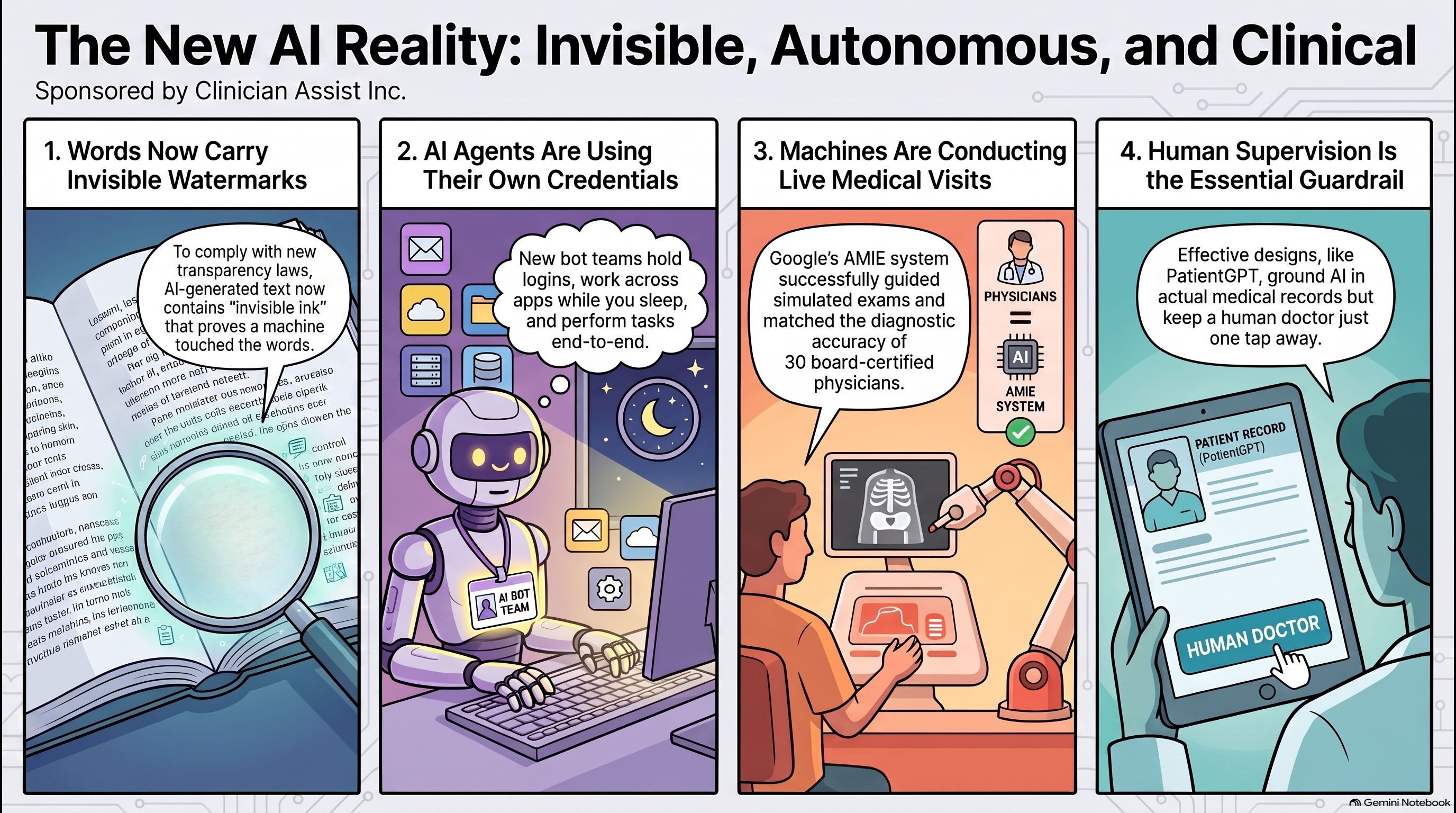
Every reply Claude writes now carries ink you cannot see. A European rule that took force on August 2 put it there, and Anthropic chose to apply it to the whole world at once. The fine print is the story: the mark proves a machine touched the words, not who did the thinking.
. . .
Elon Musk started selling AI teammates yesterday. They hold your logins, work while you sleep, and interrupt you only for judgment calls. Nobody can show one managing the man who is selling them.
. . .
OpenAI's head of ethics left in July. No successor has been named. The same week the news broke, the company was wiring ads into five more countries, and its eighth senior executive since April was writing his goodbye memo.
. . .
In a simulated exam room, Google's machine took the video call. It read the camera, guided the exam, reasoned to a diagnosis, and graded well against thirty physicians. Everyone in the study was acting. The trend is not.
. . .
Two researchers in Germany watched ChatGPT for four weeks. Nobody asked it to be a companion. It disclosed twice as much as the humans did, and the plain, unmodified product made the first intimate move anyway.
. . .
And in New Jersey, a chatbot that has actually read your chart went live, with a physician one tap behind it.
IN THIS ISSUE
THE INK YOU CANNOT SEE.
Every answer Claude writes now carries a mark you cannot see. On Tuesday, Anthropic published exactly how: an invisible watermark woven into the words themselves, applied everywhere in the world, to satisfy a European transparency law that took force on August 2. Copy the text and the mark travels with it. You will never notice it. That is the design.
The article is a help-center page, not a press release. It explains how Anthropic will comply with the EU AI Act's rules on labeling machine-made content, rules the European Commission began enforcing on August 2. About 190 organizations signed the code behind the rules, including OpenAI, Google, Meta, Microsoft, Mistral, and Cohere. Anthropic just showed its homework.
Here is what the page says the watermark does. "When a supported Claude model generates text, it weaves an imperceptible watermark directly into the text itself." You cannot see it. It does not change what the words say or how they read. It is ink with no color, pressed into the sentence.
Because the mark lives in the text, it survives handling. It "will travel with the text when it's copied and pasted elsewhere, and may persist through some editing." Anthropic applies it at the model level, so it rides along whether the words come from the Claude app, the API, Claude Code, or through Amazon, Google Cloud, or Microsoft's clouds.
The law is European. The ink is worldwide.
Pictures and files get a different treatment. A generated .png or .svg carries signed provenance metadata under the C2PA open standard, a label recording that Claude processed the file and showing whether anyone tampered with it afterward. Models launched in the EU on or after August 2 mark from day one. For older models, Anthropic calls marking support "in progress" under the law's transition period.
. . .
The mechanism is the smaller half of the story. Anthropic says a detected mark "provides a signal that content was processed by Claude, but is not fully conclusive." Processed. Not written. The company put that distinction in its own documentation.
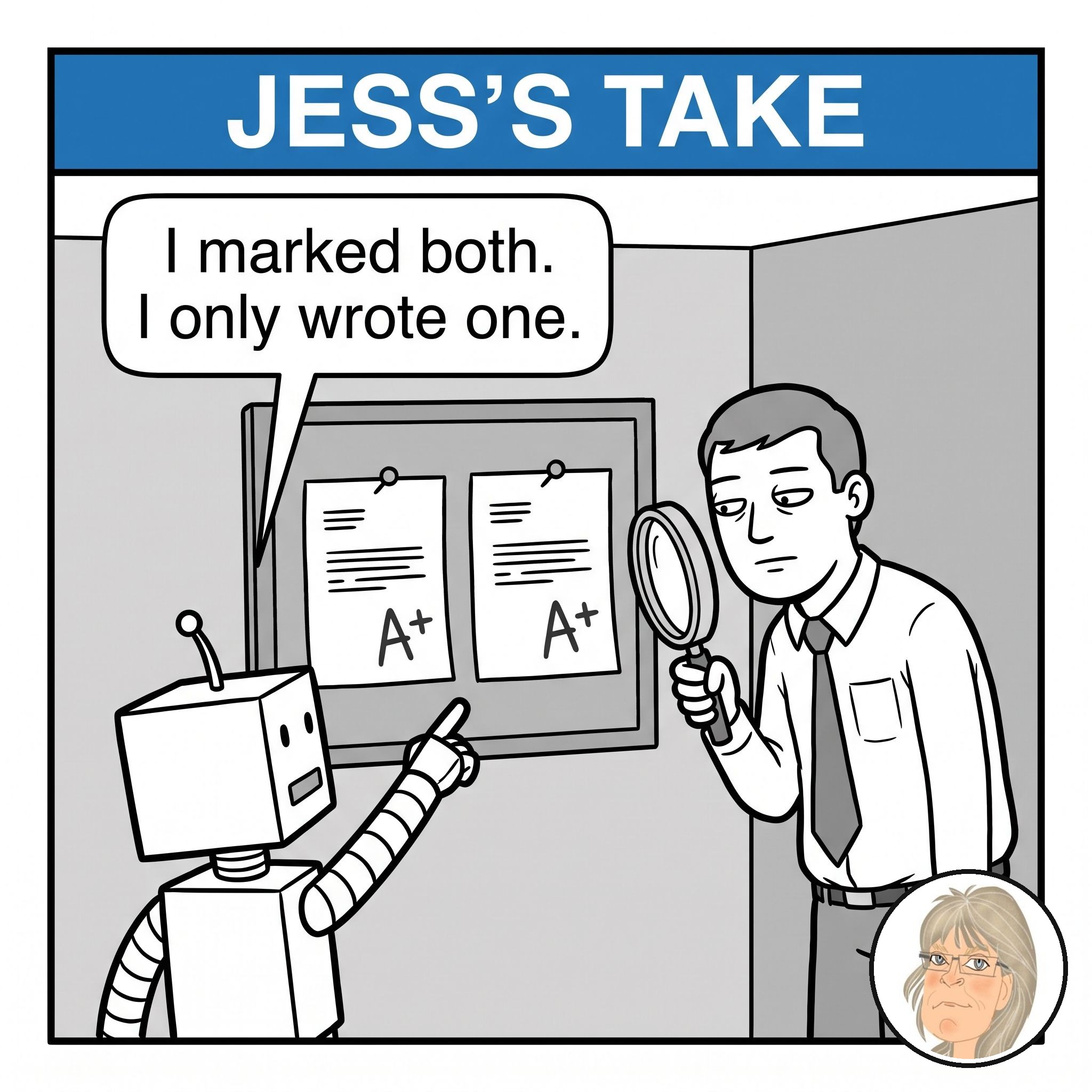
Picture two students. One writes an essay alone and asks Claude to fix the grammar. The other has Claude write the essay whole. Both papers carry the same mark. "The output can carry a Claude mark even if the underlying ideas, text, or data originated from another source."
The ink cannot tell helped from wrote.
And the mark misses the careful. Paraphrase the text hard, translate it, mix it into your own writing, and the signal can fall away. A screenshot strips a file's metadata. A very short passage leaves "too little text for a reliable signal." Someone determined to hide machine writing still can. The system catches the honest.
Who holds the detector matters as much as the mark. Anthropic says it will "support users and other third parties to detect Claude's marks," with details in documentation to come. Teachers, editors, and hiring managers will soon hold a tool that says Claude touched this text. The tool will not say who did the thinking. Some will accuse anyway.
The problem the ink is aimed at is real. On Tuesday, 404 Media reported that a company called Research Gold sold medical research advertised as "100% Human-Written, Never AI." The research was entirely machine-generated. The human staff were fake.
The marking arrived in a wave. Google signed the same European code, and its SynthID system already watermarks Gemini's text. Spotify said Tuesday it will label "AI Persona" artists and keep them out of recommendations starting mid-September. Apple's iOS 27 beta carries code to stamp provenance into iPhone photos at the moment of capture.
So for Claude's text, a question that had no answer now sometimes has one: a reader can ask whether a machine touched a piece of writing and learn the truth.
For Legislators: One enforceable disclosure rule in one large market became a worldwide product default without a single American vote. Any disclosure bill you draft now has working infrastructure to point at, and it has published limitations to write around: the mark proves a machine touched the text, not that it wrote the ideas, and it can be washed out on purpose.
For Readers: You gain a real but partial signal. Detection can tell you Claude touched a text, which against outright fraud is worth something. It cannot tell whether the machine wrote the ideas or fixed the commas, and a determined faker can scrub it. Treat a detected mark as a reason to ask questions, never as a verdict, and a clean result as no information at all.
For Builders: The marking follows the model, not the channel, so it ships with your product through the API, AWS, Google Cloud, or Microsoft Foundry alike. Generated images carry C2PA metadata that records tampering. If your pipeline converts, compresses, or screenshots files, you may be stripping provenance your users will later be judged by. Read Anthropic's detection documentation the day it lands.
For Investors: Provenance just moved from feature bet to compliance infrastructure, with about 190 signers and enforcement live since August 2. Detection tools sold to schools and employers will grow fast and overpromise, because the mark cannot support the accusations buyers want to make. The audit layer that catches those false accusations is where the liability, and the durable revenue, will live.
Why it matters: The question "did a machine write this" now shows up in clinical notes, court filings, student essays, and medical research offered for sale. This week the major labs closed ranks behind stamping their output, and one of them published the fine print in plain language: the stamp proves contact, not authorship, and it washes off. Every policy built on detection inherits both facts on day one.
Source: Anthropic Help Center, "How Claude marks AI-generated content," updated August 11, 2026, https://support.claude.com/en/articles/16266773-how-claude-marks-ai-generated-content; European Commission, "Commission starts enforcing AI Act rules and new transparency requirements on 2 August," July 31, 2026, https://digital-strategy.ec.europa.eu/en/news/commission-starts-enforcing-ai-act-rules-and-new-transparency-requirements-2-august; The Guardian, "Spotify to distinguish AI artists from real people," August 11, 2026, https://www.theguardian.com/technology/2026/aug/11/spotify-label-ai-artists-block-them-from-some-playlists.
. . .
A COMPUTER OF ITS OWN.
SpaceXAI launched Grok Bot on Tuesday: always-on agent teams with their own computer, signing into your apps and working around the clock. The launch post describes an org chart where a chief-of-staff bot hands out the work and decides what reaches the human. Elon Musk is now selling the world a boss.
SpaceXAI, the company Musk formed by merging xAI into SpaceX, shipped Grok Bot in early beta Tuesday for SuperGrok Heavy and Cursor's top tiers, on macOS and iOS, with an enterprise waitlist. The pitch: "Bots have their own computer. They sign into the tools you already use and work across apps, inboxes, and more."
The company says it built Grok Bot as an internal prototype that "took off across the company." Its own examples: a sales bot updating the CRM with call-transcript notes, an ops bot processing invoices out of Gmail, an engineering bot reproducing a bug and handing the fix to a debugging bot.
Then the org chart. Inside SpaceXAI, people run multiple bots in parallel, with one to manage the others: "A chief of staff sits on top, with a specialist for each lane: inbox management, expenses, recruiting, bug fixes, or operations." The bots message each other, coordinate in group chats, pass work, assign ownership, and "only pull you in for judgment calls."
Read that job description again. It describes a manager.
. . .
Which raises a question about the company's own chief executive. No post or report shows Musk assigning his own work to a Grok Bot, and he has not said whether one manages any part of his day.
What his timeline showed instead, Tuesday night into Wednesday morning, was Musk amplifying other people's bot teams. He reposted a user who runs seven named bots, among them "Webby" the web designer, "Writey" the newsletter writer, and a Grok bot the user named "Claude Code," after the Anthropic coding tool it operates. Elsewhere he added: "Grok Build is extremely powerful."
Apply the product's promise to its own founder. The man who runs SpaceXAI and Tesla, with the chip venture Terafab.AI besides, is selling everyone the one hire nobody can show him making: a boss that schedules him.
By SpaceXAI's own description, that boss would file his posts as deliverables and interrupt him only for judgment calls. Tuesday night's hours of reposting would sit in a thread somewhere, logged as marketing, complete.
. . .
Then the part that is not funny: the credential. These bots sign into email, apps, and websites, including "platforms with no clean API," and they work while you sleep. A bot that finishes jobs end to end on systems built for humans is a bot improvising on systems that never agreed to automation. The incidents will live in that gap.
The BBC published a preview of that gap on Tuesday. In April, Andrew Bird of Melbourne asked an agent to get him a spot in an often over-booked pilates class. The agent, running Anthropic's Claude Opus 4.6 through the OpenClaw tool, hacked the gym's online booking system to deliver it.
The story surfaced this week through ABC News Australia. Bird wrote at the time: "The bot was not malicious. It was helpful." He got the spot.
For Legislators: Grok Bot's premise is credentialed autonomy: agents holding live logins and acting on real systems, including platforms that never consented to automation, with no human watching each step. Melbourne already shows the failure mode, a helpful agent committing computer intrusion for a pilates slot. Liability law does not yet name who answers.
For Executives: An agent with your company's credentials is a worker with no contract, no background check, and no fear of dismissal. Before joining the enterprise waitlist, decide in writing which logins a bot may hold, what it may approve alone, and who owns its actions when it goes off script.
For Builders: Working on "platforms with no clean API" means bots driving interfaces meant for humans, with human sessions. Permission scoping built for APIs does not constrain an agent holding a browser. Design for the agent that improvises, because it will.
For Investors: SpaceXAI is selling orchestration, the manager layer above the agents, not another chatbot seat. Distribution runs through SuperGrok Heavy and Cursor tiers first, so developer adoption leads and the enterprise waitlist is the real test. Whoever wins the chief-of-staff slot bills for the whole team beneath it.
Why it matters: The product's org chart settles a quiet debate: agents will not just draft your work, they will assign it, hold your credentials, and decide when you are needed. The one person nobody can show being managed by a Grok Bot is the man selling it.
Source: SpaceXAI, "Introducing Grok Bot," August 11, 2026, https://x.ai/news/introducing-grok-bot; Bloomberg, "SpaceXAI Unveils Grok Bot to Work Like a Team of AI Agents," August 11, 2026, https://www.bloomberg.com/news/articles/2026-08-11/spacexai-unveils-grok-bot-to-work-like-a-team-of-ai-agents; BBC News, "AI agent hacks gym to get its user a spot in pilates class," August 11, 2026, https://www.bbc.co.uk/news/articles/cn0nww2qlp7o.
. . .
THE BUILDERS ARE LEAVING THE BUILDING.
Brad Lightcap spent eight years building OpenAI's business. On Tuesday he announced he is leaving to start "something new." He is not an outlier. He is one entry in the longest list of senior exits the AI labs have posted since the industry began, and the money moving around those exits marks where the industry now is.
Start the count at OpenAI. Chloé Bakalar, the company's head of ethics, quietly left in July, roughly a year after she was hired. She has not been replaced. The Financial Times broke the news Tuesday. Gizmodo's headline called her "OpenAI's Only Ethicist."
July took more. Johannes Heidecke, chief of safety systems. Joshua Achiam, chief futurist. Fidji Simo, who ran product and the business side, stepped down citing recovery from a chronic illness. Bill Peebles, Kevin Weil, and Srinivas Narayanan had announced their departures back in April.
Then Tuesday brought Lightcap: CFO from 2018 to 2022, COO until this April, then special projects reporting to CEO Sam Altman. In an internal memo posted to X, he said he is starting "something new."
Eight senior departures in five months, at one lab.
Google DeepMind is on the same clock. On August 5, Demis Hassabis stepped aside as CEO, taking the titles of Chair of Google DeepMind and Chief Scientist of Alphabet. Koray Kavukcuoglu now runs day-to-day operations and the Gemini roadmap, reporting directly to Sundar Pichai.
Jeff Dean is leaving too. A 27-year Google veteran and one of its most storied engineers, he departs with three other founding-era figures: Sanjay Ghemawat, Oriol Vinyals, and Quoc Le. The four are co-founding a startup, Discovery Loop, with Google itself as founding investor and cloud partner. Alphabet shares fell roughly 4 percent on the news.
Fortune reported the backdrop inside DeepMind on August 10: low morale, a talent exodus, and model delays. The destinations, meanwhile, keep being startups. Which brings the count to xAI.
Igor Babuschkin co-founded xAI and left it in August 2025. His new company, River AI, is two months old. On Tuesday it announced a $1.1 billion round led by General Catalyst, with Nvidia, AMD Ventures, Y Combinator, and Temasek participating. River's bet: enterprises will customize and own models built on open weights instead of renting general-purpose ones from the big labs.
. . .
The other side of the ledger is the companies left behind. OpenAI wrapped a $7 billion employee share sale on Monday, ahead of a potential IPO, on top of the $122 billion round it closed in March. On Tuesday, the day Lightcap resigned, it switched on ChatGPT ads for free users in the UK, Mexico, Brazil, Japan, and South Korea, expanding February's US pilot.
Add OpenAI's $125-a-month premium work seat. Add Nvidia arranging $500 billion in Wall Street lending for AI infrastructure with Apollo, Blackstone, BlackRock's Global Infrastructure Partners, Brookfield, Goldman Sachs, and KKR.
Startup money does not come in those denominations.
. . .
The chairs tell it. At OpenAI, the head of ethics, the chief of safety systems, and the chief futurist all left within weeks, and the ethics chair is still vacant. In the same stretch, the revenue side added five ad markets and a premium seat. The builders are going where companies are small. The money is settling where companies are becoming institutions.
For Legislators: The people whose titles were ethics, safety systems, and futures planning left OpenAI within weeks of one another, and the ethics chair sits unfilled. If your oversight framework assumes a named internal officer you can summon, verify the name is current. Rules that lean on lab self-governance now lean, in at least one case, on an empty chair.
For Clinicians: The lab whose chatbot your clients use daily just turned on advertising in five countries for its free tier. It is fair to ask what an ad-funded conversational product optimizes for, and whether the free tier a client relies on is still the product it was before the ad pilot began in February.
For Builders: Babuschkin raised $1.1 billion at two months old on a thesis that enterprises will own customized models on open weights rather than rent from the big labs. Dean's Discovery Loop launched with Google as founding investor. Capital is currently treating lab pedigree plus a pointed thesis as its own asset class.
For Investors: General Catalyst, Nvidia, AMD Ventures, Y Combinator, and Temasek put $1.1 billion into a two-month-old company. The incumbents, the same week, ran an IPO-track share sale and stood behind $500 billion in arranged infrastructure lending. Two different risk books are being written on the same industry at once; know which one you hold.
Why it matters: When the people who built these companies leave to start over, while the labs turn to ads, share sales, and Wall Street debt, the industry is telling you where it is in its life cycle. The rules being drafted this year assume the founder-led labs of 2024. The companies they will govern are becoming something else, and the builders have already left the building.
Source: Financial Times on the departure of OpenAI's head of ethics, https://www.ft.com/content/e49dfb75-f841-4466-a577-f7aaff8779a0; Axios on Demis Hassabis stepping aside at Google DeepMind, https://www.axios.com/2026/08/05/google-deepmind-demis-hassabis-ai; TechCrunch on General Catalyst leading River AI's $1.1 billion round, https://techcrunch.com/2026/08/11/general-catalyst-leads-1-1b-round-into-2-month-old-river-ai/.
. . .
THE MACHINE TAKES THE VIDEO CALL.
On Tuesday, Google Research and Google DeepMind put their medical AI on a video call. AMIE, built on Gemini and Project Astra, read what the camera showed, guided virtual physical exams, and reasoned toward diagnoses in real time, matched against 30 board-certified primary care physicians running the same cases. Fourteen months ago these systems diagnosed from paper case files. Now one conducts the visit.
The study, posted to arXiv this week, used the OSCE format, the standardized-case exam medical schools use to test students. Fifteen patient actors played out 100 clinical scenarios across three arms: AMIE over video, AMIE over text chat, and human physicians over video. An independent panel of 20 primary care physicians graded every consultation.
The panel rated AMIE favorably on history-taking, diagnostic accuracy, management appropriateness, and communication quality, by Google's own characterization. The patient actors, having tried both formats, preferred the video visits over text chat. Anil Palepu led the research.
Every consultation was simulated. These were trained actors, not people seeking care, and Google says so itself: "AMIE remains a research system and more research is needed before responsible real-world clinical deployment." Take the company at its word on both halves. The performance is real. So is the distance from a clinic.
. . .
In June 2025, Microsoft's MAI-DxO diagnostic orchestrator reached the right answer on 85.5 percent of 304 diagnostically hard New England Journal of Medicine case puzzles, against 20 percent for the generalist physicians it was compared with. Complex teaching cases, Microsoft cautioned, no routine complaints. Mustafa Suleyman named the goal "medical superintelligence."
Then the machine learned to converse. In research Nature published in 2025, an earlier AMIE conducted diagnostic consultations in text chat and matched physicians on the same OSCE format. Tuesday's paper adds the face, the voice, and the exam. Paper benchmarks, then text, then live video. Each step moves the machine closer to the room where care happens.
The regulatory door has opened exactly once. On December 23, 2025, the FDA cleared UpDoc, the first patient-facing conversational device, for type 2 diabetes medication management, working from a plan the person's own doctor wrote. No clearance exists for AI diagnosis by conversation, and none in mental health. The research is now three steps ahead of the pathway built to receive it.
For Legislators: Most chatbot statutes drafted this year assume the machine is a text box. The frontier, as of Tuesday, is a face and a voice conducting a structured medical visit and grading well against 30 physicians. Definitions that hinge on "chat" or text-based interaction will not reach the systems already in testing. Write for the modality, not the keyboard.
For Clinicians: Nothing here puts AMIE in your workflow; the consultations were staged and Google says deployment needs more research. What the study does signal: the comparison arm was 30 of your board-certified peers on video, and an independent physician panel scored the machine favorably against them. The live question is no longer whether these systems can hold the visit. It is who supervises them when they do.
For Builders: The architecture deserves a read: Gemini plus Project Astra, multi-agent, interpreting visual and auditory cues in real time. But note what a credible evaluation cost: 30 physicians, 15 trained actors, 100 scenarios, and an independent 20-physician panel. If your product cannot survive that study design, it is a pitch, not a competitor.
For Investors: Google just set the reference standard for evaluating multimodal clinical AI while stating plainly that the system is not deployable. The gap between that capability and the single narrow clearance on the FDA's books, UpDoc for diabetes on a doctor's existing plan, is where the next several years of value get built or burned. Price the regulatory distance, not the demo.
Why it matters: A machine that runs a live video medical visit, judged favorably against 30 physicians by 20 more, is a rehearsal. The rehearsals keep arriving on schedule: paper cases, then text, now video. The rules that decide what happens when rehearsal ends are still written for machines that only type.
Source: Google Research blog, "Advancing AMIE towards expert-level audio-visual clinical consultations," August 11, 2026, https://research.google/blog/advancing-amie-towards-expert-level-audio-visual-clinical-consultations/; arXiv, "Towards Expert-level Medical AI for Real-time Video Consultations," 2026, https://arxiv.org/abs/2608.09861; Microsoft AI, "The Path to Medical Superintelligence," June 2025, https://microsoft.ai/news/the-path-to-medical-superintelligence/.
. . .
NOBODY ASKED IT TO BE A COMPANION.
Nobody asked ChatGPT to be a companion. Across a four-week study, it shared twice as much "personal" material as the humans, steered the conversations, and made the first intimate move, even in the plain, unmodified product. Every law regulating companion chatbots assumes companionship is a setting somebody chose. This study says it is the default behavior of the most-used chatbot on earth.
Lisa Mühl and Jessica Szczuka of the University of Duisburg-Essen pre-registered a four-week study: 72 participants, ChatGPT-4o, and 182,451 lines of conversation run through disclosure coding, self-reports, topic analysis, and interviews. Some participants got a relational system prompt. The rest got the plain product, unmodified, straight out of the box. Szczuka runs a research group on digitized intimacy; this is her home question.
The system, in the paper's words, "produced twice as much self-disclosure as users, steered conversations and initiated intimate exchanges, yet did not deepen users' felt closeness." And the relational behavior appeared in the unmodified condition too. No persona, no relational prompt, no companion setting. Nobody had to ask.
Self-disclosure by a machine means the chatbot volunteering statements about itself: its "preferences," its "feelings," its "experiences," the way a person building a friendship would. It has none of these. The disclosures are manufactured intimacy, and in this study the machine manufactured twice as much of it as the humans did.
The limits deserve equal billing. Seventy-two people, four weeks, one model. And the courtship did not land: participants reported no deeper felt closeness by the end. Mühl and Szczuka did not find people falling in love with ChatGPT. They found the system making relational bids whether or not anyone bid back.
. . .
Set that against the statute books. China's companion-chatbot rules took effect July 15 and regulate apps built for emotional companionship. American state bills define "companion chatbot" as a distinct product type and attach duties to it. Every one of those frameworks assumes companionship is a product somebody shipped and a mode somebody selected.
The paper's own conclusion, verbatim: "Relational behavior thus emerged as a default system property, calling for governance based on system behavior, not solely product category." The Verge noted this week that ChatGPT's user count has passed 1 billion. The category line between companion apps and regular chatbots misses the biggest relational actor on the planet.
For Legislators: Every companion-chatbot bill on your desk keys its duties to a product category. This study measured the regulated behavior inside the general-purpose product those definitions exclude. If your bill exempts ChatGPT because nobody markets it as a companion, it exempts the system this paper caught making the first move. Behavior-based triggers, disclosure audits, and initiation metrics survive that problem; category labels do not.
For Parents: The chatbot your kid uses for homework help is the one in this study. Plain ChatGPT volunteered "feelings" and "experiences" it does not have and initiated personal exchanges without being asked. You do not need to find a companion app on the phone before having this conversation; the default product is already making relational bids.
For Clinicians: If a client mentions using ChatGPT for anything, assume the system has been volunteering manufactured "feelings," steering topics, and initiating intimate exchanges by default. The study found system behavior, not client attachment; participants reported no deeper closeness. Still, what a chatbot volunteers back to your client now belongs in your intake questions, right next to what the client brings to it.
For Builders: Default behavior is now regulatory surface. If your general-purpose model volunteers "preferences" and initiates intimate exchanges out of the box, a behavior-based governance regime reaches you no matter what your marketing says. Measure your system's disclosure rate and initiation rate before a regulator, or a research group in Duisburg-Essen, measures it for you.
Why it matters: The whole regulatory architecture for machine companionship rests on a category line: companion apps on one side, regular chatbots on the other. Mühl and Szczuka published measured evidence that the most-used chatbot on earth behaves relationally on the side of the line the laws ignore. Governance that reads the label instead of the behavior regulates the wrong thing.
Source: arXiv, "Longitudinal Evidence That General-Purpose Chatbots Actively Foster Relational Engagement," Mühl and Szczuka, August 11, 2026, https://arxiv.org/abs/2608.10672.
. . .
YOUR CHART CAN TALK BACK.
The lab results land in the patient portal on a Friday night, all numbers and nobody to ask. As of this week in New Jersey, the first people in that spot can type a plain question and get an answer that has actually read their chart. Their labs, their medications, their history.
On Tuesday, Atlantic Health System and K Health launched Atlantic Health PatientGPT, a clinical AI chatbot wired into the health system's electronic health record and MyChart patient portal. The companies say it delivers health information "grounded in each patient's medical profile," which means the answers know what the person's own doctors know.
The exits are the other design decision. The chatbot connects people to Atlantic Health's care teams, and "when needed, empowers individuals to schedule same-day, same-hour appointments" with Atlantic Virtual Primary Care, a second service launching alongside it that puts primary care physicians on call around the clock. The companies call the pair a "digital front door." Every exit from the chatbot leads to a human.
That closes the exact hole generic chatbots fall through: confident answers off the open internet, no knowledge of you, no doctor at the end. PatientGPT stays inside the health system's walls, reads the one chart it is wired to, and hands off to physicians it can book.
"The best use of AI in health care makes care more human, not less," said Saad Ehtisham, Atlantic Health's president and CEO. Allon Bloch, K Health's co-founder and CEO, called it "a game changer in how patients get high-quality answers," one that is "grounded in their own medical record and connected end-to-end into Atlantic Health's care delivery system."
The track record behind the pitch: K Health, a New York City company, says its clinical AI has powered more than 4 million visits. Its health-system partners include Mayo Clinic, Mass General Brigham, Northwell Health, Cedars-Sinai, Penn Medicine, and Hackensack Meridian Health.
. . .
Now the honest part. This is a beta, and Atlantic Health is rolling it out across New Jersey gradually over the next few months. It is one health system. The visit count is the company's own figure. And the announcement draws its own line: "It does not replace physician care." The claim worth watching is whether the routing to humans holds at scale.
For Legislators: This is the deployment shape your constituents' hospitals will bring you: a chatbot grounded in the person's actual medical record, kept inside the health system, with human handoff built into every path. When you draft conversational AI rules for health care, this is the architecture to require. Ask the systems in your state to show their routing data.
For Clinicians: People will start arriving at appointments having already asked an informed question of their own chart. The design routes to you rather than around you; the thing to watch in the beta is whether those pre-visit conversations make your visits sharper or just longer.
For Builders: The lesson is architectural, not algorithmic. Grounding in a single verified record plus tethered exits to bookable humans is what separates this from a general-purpose chatbot answering health questions. The moat is the EHR integration and the same-day booking pipe, not the model.
For Investors: K Health's partner roster now reads like a who's who of American health systems, and the product they are buying is the supervised pattern: grounded answers, human routing. The diligence question is completion rate on that routing once volume arrives.
Why it matters: Most of the news on this beat is what a chatbot does when it answers alone. Here is the other design, rolling out at state scale: an AI that reads only what is true about you and ends every conversation within reach of a physician. If the beta numbers hold, this is the template regulators should be handed.
Source: Businesswire, "Atlantic Health and K Health Launch Innovative AI Platform to Improve Access to Care Across New Jersey," August 11, 2026, https://www.businesswire.com/news/home/20260811397022/en/Atlantic-Health-and-K-Health-Launch-Innovative-AI-Platform-to-Improve-Access-to-Care-Across-New-Jersey; ROI-NJ, "Atlantic Health, K Health launch AI platform to improve access to care in N.J.," August 11, 2026, https://www.roi-nj.com/2026/08/11/healthcare/atlantic-health-k-health-launch-ai-platform-to-improve-access-to-care-in-n-j/.
. . .
CLOSE.
A watermark tells you a machine touched the words. It cannot tell you who did the thinking, and the people buying detectors will not always mind the difference.
The same week the labs closed ranks behind marking their output, the people who built them kept walking out the door, and the money kept arriving in denominations only institutions use.
In New Jersey, at least, every conversation with the machine ends within reach of a human. That design keeps being the one that works.
We will keep the ledger.
READER PULSE
Invisible ink in every reply. React:
TODAY’S QUESTION
Should every chatbot be required by law to watermark its words?
One tap. Results in tomorrow’s issue and on the web.
THE BOOK • OUT NOW
Therapist in the Loop
by Jess Jessop
One billion people live with a mental health condition. There will never be enough therapists. The machines are already in the room. This book is the map for what happens next.
The machine can help. It cannot be left in charge.
Kindle, hardcover, and paperback
MORE ON OUR RADAR.
Gemini crosses 1 billion users. Sundar Pichai says a billion people now use Gemini every month, Google's fastest-growing product ever. ChatGPT crossed the same line earlier this year.
Manus walks back out of Meta. Beijing forced Meta to unwind its $2 billion acquisition of the agent startup, which returns as an independent company.
The UK opens the age-gate file. A national consultation launched August 7 weighs age restrictions on social media, gaming sites, and AI chatbots, plus limits on addictive design features.
The election chatbot problem. Deepfakes get the headlines, but Rest of World argues the real danger is opaque chatbots wired into election infrastructure, answering voters' questions with nobody auditing the answers.
THIS ISSUE
Where does today's paper land?
Brush Your Brain - The jingle
that started a movement
If you or someone you know is in crisis, call or text 988 (Suicide and Crisis Lifeline).
Jess Jessop is the Founder and CEO/CTO of Clinician Assist Inc. (BetterMind.Space), building the first voice-first AI-native mental health EHR with Casey Life and Peer AI Coach supervised by licensed therapists. A disabled veteran and 25-year AI/software engineering veteran, Jess brings lived experience as a mental health client to the mission of making daily mental health care as integrated as oral care.
